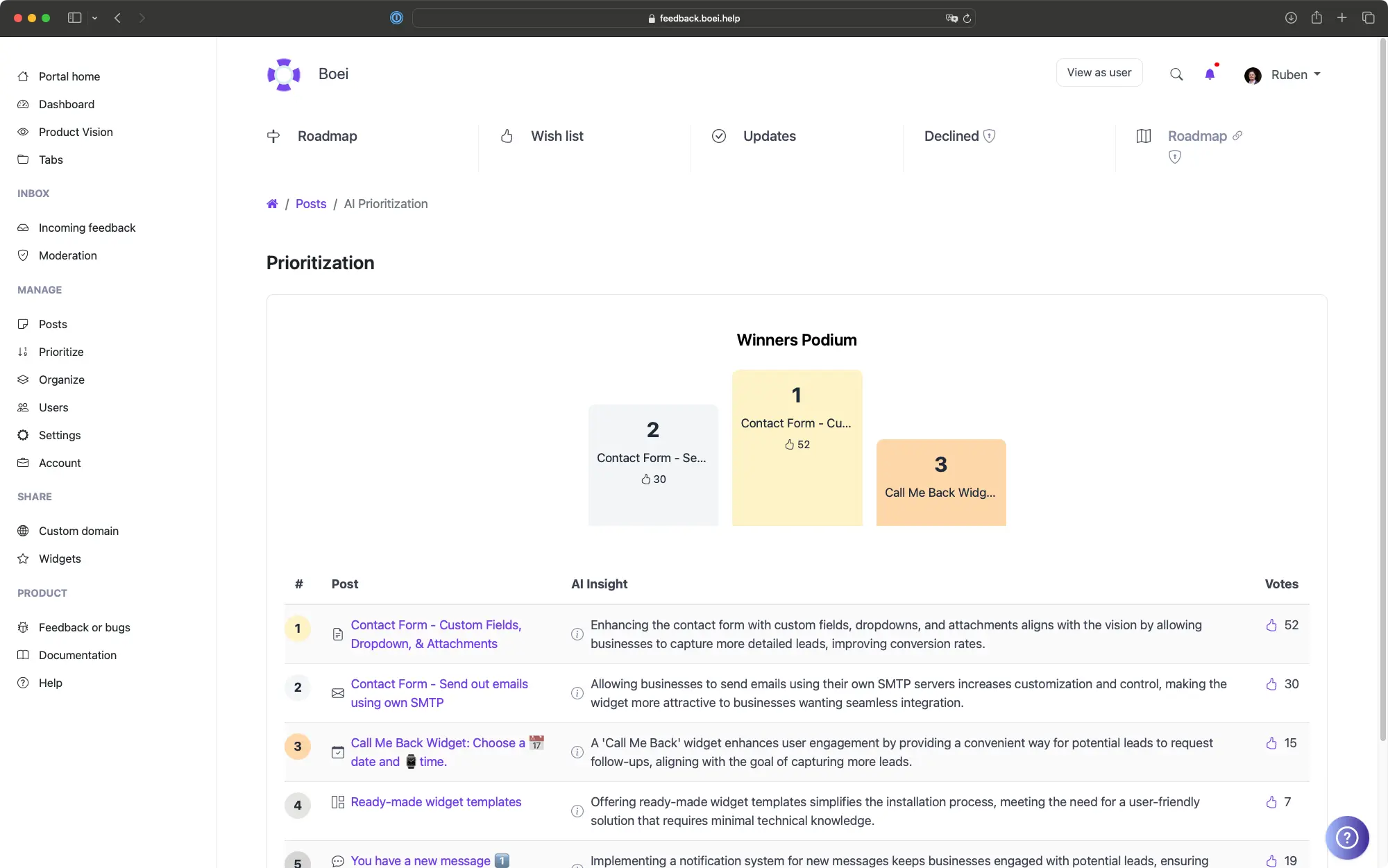




ProductLift automatically syncs MRR, LTV, plan name, and subscription status from Stripe. See the revenue behind every feature request so you can prioritize what moves the needle for your business, not just what gets the most votes.
Enrich every user profile with live revenue data from Stripe
Monthly recurring revenue and lifetime value pull from Stripe automatically. Every user profile in ProductLift shows their current revenue contribution.
See which plan each customer is on (Free, Pro, Enterprise) and whether they are active, trialing, or churned. Filter feedback by any of these.
Sort and filter feature requests by total MRR of voters. See which requests come from your highest-paying customers versus free tier users.
Create user segments based on MRR ranges, plan names, or subscription status. View feedback from Enterprise customers separately from free tier users.
Use revenue data in RICE, ICE, and other prioritization frameworks. A feature requested by $50K MRR customers scores differently than one from free users.
Stripe data refreshes automatically. When a customer upgrades their plan, their ProductLift profile reflects the new MRR right away.
Before
With ProductLift
Most feedback tools treat every vote equally. A free trial user and an enterprise customer paying thousands per month each get one vote, which means a feature requested by hundreds of free users can outrank a critical need from your top revenue accounts. This is a fundamental problem for SaaS businesses where a small percentage of customers often represent a large share of total revenue. Losing even one enterprise account because their needs were consistently deprioritized can cost more than acquiring dozens of smaller customers.
Revenue-weighted prioritization solves this by enriching every user profile with billing data. When you can see the combined monthly recurring revenue behind each feature request, prioritization decisions become strategic rather than purely democratic. A request backed by $30K in combined MRR tells a different story than the same request backed by $300. Both data points matter, but they inform different decisions. The high MRR request might justify fast-tracking development. The low MRR request might indicate a growth opportunity if combined with other signals.
Beyond individual request prioritization, revenue data enables powerful segmentation. Product teams can view feedback exclusively from enterprise customers, from customers on a specific plan, from churned accounts, or from users in a trial period. Each segment reveals different needs. Enterprise customers often request advanced configuration, compliance features, and API capabilities. Growth-tier customers request collaboration tools and workflow improvements. Free-tier users request features that would justify upgrading. Understanding these patterns by segment helps product teams build for the right audience at the right time.
ProductLift's Stripe integration syncs MRR, lifetime value, plan name, and subscription status automatically. User profiles update in real time when customers upgrade, downgrade, or cancel. Variable user segments let you create filtered views based on any combination of revenue data and custom fields. When using RICE, ICE, or other prioritization frameworks, revenue impact becomes a first-class scoring dimension rather than a number someone manually estimates in a spreadsheet.
Sebastian F.
Entrepreneur
Aaron Dye
Timothy M.
Product Manager
Ben
Product Owner
Marco
Chris R.
Founder
Connect Stripe and see the business impact behind every feature request.