 Ruben Buijs
About FastPages
FastPages is a landing page builder that lets entrepreneurs and marketers create high converting landing pages, pop-ups, and interactive funnels without writing a single line of code. The platform has grown steadily since launch, attracting thousands of users who rely on it for lead generation, product launches, and sales campaigns.
As FastPages gained traction, something predictable happened: users started asking for new features. A lot of them. Requests came in through support tickets, social media comments, email replies, and community threads. The team knew their users had great ideas, but there was no structured way to collect, organize, or act on all that input.
The challenge: feedback everywhere, clarity nowhere
For a small SaaS team, scattered feedback is more than an inconvenience. It creates real problems:
- Duplicate requests: The same feature gets requested in five different places, making it hard to gauge actual demand.
- Lost context: A brilliant suggestion buried in a support email from three months ago is effectively invisible.
- Guesswork over data: Without a way to measure which features matter most to users, the team had to rely on gut feeling when planning sprints.
- User frustration: Customers who take the time to share ideas want to know their voice is heard. Silence erodes trust.
FastPages needed a single source of truth for product feedback. They needed a system where users could submit ideas, where the community could signal what mattered most, and where the team could communicate what was planned, in progress, and shipped.
The solution: a feedback board and public roadmap
FastPages chose ProductLift to bring structure to their feedback process. The setup covered three core areas.
Feature voting with a wishlist
The team created a feedback board where users can submit feature requests and browse ideas from other community members. Each request can be upvoted, which gives the FastPages team a clear, quantifiable signal of demand. Instead of guessing which features would have the biggest impact, they can sort by votes and see exactly what users care about.
This feature voting approach removes ambiguity. When 40 users upvote A/B testing support and only 3 upvote a niche integration, the priority becomes obvious. The wishlist also reduces duplicate requests because users can search existing ideas before submitting their own.
A public roadmap for transparency
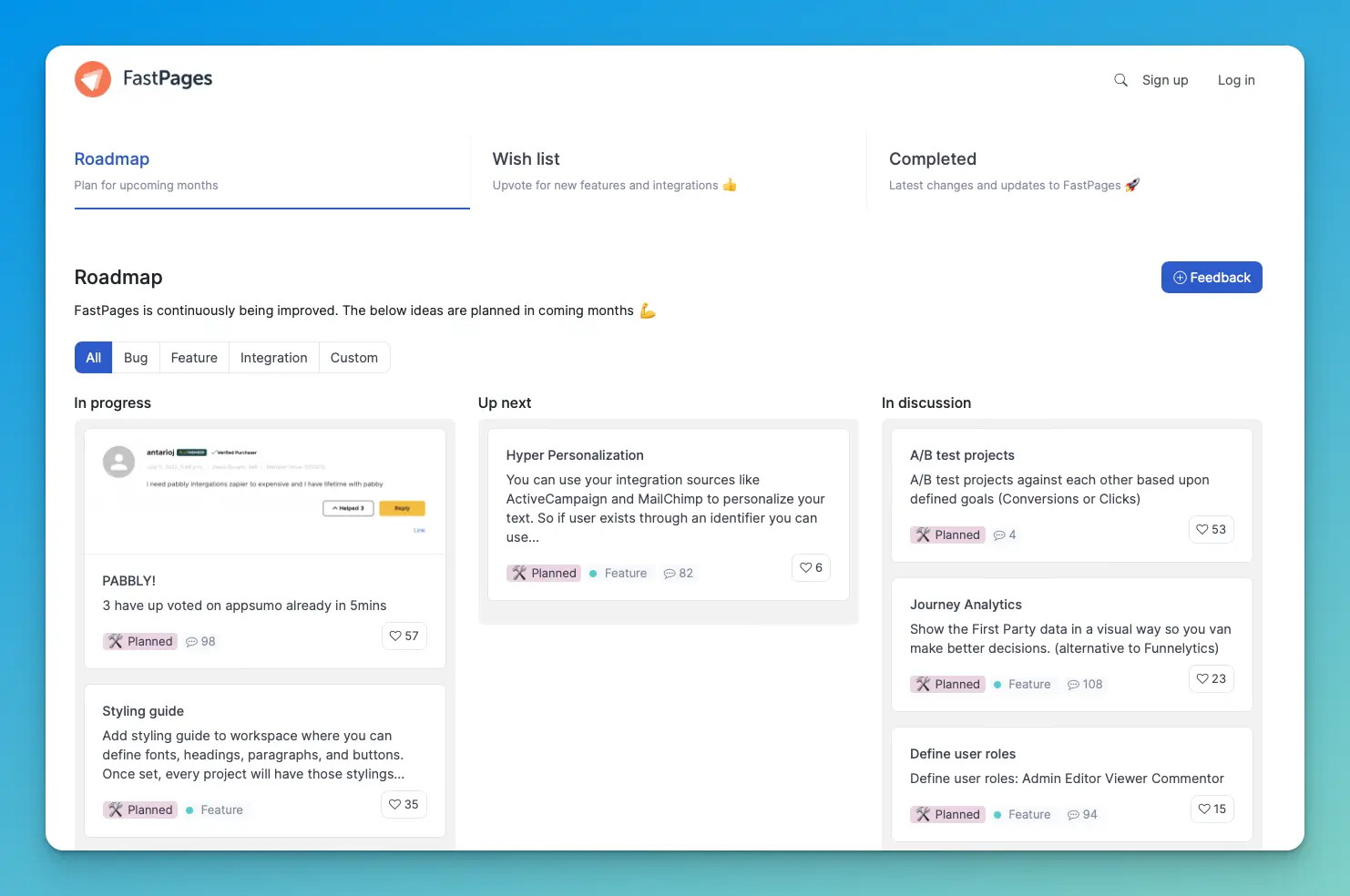
FastPages set up a public roadmap that shows what the team is working on and what is coming next. The roadmap is organized into columns (planned, in progress, completed) so anyone can see the current status of a feature at a glance.
This transparency does two things. First, it builds trust. Users can see that their feedback actually influences the product direction. Second, it reduces repetitive "when is this launching?" questions because the answer is already visible on the roadmap.
Features like A/B testing and Pabbly integration appeared on the roadmap early, generating excitement and giving users a reason to check back regularly.
A changelog to close the loop
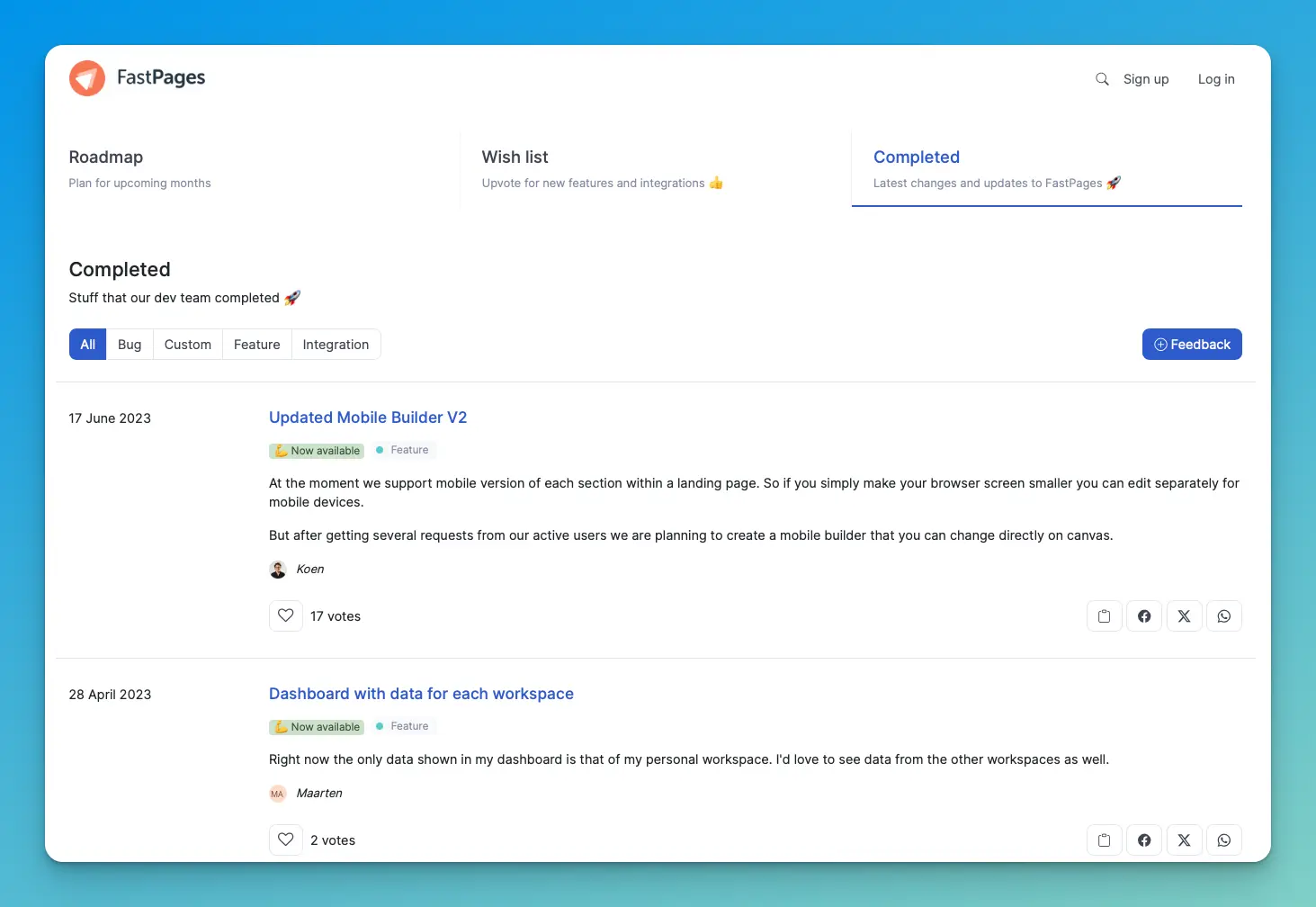
Once a feature ships, FastPages moves it to a "completed" section that serves as a changelog. This is the final step in the feedback loop: users who requested or voted for a feature can see that it has been delivered. Closing the loop is one of the most overlooked parts of feedback management, and FastPages handles it well by making shipped features visible to everyone.
Results at a glance
Since adopting ProductLift, FastPages has seen measurable improvements across their feedback and development workflow:
- 800+ votes collected from users, providing a rich dataset of prioritized feature requests
- Clearer development priorities based on actual user demand instead of assumptions
- Fewer duplicate support tickets because users find and upvote existing requests
- Higher user engagement as customers return to the board to track progress and vote on new ideas
- Faster communication of shipped features through the public changelog
Day-to-day workflow: how FastPages uses ProductLift
Understanding the results is useful, but seeing how the process works in practice is even more valuable.
Collecting feedback: Users land on the FastPages feedback board and either browse existing requests or submit a new one. Each submission includes a title and description, and users can add context about their use case. Other community members upvote the ideas they care about.
Reviewing and triaging: The FastPages team reviews incoming requests regularly. They look at vote counts, read user comments for context, and assess technical feasibility. High vote items that align with the product vision get moved to the "planned" column on the roadmap.
Deciding what to build: When planning a development cycle, the team filters the feedback board by votes and categories. This gives them a shortlist of features that are both popular and strategically important. It is a practical approach to prioritizing feature requests without overcomplicating the process.
Building and updating: As work progresses, features move from "planned" to "in progress" on the roadmap. Users who voted for a feature get notified of status changes, keeping them in the loop without requiring manual outreach from the team.
Shipping and announcing: When a feature goes live, it moves to "completed." Users see the update on the roadmap and in the changelog. This moment of closure reinforces the value of participating in the feedback process and encourages users to continue sharing ideas.
Key takeaways for other SaaS teams
The FastPages story highlights several lessons that apply to any product team dealing with growing user feedback.
Start collecting feedback early. You do not need thousands of users before structured feedback becomes valuable. Even a small community generates insights that are easy to miss without a dedicated system.
Let users prioritize for you. Voting removes the guesswork from product planning. When your users tell you what they want most, you spend less time debating priorities internally and more time building.
Make your roadmap public. Transparency is a competitive advantage. A public roadmap shows users that you listen, that you ship, and that you have a plan. It builds confidence in your product.
Close the feedback loop. Collecting feedback without following up is worse than not collecting it at all. When users see their requests go from idea to shipped feature, they become more engaged and more loyal.
Keep the process simple. FastPages did not build a complex workflow with multiple approval stages and committee reviews. They set up a feedback board, let users vote, and used that data to guide their roadmap. Simplicity is what makes the process sustainable.
Get started with your own feedback workflow
FastPages turned scattered feature requests into a structured, transparent process that benefits both their team and their users. The result is a product that evolves based on real user needs, not assumptions.
Want to set up a similar feedback driven workflow? Explore how feedback boards and feature voting can help you collect and prioritize user input. Then learn how to turn feature requests into a roadmap that keeps your users engaged and your team focused.
Last updated on Apr 8, 2026