 Ruben Buijs
Who is Merch Dominator?
Merch Dominator is a popular platform built for sellers on Amazon Merch On Demand. Founded by entrepreneur and YouTuber Mr Addie, the tool helps sellers find profitable keywords, analyze trending designs, and optimize their listings to stand out in a crowded marketplace. What started as an internal solution quickly grew into a product used by over 80,000 sellers worldwide.
With a massive and highly engaged user base, Merch Dominator had a good problem: thousands of people who cared deeply about the product and had strong opinions about where it should go next. That kind of enthusiasm is exactly what fuels great software. But without the right system to capture and organize all that feedback, it can also become overwhelming.
The challenge: feedback at scale
When you have 80,000 users, feature requests come from everywhere. Emails, YouTube comments, support tickets, social media messages, community forums. The Merch Dominator team was drowning in unstructured input with no reliable way to track what users actually wanted most.
Before adopting a dedicated feedback system, the team faced several recurring problems:
- Scattered requests: Feature ideas arrived through multiple channels, making it nearly impossible to see the full picture in one place.
- No way to measure demand: Without a voting mechanism, the team had to guess which requests represented a vocal minority and which ones reflected widespread need.
- Lost context: Individual emails and messages lacked the surrounding discussion that helps a development team understand the "why" behind a request.
- Communication gaps: Users who submitted ideas rarely heard back about what happened to their suggestions. This created frustration and a sense that feedback went into a black hole.
- Prioritization by gut feeling: Without aggregated data, the team relied on instinct to decide what to build next. Sometimes that worked. Often it meant spending weeks on features that moved the needle less than expected.
For a bootstrapped team shipping fast, this was unsustainable. They needed a structured approach that could scale with their user base.
The solution: structured feedback with ProductLift
The Merch Dominator team chose ProductLift to bring order to the chaos. The implementation was straightforward: connect their existing user base through single sign-on so that every Merch Dominator user could seamlessly participate without creating a separate account.
Here is what the setup looked like in practice:
Feedback boards for organized input
Instead of collecting requests across a dozen channels, the team set up a centralized feedback board where users could submit ideas, describe their use cases, and browse what others had already suggested. Duplicate requests became a thing of the past because users could search existing ideas and add their vote instead of opening a new thread.
Feature voting to surface real demand
Feature voting transformed how the team understood user priorities. Rather than counting emails or reading through comment threads, they could see at a glance which features had the most support. With over 1,200 votes coming in each month, the signal was strong and clear. For more on how to get the most out of this approach, see our guide on feature voting best practices.
A public roadmap for transparency
The team launched a public roadmap at roadmap.merchdominator.com to show users exactly what was planned, what was in progress, and what had been completed. This single change dramatically reduced the number of "when is feature X coming?" support tickets. Users could check the roadmap themselves and see where things stood.
Prioritization backed by data
With voting data flowing in consistently, the team could now prioritize with confidence. Instead of debating internally about which feature to tackle next, they had real numbers to guide decisions. The combination of vote counts, user comments, and business strategy gave them a framework for making faster, better choices.
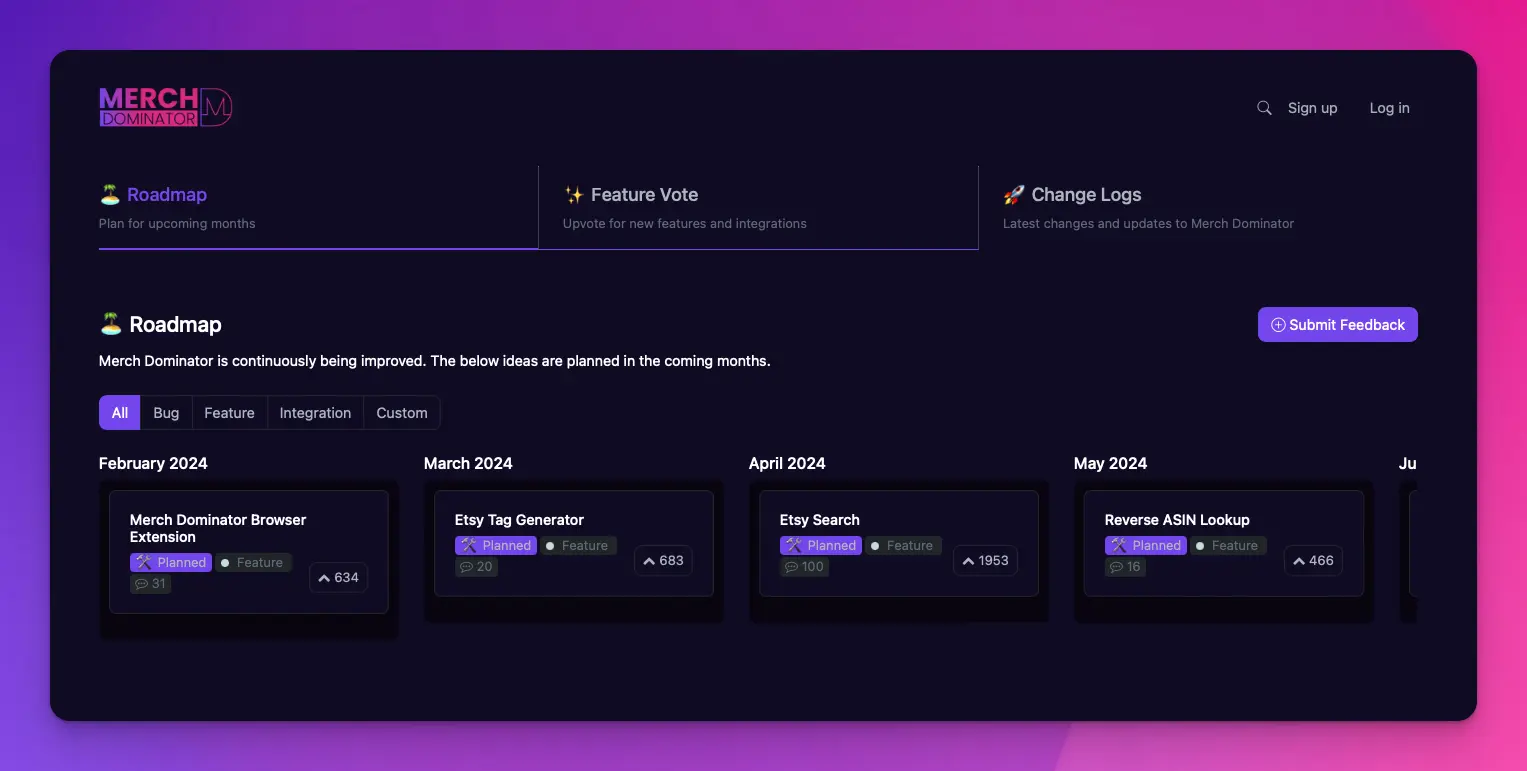
Results at a glance
- 57,000+ users connected via single sign-on
- 1,200+ votes submitted every month
- Centralized feedback replacing scattered emails, comments, and tickets
- Public roadmap reducing repetitive support questions
- Faster development cycles driven by data instead of guesswork
- Stronger user trust through transparent communication
The impact: what changed after adopting ProductLift
The numbers tell part of the story, but the real shift was cultural. The Merch Dominator team went from reactive (responding to the loudest voices) to proactive (building what the data showed users needed most).
Development cycles got shorter because the team spent less time debating priorities and more time building. When a feature shipped, they could notify everyone who had voted for it, closing the loop and reinforcing the message that user feedback actually matters. That feedback loop created a virtuous cycle: users saw their input leading to real changes, so they submitted more ideas and voted more actively.
Support volume dropped noticeably after the public roadmap went live. Users who previously emailed asking about upcoming features could now check the roadmap directly. The support team could also point questioners to the roadmap or feedback board, turning a support interaction into a community engagement moment.
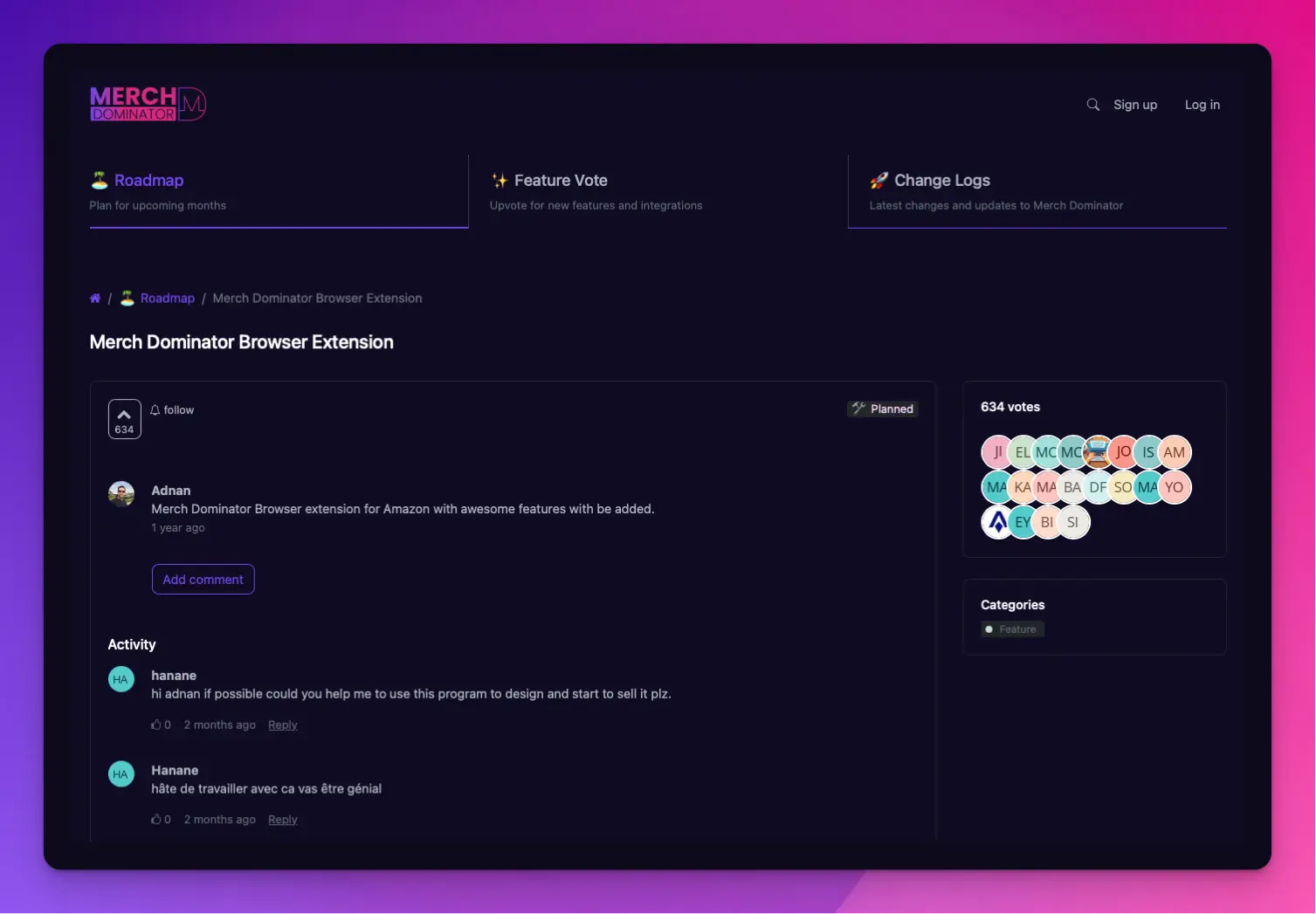
How the team uses ProductLift day to day
The Merch Dominator team has built a simple weekly workflow around their feedback data:
- Review new submissions: Each week the team scans newly submitted ideas and merges any duplicates. They add internal notes and tags to keep things organized.
- Check the leaderboard: The highest voted features get discussed in the weekly planning meeting. Vote count is the starting point, but the team also considers implementation effort and strategic alignment.
- Update statuses: As features move through the pipeline, the team updates their status on the roadmap. Users who voted on those features receive automatic notifications, keeping them informed without any manual outreach.
- Respond to comments: The team regularly replies to user comments on the feedback board. Even a short acknowledgment ("Great idea, we're considering this for Q3") goes a long way toward building trust.
- Ship and celebrate: When a popular feature goes live, the team publishes an update. Users who championed that feature feel heard, and the broader community sees that the feedback process works.
This workflow takes less than an hour per week but keeps the entire product development process aligned with what users actually want.
Key takeaways for SaaS teams
Merch Dominator's experience offers practical lessons for any team managing a product with an active user base:
- Centralize feedback early. The longer you wait to set up a structured system, the more scattered your input becomes. Even if your user base is small today, building the habit early pays off as you grow.
- Let users vote. Voting is the fastest way to separate widely desired features from niche requests. It also gives users a sense of ownership in the product direction.
- Make your roadmap public. Transparency builds trust. A public roadmap reduces support tickets, sets expectations, and shows users you take their input seriously.
- Close the feedback loop. Collecting feedback is only half the equation. Notifying users when their requested feature ships turns passive voters into loyal advocates.
- Use data to prioritize, not just intuition. Gut feeling has its place, but when you have thousands of users telling you what they need, listen to the data first.
- Keep it lightweight. You do not need a complex process. A weekly review of top voted items and regular status updates is enough to keep things moving.
Ready to try it yourself?
If managing feedback from a growing user base feels chaotic, you are not alone. Merch Dominator was in the same spot before they set up a structured system with ProductLift. The good news is that getting started takes minutes, not months.
Start your free trial and see how a feedback board, feature voting, and a public roadmap can bring clarity to your product development process.
Last updated on Apr 8, 2026