Most SaaS teams treat customer feedback collection like a checkbox: set up a survey, get a trickle of responses, dump them into a spreadsheet. Meanwhile, the real feedback is buried in support tickets, Slack threads, and sales call notes nobody reads. This guide covers every major feedback collection channel, when to use each one, and how to build a program that turns raw customer input into product decisions.
Before diving into specific channels, it helps to understand two fundamentally different approaches.
Active collection means you initiate the conversation. You send a survey, ask a question during a call, or prompt users with an in-app widget. You control the timing, the audience, and the questions.
Passive collection means the customer initiates. They submit a support ticket, post on your community forum, leave a review, or vote on a feature request. You create the channels and wait for feedback to arrive.
Key takeaway: The best feedback programs combine both approaches. Active methods fill gaps in your understanding. Passive methods surface priorities you didn't think to ask about, which is often more valuable because it reflects genuine motivation.
A McKinsey study found that companies using multiple feedback channels outperform single-channel programs by 30% in customer satisfaction improvements. The reason is simple: different channels capture different types of customers at different moments. A user who would never fill out a survey will happily click a voting button. A customer who ignores your feedback board often pours their heart out during a sales renewal call.
The other important distinction is between structured and unstructured feedback.
Structured feedback follows a predefined format. Think NPS scores, multiple choice surveys, rating scales, or feature votes. It's easy to aggregate and analyze at scale. The tradeoff is that you only learn about what you asked. For a comparison of the most common structured survey types, see our guide on CSAT vs NPS vs CES.
Unstructured feedback is free text, verbal commentary, or any format where the customer expresses themselves openly. Support tickets, interview transcripts, forum posts, and open-ended survey responses all fall here. Richer in detail, harder to analyze.
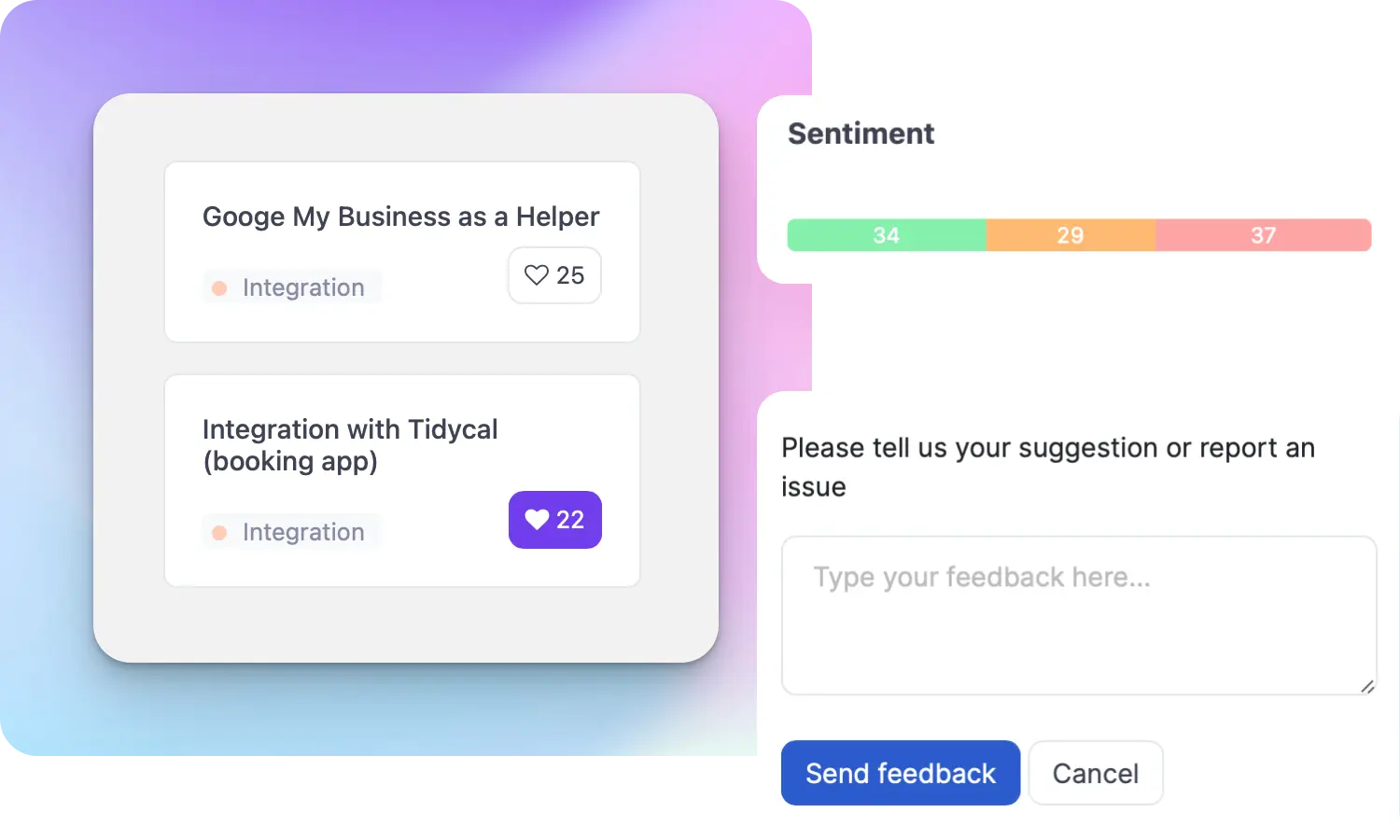
You need both. Structured data tells you how much and how many. Unstructured data tells you why and what else. ProductLift handles this by letting customers submit free-text feedback while the voting system adds a structured signal layer on top. That means one vote per user, sort by Most Voted or Trending, and a voter list that shows each person's email, avatar, and MRR from Stripe.
Widgets let you capture feedback at the exact moment a customer is using your product. Context is highest and memory is freshest. According to Pendo's 2024 State of Product report, in-app feedback captures 3 to 5 times more responses than email surveys for the same user base.
ProductLift offers five distinct widget types, each designed for a different collection scenario:
Every widget is configurable. Customize the fields (title, description, category, attachments, custom fields), prefill data for logged-in users, pre-select categories, and match your brand with custom colors, position, and text. The result is a collection experience that feels native to your product.
Try it yourself: Set up a feedback widget in under 5 minutes. No credit card required.
A dedicated feedback board is a public (or private) space where customers submit ideas, vote on each other's suggestions, and track the status of requests. Think of it as a structured wish list managed by your product team.
Feedback boards solve a problem no other channel handles well: aggregation with signal. When 200 people vote for the same feature, that's a fundamentally different signal than 200 separate support tickets about different things. The feature voting mechanism quantifies demand in a way surveys and interviews can't.
Good feedback boards include:
Boards also create a self-service dynamic. Before submitting a new request, customers browse existing ones and often find that someone has already articulated their need. This reduces duplicates and concentrates signal.
Email remains one of the most effective channels for certain use cases despite being the oldest digital feedback method. It works particularly well for:
Email response rates for SaaS typically fall between 5% and 15%. The key to making email work is what happens after a reply arrives. ProductLift's email integration can auto-create feedback items from forwarded emails, so customer replies go directly into your feedback system without manual copying. Your support team simply forwards relevant emails, and they appear as votable, trackable items alongside everything else.
Your support team talks to more customers than anyone else in the company. Every ticket is a piece of feedback, whether the customer intended it that way or not.
The challenge is extraction. Support teams are focused on resolving issues, not cataloging product insights. To tap this channel effectively, you need a process for tagging tickets and a regular review cadence where product and support sit down together.
Common approaches include:
Conversations produce the richest, most nuanced feedback. A 30-minute customer interview can reveal more about underlying needs than a thousand survey responses.
Sales calls are especially valuable because they capture the feedback of people who almost bought but didn't. Win/loss analysis is one of the most underused feedback sources in SaaS. According to Clozd research, companies that conduct systematic win/loss analysis improve their win rates by 15 to 30%.
For ongoing customers, quarterly check-in calls provide depth that no other channel matches. The key is having a loose structure: a few prepared questions, but room for the conversation to go wherever the customer takes it. After each call, the interviewer should log key feedback items into your centralized system (manual entry keeps this fast) so nothing is lost.
Net Promoter Score (NPS) asks: "How likely are you to recommend us?" on a 0 to 10 scale. Customer Satisfaction (CSAT) asks: "How satisfied are you with [specific interaction]?" typically on a 1 to 5 scale.
Both are useful as trend indicators. A dropping NPS tells you something is wrong. A consistently high CSAT on support tells you your team is strong there. But Bain & Company (the creators of NPS) found that the real value comes from the follow-up question: "Why did you give that score?" That open text response is where the actionable insight lives.
Surveys work best when they're short, timed well, and sent to the right audience. A two-question survey sent after a meaningful product interaction will always outperform a 20-question survey sent quarterly.
Customers talk about your product on Twitter, LinkedIn, Reddit, G2, Capterra, and dozens of other platforms. This feedback is unfiltered, brutally honest, and highly public.
Monitoring social and review channels matters for two reasons. First, it catches issues you would never hear about through direct channels (many unhappy customers never contact support). Second, public feedback influences prospects, so responding thoughtfully is both a product insight opportunity and a marketing activity.
Some SaaS companies build their own community forums. Others participate in industry-specific communities where their product is discussed. Either way, forums produce rich, threaded discussions that often go deeper than any other channel.
Forums work well for products with power users who want to share workflows, suggest improvements, and help each other. They're less effective for products with casual users who would never join a community.
| Channel | Type | Signal Quality | Volume | Effort to Manage | Best For |
|---|---|---|---|---|---|
| In-app widgets | Passive | Medium | High | Low | Continuous collection from active users |
| Feedback boards | Passive | High | Medium to High | Low | Feature prioritization with voting signal |
| Email (forwarding) | Active/Passive | Medium | Low to Medium | Low (with auto-create) | Milestone moments and targeted segments |
| Support tickets | Passive | High (contextual) | High | High (extraction) | Bug reports and pain point discovery |
| Sales calls | Active | Very High | Low | High (logging required) | Buying decisions, objections, win/loss |
| NPS/CSAT surveys | Active | Low to Medium | Medium | Low | Trend tracking and benchmarking |
| Social media/Reviews | Passive | Medium | Low | Medium | Public sentiment and unfiltered opinions |
| Community forums | Passive | High | Low to Medium | Medium | Power user insights and deep discussions |
Key takeaway: No single channel captures everything. The highest performing feedback programs use 3 to 4 channels that funnel into one centralized system, giving you both volume (widgets, boards) and depth (interviews, support).
These two methods often compete for attention, so let's compare them directly across every dimension that matters.
| Dimension | Feedback Board | Survey |
|---|---|---|
| Who initiates | Customer (passive) | Company (active) |
| Question format | Open-ended, customer-defined | Predefined by you |
| Signal aggregation | Votes quantify demand automatically | Each response is isolated |
| Response rate | Ongoing (no expiration) | Declines over time (survey fatigue) |
| Bias risk | Vocal minority overrepresentation | Question framing bias |
| Duplicate handling | Merge posts, combine votes | Each response is unique |
| Follow-up capability | Comments, status updates, notifications | One-time data collection |
| Analysis effort | Low (sorting, filtering) | Medium to High (especially open text) |
| Cost to maintain | Low (self-serve) | Medium (design, distribute, analyze each round) |
| Best for | Feature prioritization, ongoing collection | Specific research questions, benchmarks |
Surveys excel when you need answers to specific questions. "How easy was onboarding?" or "Which of these three features matters most?" You control what you learn. The downside: you only learn about what you think to ask, response rates decline over time, and each response is isolated.
Feedback boards excel when you want to understand what customers care about on their own terms. The voting mechanism surfaces demand signals that surveys can't replicate. You can sort by Most Voted, Trending, or Recent to see different angles on the same data. And because voters are tracked with their email, plan type, and MRR, you can segment the signal by customer value.
The ideal setup uses both. Use surveys for targeted research questions. Use a feedback board as an always-on channel for feature ideas and product direction.
Try it yourself: Launch a feedback board with voting in minutes. No credit card required.
Start with what you want feedback to help you do:
Your goals determine which channels to prioritize and how to organize incoming feedback. A customer-led growth strategy makes feedback the foundation for all of these goals, not just an input to one of them.
You don't need all eight channels from day one. Start with two or three based on your goals:
For each channel, define:
Centralizing feedback into a single system is critical. When feedback lives in five different tools, patterns become invisible. ProductLift lets you funnel feedback from multiple channels: widget submissions, direct portal entries, email integration (auto-create from forwarded emails), manual entry by your team, and bulk CSV/Excel import. Everything lands in one board where it can be categorized, voted on, and tracked through to delivery.
A feedback program needs clear ownership:
The biggest mistake in feedback collection is making it a one-way street. If customers take the time to share their thoughts and never hear back, they stop sharing. Your program needs a built-in mechanism for closing the loop: telling customers what you did with their feedback.
This is where ProductLift's Journey Model becomes essential. A single feedback item travels from feedback board to roadmap to changelog to knowledge base. At every status change, voters receive automatic notifications via email, in-app alerts, or Slack. The loop closes itself because the system knows who voted and notifies them automatically. No manual outreach required. For a deeper look at how this loop drives retention, see our guide on the customer feedback loop.
Raw feedback is noise. Organized feedback is signal. Here's how to turn one into the other.
Start with broad categories that map to your product areas:
Within each category, use tags for finer granularity. For example, feature requests can be tagged with the product area they relate to (onboarding, reporting, integrations).
Without active management, your feedback system fills up with near-identical requests phrased differently. "Add dark mode," "Night theme please," and "The white background hurts my eyes" are all the same request.
ProductLift's post merging combines duplicates so all votes, followers, and comments transfer to the target post. Your vote counts stay accurate, and the merged post's followers continue to receive status update notifications. You can also use bulk operations to update status, category, tags, or assignments for 2 to 500 posts at once. This is especially useful when cleaning up after a big import or review session.
A feature request from a customer paying $500/month carries different weight than the same request from a free trial user. Linking feedback to customer data lets you make prioritization decisions grounded in business impact.
With ProductLift's Stripe integration, MRR, LTV, plan type, and customer status sync automatically. You can sort posts by "Total Voter MRR" to see which feature requests carry the most revenue weight. You can filter voters by MRR range, LTV range, plan type, customer status, custom fields, vote counts, or account age. These user segments turn opinion-based prioritization into evidence-based decision making.
Key takeaway: Connecting feedback to revenue data transforms how you prioritize. When you can see that the top-voted request represents $45,000 in monthly recurring revenue, the conversation shifts from opinion to evidence.
Individual feedback items matter less than patterns. Review your feedback monthly or quarterly to identify emerging themes:
Use saved queries in ProductLift to save your most-used filter and sort combinations, then load them with a single click during your regular reviews.
A feedback program isn't set-and-forget. Track these metrics to know whether it's working.
| Metric Category | Metric | What It Tells You | Target |
|---|---|---|---|
| Collection | Feedback volume (submissions/month) | Whether customers are engaging | Steady or growing |
| Collection | Channel distribution | Which channels need promotion | No single channel >70% |
| Collection | Participation rate (% of active users) | Breadth of input | >5% in 90 days |
| Quality | Actionability rate | Whether feedback is specific enough to act on | >60% |
| Quality | Duplicate rate | Search/detection effectiveness | Declining over time |
| Quality | Category balance | Coverage across product areas | No category >40% |
| Action | Triage time | Speed of acknowledgment | <48 hours |
| Action | Action rate (changes within 6 months) | Whether feedback drives decisions | >20% |
| Action | Loop closure rate | Whether submitters get notified | >60% |
| Business Impact | Feedback-influenced revenue | ROI of the program | Track quarterly |
| Business Impact | NPS/CSAT trend | Satisfaction trajectory | Improving |
| Business Impact | Churn correlation | Retention impact of closing loops | Lower churn for engaged users |
If 90% of your feedback comes from support tickets and 0% from your feedback board, your board needs better promotion. See our guide on promoting your board.
Try it yourself: Start collecting and organizing feedback today. No credit card required.
Collecting without acting. The fastest way to kill a feedback program is to collect enthusiastically and then do nothing. Customers notice. According to Microsoft's Global State of Customer Service report, 77% of customers view brands more favorably when they proactively invite and accept feedback. But that only holds when something changes as a result.
Asking too many questions. Long surveys and complex forms reduce participation. Keep collection moments short and specific.
Ignoring quiet customers. The loudest customers aren't always the most important. Actively seek feedback from silent segments, especially high-value accounts. Use your Stripe data to identify top-revenue accounts that have never submitted feedback and reach out proactively.
Treating all feedback equally. A request from 200 customers on your highest-paying plan isn't the same as a request from 2 free users. Weight feedback by business impact using revenue data and user segments.
No single source of truth. When feedback lives in Intercom, Notion, Google Sheets, Slack, and email, patterns are impossible to spot. Centralize everything into one system.
Forgetting to close the loop. If you ship a feature that 150 people requested and never tell them, you wasted a massive opportunity to build loyalty. Always respond to feedback and let the system close the loop automatically.
There's no magic number. A single piece of feedback from a strategic enterprise account can be enough to prioritize a feature. For broader product decisions, look for patterns across at least 10 to 20 independent data points. The quality and consistency of the signal matters more than volume. Revenue weighting helps here: if 10 customers representing $30,000 in MRR all ask for the same thing, that's a stronger signal than 50 free users requesting something different.
Both have merit. Public boards build transparency and community, showing customers you care about their input. They also reduce duplicate submissions because users can see and vote on existing requests. Private boards work better if you handle sensitive B2B feedback or want tighter control over the conversation. Many teams start private and go public once they have a moderation process in place. ProductLift supports both, with options for manual moderation queues and AI auto-moderation with configurable confidence thresholds.
Reduce friction. A floating button widget that takes 10 seconds will always outperform a separate feedback portal that requires a login. Time your asks well: after a key milestone, after using a core feature, or after a positive support interaction. And show customers that feedback leads to action. When people see their suggestions move through statuses and eventually get shipped (with automatic notifications at each stage), they submit more. ProductLift supports anonymous voting as well, lowering the barrier even further.
Feature requests are a subset of product feedback. A feature request says "I want X." Product feedback also includes usability observations ("this flow is confusing"), sentiment data ("I love this feature"), bug reports, and competitive intelligence ("your competitor does Y"). A complete feedback program captures all of these, not just feature requests. Your category system should distinguish between them so each type gets routed to the right team.
Not all feedback should be acted on. Some requests would take your product in a direction that doesn't align with your strategy. Acknowledge the feedback, explain your reasoning when appropriate, and move on. A feedback board with clear statuses (like "Not Planned") lets you communicate these decisions transparently without ignoring the customer. Using the "Use for Changelog" comment feature, your product team can craft polished explanations that go out with status change notifications.
Triage new feedback daily or every few days so submitters get timely acknowledgment. Do a deeper thematic review monthly or quarterly to spot emerging patterns and inform roadmap planning. The daily triage can be quick: with saved queries, you load your "New and Unreviewed" filter, categorize items, merge duplicates, and move on in 5 to 10 minutes. The monthly review should be a dedicated session with product, support, and engineering, using revenue-weighted sorting to ensure you're focusing on what matters most to your business.
Join over 5,204 product managers and see how easy it is to build products people love.





Did you know 80% of software features are rarely or never used? That's a lot of wasted effort.
SaaS software companies spend billions on unused features. In 2025, it was $29.5 billion.
We saw this problem and decided to do something about it. Product teams needed a better way to decide what to build.
That's why we created ProductLift - to put all feedback in one place, helping teams easily see what features matter most.
In the last five years, we've helped over 5,204 product teams (like yours) double feature adoption and halve the costs. I'd love for you to give it a try.

Founder & Digital Consultant
Most feedback loops break after collection. Learn the 5 stages of a closed feedback loop and how to notify customers automatically.
Learn when to promote feature requests to your roadmap, how to merge duplicates, notify voters, and keep credibility through the full lifecycle.
Learn 7 tactful ways to decline feature requests while keeping customers engaged. Includes response templates and expectation management tips.
Learn how to prioritize feature requests using RICE, ICE, MoSCoW, and Impact-Effort. Combine scoring models with revenue data to build what matters.
Learn how to distinguish bugs from feature requests, handle grey areas, and classify edge cases. Includes a decision framework and communication tips.
With bike energy  from Utrecht
Ruby Foundry B.V. - KVK: 99995662 - BTW: NL869219789B01