Only 8% of SaaS users actively read product updates, according to a 2024 Pendo study. That means 92% of the features you ship go unnoticed by the people who would benefit most. This guide covers how to write release notes that actually get read, with practical templates, before/after rewrites, and a distribution strategy that puts your updates in front of the right people.
Release notes fail for a handful of predictable reasons, and they all come back to one mistake: writing for yourself instead of your reader.
They're written for the team, not the user. Internal jargon, ticket numbers, and implementation details creep in because the person writing just finished building the feature. "Refactored query layer for dashboard component" means nothing to the person waiting for their dashboard to load faster.
They bury the value. A headline like "Performance improvements" tells the reader nothing about what changed or why they should care. Readers see vague headlines, assume nothing important happened, and move on.
They list everything equally. A major workflow overhaul gets the same bullet formatting as a typo fix. When readers scan and see nothing that looks significant, they stop scanning.
They're hard to find. Published on a page nobody visits, with no notification, no link from the product, and no email. According to a 2023 UserGuiding study, 67% of SaaS companies that maintain a changelog don't actively promote it. The changelog page itself is the only distribution channel.
Key takeaway: The single biggest reason release notes fail isn't bad writing. It's bad distribution. Even average writing will outperform great writing that nobody sees.
Every strong release note, whether it covers a single feature or an entire release, follows a consistent four-part structure.
The headline is the only thing most people read. Make it count.
| Weak Headline | Strong Headline |
|---|---|
| New export feature | Export your data to CSV, Excel, and PDF in one click |
| Performance improvements | Dashboard loads 3x faster on large accounts |
| Bug fixes | Fixed: notifications not sending for status changes |
| API update | New webhooks let you trigger workflows from any event |
| Integration added | Connect Stripe to see revenue data on every feedback post |
The pattern: what changed + why it matters. If your headline could apply to any product, it's too vague.
Expand on the headline. Explain the context: what problem this solves, who it helps, and what's different now.
Good descriptions answer the question "so what?" without requiring the reader to click through to documentation. They include a specific detail (a number, a use case, or a scenario) that makes the change feel tangible.
Screenshots, GIFs, or short videos make release notes dramatically more engaging. Wistia's research found that pages with embedded video hold attention 2.6x longer than text-only pages. A 10-second screen recording of a new feature in action communicates more than three paragraphs of text.
Not every update needs a visual. Bug fixes and performance improvements usually don't. But any new UI, workflow change, or redesign benefits from one.
Tell the reader what to do next. "Try it now," "Read the docs," or "Let us know what you think" gives people a clear next step. Without it, they read, nod, and forget. Chameleon's 2024 Product Adoption Report found that release notes with explicit CTAs drove 22% more first-time feature usage than those without.
One of the biggest mistakes teams make is writing a single version of release notes for everyone. Your customers, your developers, and your internal team all need different things.
Example:
Bulk actions for your feedback board
You can now select multiple feedback posts and update their status, add tags, or merge them in one step. If you manage a board with hundreds of posts, this will save you significant time every week.
Example:
New
webhook.eventsendpointYou can now subscribe to granular event types instead of receiving all events. Supported types include
post.created,post.status_changed, andvote.added. See the [API docs] for the full list.Breaking change: the legacy
/hooksendpoint will be deprecated on June 1, 2026.
This version usually lives in an internal wiki or Slack channel, not your public release notes.
Try it yourself: ProductLift's changelog feature lets you write once and distribute through multiple channels, including an embeddable widget, email notifications, and social sharing. Start your free trial. No credit card required.
Small formatting choices have an outsized impact on whether people actually read your notes.
Group updates by type so readers can scan for what matters to them:
Some teams use emoji for visual scanning. Others use colored labels. Both work. The key is consistency.
Most readers scan, not read. Structure your notes for scanning:
Every release note needs a clear timestamp. If you use semantic versioning (v2.4.0), include it. If you release continuously, a date is sufficient. This helps users reference specific changes later when talking to support.
When you ship a release with 15 changes, don't list all 15 as equals. Group them:
This hierarchy tells readers where to focus their attention. In ProductLift, you can combine multiple shipped items into one release and write (or generate) a single introduction that ties them all together. Every voter on every linked feedback item gets notified, even though it's a single announcement. Across the platform, 6,035 product teams have shipped 39,406 features this way. Automatic notifications go out to the people who originally requested each one.
Key takeaway: Grouping related changes under a single theme makes releases feel intentional instead of random. A release titled "Smarter Prioritization" tells a better story than a list of seven unrelated bullet points.
Here's a template you can adapt for your own release notes:
## [Release Name or Date]

[1-2 sentence introduction summarizing the theme of this release]

### Headline Feature Name

[2-4 sentences explaining the feature, the problem it solves, and who benefits]

[Screenshot or GIF]

[Call to action: Try it / Read the docs / etc.]

### Other Improvements

- **Improvement 1:** Short description of what changed and why
- **Improvement 2:** Short description of what changed and why

### Fixes

- Fixed an issue where [specific behavior] occurred when [specific condition]
- Resolved [specific problem] affecting [specific user group]Let's take some real-world patterns and improve them.
Before:
- Performance improvements
- Bug fixes
- UI updates
After:
Faster dashboard loading
Large accounts (10,000+ feedback posts) now load the dashboard in under 2 seconds, down from 8 seconds. We rebuilt the query layer to fetch only the data visible on screen.Fixes
- Fixed: CSV export failing for boards with custom fields containing special characters
- Fixed: email notifications not sending when a post moved to "Shipped"
UI refresh for the settings page
We reorganized the settings page into tabbed sections (General, Branding, Integrations, Team) so you can find what you need faster.
Before:
Migrated user_preferences table to new schema. Updated Redis cache invalidation logic for session tokens. Refactored middleware chain for auth flows. JIRA-4521, JIRA-4523, JIRA-4530.
After:
Faster login and improved session handling
We rebuilt how user sessions are managed behind the scenes. You should notice faster login times and fewer unexpected logouts, especially if you use multiple browser tabs. No action needed on your end.
Before:
New: Webhook retry mechanism with exponential backoff and dead letter queue support.
After:
Webhooks now retry automatically when your server is down
If your endpoint is temporarily unavailable, we will retry the webhook delivery up to 5 times over 24 hours using increasing intervals. After all retries are exhausted, failed deliveries appear in a new "Failed Webhooks" tab where you can inspect and manually retry them.
Before:
v4.2.1 changelog:
- Added POST /api/v2/feedback/merge endpoint
- Deprecated PATCH /api/v1/feedback/:id/tags
- Bumped max payload to 5MB
- Fixed race condition in vote deduplication
After (customer-facing):
Merge duplicate feedback posts via the API
If you use our API to manage feedback, you can now merge duplicate posts programmatically. This is useful for teams that import feedback from multiple sources and want to consolidate automatically.Larger file uploads
You can now attach files up to 5MB (previously 2MB) to feedback posts and comments.
After (developer-facing):
New
POST /api/v2/feedback/mergeendpoint (replaces manual merge flow)
Accepts an array of post IDs and merges them into a single post. Votes and comments are consolidated. See the [API docs] for request/response schema.Deprecation:
PATCH /api/v1/feedback/:id/tagswill be removed July 1, 2026. Use the v2 tagging endpoint instead. [Migration guide]
Writing great release notes is only half the job. You also need to put them where your users will actually see them. Here's how the main channels compare:
| Channel | Reach | Engagement | Best For | Effort |
|---|---|---|---|---|
| In-product widget | Active users only | Highest (34% click rate) | Feature announcements, small updates | Low |
| Email digest | Full user base | Moderate (18-34% open rate) | Weekly/monthly summaries | Medium |
| Changelog page | Visitors, prospects, SEO | Lower but persistent | Complete record, trust signal | Low |
| Social media | Public, potential users | Variable | Headline features with visuals | Medium |
| Direct notification to requesters | Specific voters | Highest (45%+ open rate) | Closing the feedback loop | Depends on tooling |
The highest-visibility channel. A small badge, banner, or "What's New" widget inside your product catches users at the moment they're most engaged. ProductLift offers a "What's New" mini widget that shows recent changelog entries as a popup overlay, so users can see what's new without leaving the page they're on.
A periodic email (weekly or monthly) summarizing recent changes. This reaches users who aren't logging in regularly but still care about the product. Keep it concise and link to the full notes.
Twitter/X and LinkedIn work well for announcing headline features. Focus on one feature per post with a visual. ProductLift's changelog includes social sharing buttons on each entry, making it easy for your team (and your users) to spread the word.
Your public changelog page serves as the permanent record. It's also a trust signal for potential customers evaluating your product. Prospects often check a changelog to see if a product is actively maintained.
This is the most underrated distribution channel. When a feature ships that was originally requested by users, notify those specific people. They gave you the idea, waited for it, and now it exists. Telling them directly creates loyalty that no marketing campaign can match.
Try it yourself: ProductLift's Journey Model means every post travels from feedback to roadmap to changelog. When a post moves to "Shipped," every voter gets notified automatically. No credit card required.
Writing a release introduction that ties together 10 or 15 different changes into a coherent narrative is time consuming. This is especially true when you're shipping weekly.
ProductLift's AI Changelog Summarization generates a polished release introduction from all the shipped items in a grouped release. Because every item links back to its original feedback post, the AI has full context on what was built and why. You can set the audience (technical vs. non-technical), tone (formal vs. casual), and format (narrative vs. bullet points). The system then produces a first draft that captures the theme of the release.
That said, always review and edit AI-generated text. It's a starting point, not a finished product.
Key takeaway: AI works best for the "blank page" problem. Generating a coherent first draft from 12 shipped items is where it saves the most time. The editing pass where you add voice and nuance is still your job.
For developer-heavy teams, there's often a gap between what gets committed and what gets communicated. Engineers write commit messages for other engineers. Customers need something different.
ProductLift's Git2Log feature bridges this gap by converting git commits into user-facing changelog entries using AI. A well-structured commit message like feat(dashboard): add CSV export for custom date ranges contains all the information needed. Git2Log strips the technical format and rewrites it for your audience.
This workflow works best when your team follows a consistent commit convention (like Conventional Commits). The translation layer handles the rest, turning fix(auth): resolve race condition in session refresh into "Fixed: occasional unexpected logouts when using multiple browser tabs."
For teams using Jira or similar tools, you can also push status changes through your integration so shipped items in your project tracker automatically update in ProductLift.
One pattern saves time for teams that ship fast. When an engineer or PM adds a comment to a feedback post explaining what was built, they can check "Use for Changelog" on that comment. That comment becomes the public-facing changelog entry, no separate writing step required.
This works because the best changelog descriptions are often written in the moment, right after shipping, when context is fresh. The alternative (going back days later to write a summary) produces vaguer, less specific notes.
Combined with the ability to group multiple items into a single release, this creates an efficient workflow. Comments are written as items ship, then grouped and published with an AI-generated introduction that ties them together.
How do you know if your release notes are actually being read? Track these signals:
You don't need a complex analytics setup. Even basic page views on your changelog page will tell you whether your notes are reaching anyone.
Try it yourself: Set up a changelog with ProductLift and start tracking engagement with reactions, notifications, and the "What's New" widget. See the getting started guide for setup. No credit card required.
Release notes are one of the few touchpoints where you can turn a shipped feature into a moment of delight. Teams that treat them as a communication opportunity, not an obligation, see measurably higher feature adoption and stronger customer retention.
It depends on your release cadence. If you ship continuously, a weekly or biweekly digest works well. If you do larger releases on a set schedule, publish notes with each release. The key is consistency. Pendo's data shows that teams publishing on a regular schedule see 40% more returning readers compared to teams that publish sporadically.
Yes, but be selective. Significant bug fixes that affected many users deserve a mention because they show you're listening and responding. Minor fixes (typos, edge cases affecting a handful of users) can be batched into a short list or omitted entirely. The general rule: if a user reported it, mention the fix. If a user noticed the bug, definitely mention it. If only your engineering team knew about it, skip it.
For a single feature, 3-5 sentences plus a visual is usually enough. For a grouped release covering multiple changes, aim for a page that takes 2-3 minutes to read. If it takes longer, you're probably including too much detail. Link to your knowledge base for deep dives and save the release notes for the "what" and "why."
Ideally, a product manager or product marketing person who understands both the feature and the customer. Engineers can provide the technical details, but someone with customer empathy should do the final writing. The "Use for Changelog" workflow in ProductLift works well here: the engineer writes a comment when shipping, and a PM reviews it before publication.
A changelog is the ongoing log of all changes, typically in reverse chronological order. Release notes are a curated summary of a specific release, often with more narrative and context. Many teams combine both by maintaining individual changelog entries and periodically grouping them into release summaries. See our full breakdown in Changelog vs Release Notes for more detail, and check out our roundup of 15 best changelog examples to see these patterns in action.
Use multiple channels. An in-product "What's New" widget catches active users. Email digests reach inactive users. Social media reaches prospects. And direct notifications to feature requesters close the feedback loop. The teams with the highest engagement use all four channels simultaneously and tailor the message to each. ProductLift handles three of these automatically: the widget, voter notifications, and social sharing buttons on each entry.
Join over 5,204 product managers and see how easy it is to build products people love.





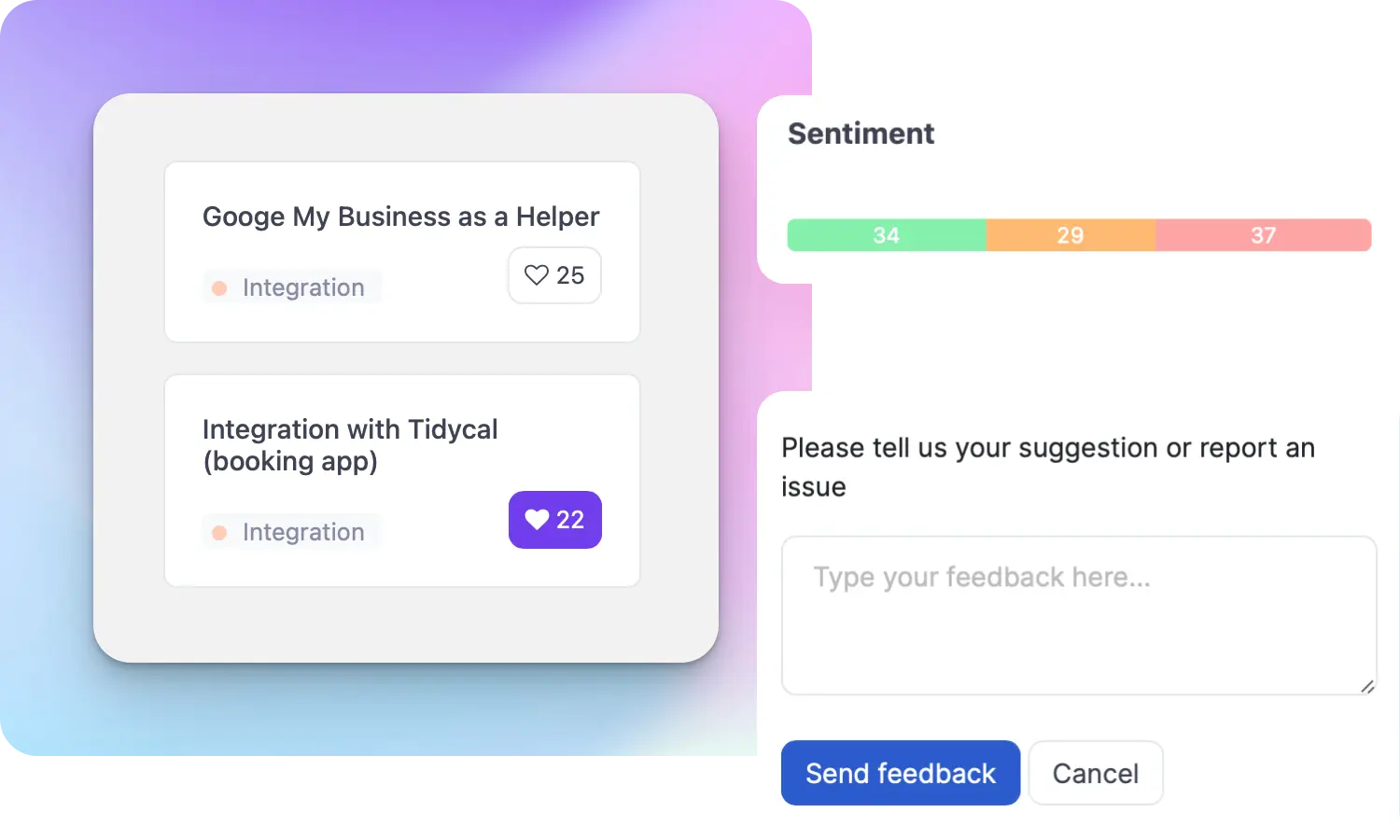
Did you know 80% of software features are rarely or never used? That's a lot of wasted effort.
SaaS software companies spend billions on unused features. In 2025, it was $29.5 billion.
We saw this problem and decided to do something about it. Product teams needed a better way to decide what to build.
That's why we created ProductLift - to put all feedback in one place, helping teams easily see what features matter most.
In the last five years, we've helped over 5,204 product teams (like yours) double feature adoption and halve the costs. I'd love for you to give it a try.

Founder & Digital Consultant
Understand the difference between a changelog and release notes. Compare format, audience, frequency, and learn when to use each for your SaaS product.
Analyze 15 outstanding SaaS changelogs from companies like Stripe, Linear, and Notion. See what makes each effective and steal patterns for your own.
Learn when and how to make your product roadmap public. Covers formats (Now/Next/Later, timeline, kanban), what to show vs hide, and managing expectations.
Most feedback loops break after collection. Learn the 5 stages of a closed feedback loop and how to notify customers automatically.
Learn every feedback collection channel, how to organize responses, and how to build a program that drives product decisions. Practical SaaS guide.
With bike energy  from Utrecht
Ruby Foundry B.V. - KVK: 99995662 - BTW: NL869219789B01