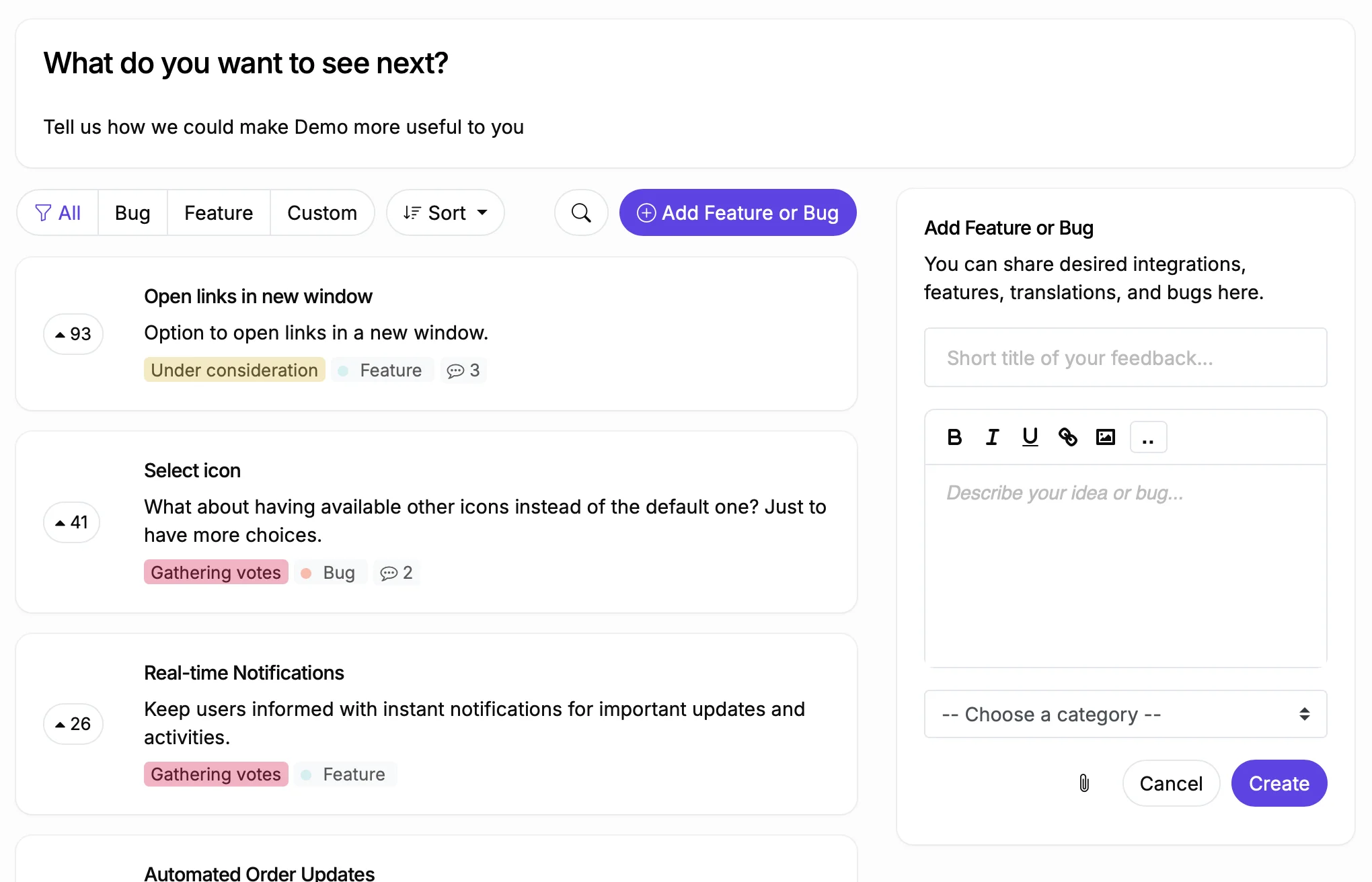
Customer success teams waste hours chasing product updates and relaying feedback through Slack. ProductLift gives you a single place to collect requests, track them through development, and notify customers the moment you ship.
Before
With ProductLift
Customer success teams sit at the intersection of the customer and the product organization. They hear firsthand which missing features frustrate accounts, which improvements would unlock expansion revenue, and which unresolved requests put renewals at risk. Yet in most companies, this intelligence has no structured home. It lives in CRM notes, Slack messages to the product manager, and verbal updates during weekly syncs that are forgotten by the next meeting.
The cost of this gap is measurable. When a customer asks for a feature and never hears back, trust erodes. When a CS manager can't show the product team that five enterprise accounts are asking for the same capability, those accounts get deprioritized in favor of whatever request happens to be top of mind. When a feature finally ships but nobody tells the customers who asked for it, the company misses the retention and expansion opportunity that the feature was supposed to create.
Closing the feedback loop is the single highest leverage activity a customer success team can perform. Research consistently shows that customers who feel heard are significantly less likely to churn, even when their request has not been fulfilled yet. The key is visibility: customers need to see that their input was received, that it is being evaluated, and that they'll be notified if and when it ships. This transforms the relationship from "I submitted a request into a void" to "I can see my request on the roadmap and it is scheduled for next quarter."
Revenue-weighted prioritization adds another dimension. Not every feature request carries the same business impact. A request from ten free-tier users is different from the same request backed by five enterprise accounts representing substantial monthly recurring revenue. By connecting billing data to the feedback pipeline, customer success teams can make a compelling, data-backed case for the features that protect and grow the most valuable accounts.
ProductLift gives customer success teams a dedicated workflow for this. CS managers submit requests on behalf of customers, attach account context and revenue data via the Stripe integration, and track each request through the Journey Model: from feedback board to roadmap to changelog. When the feature ships, every linked customer gets an automatic notification. The CS team can then use the changelog as proof of value during renewal conversations, showing a clear history of features that were requested by the customer and delivered by the product team.
Log feature requests during calls or from support tickets. Attach the customer's name, account, and MRR so product sees the full picture.
Connect Stripe to see which requests come from your highest value accounts. Prioritize features that protect and grow revenue.
When product moves a feature to In Progress or Shipped, every customer who requested it gets notified. No more manual follow-up emails.
Add private context to requests that only your team can see. Share churn risk, renewal dates, or deal size without exposing it to customers.
Share a public or customer-only roadmap so accounts can see what you are building next. Reduce inbound questions and build trust.
When you ship, publish to your changelog. Customers see the value you deliver over time, which strengthens renewal conversations.
6,035
Product teams using ProductLift
157,624
Feature requests collected
39,406
Features shipped and announced
Sebastian F.
Entrepreneur
Aaron Dye
Timothy M.
Product Manager
Ben
Product Owner
Marco
Chris R.
Founder
Join 6,000+ teams using ProductLift to close the feedback loop and reduce churn