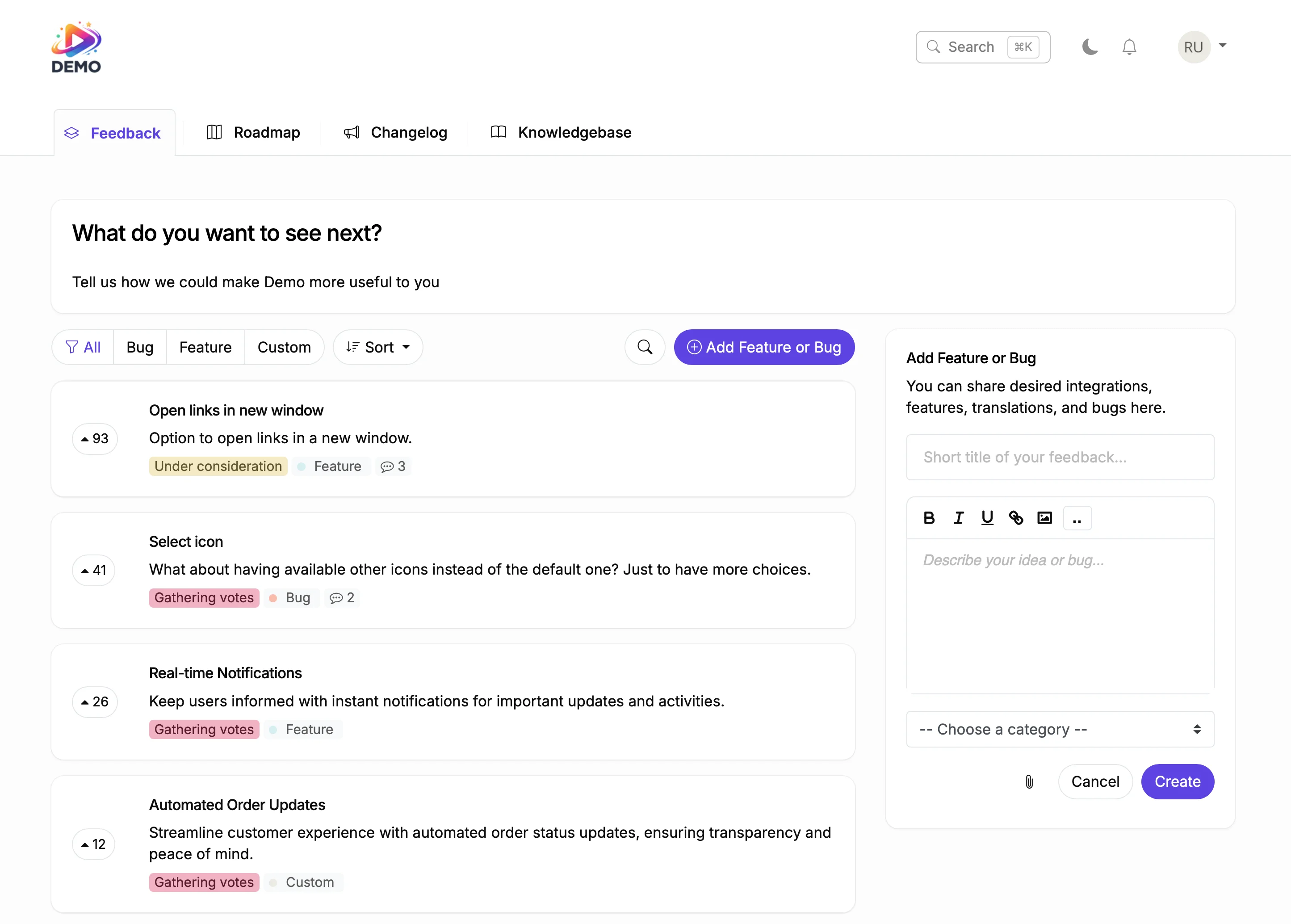
Product ideas come from customers, sales, support, executives, and competitors. Most get lost in email, Slack, or meeting notes. ProductLift captures them all in one place, lets stakeholders vote, and gives you frameworks to decide which ideas deserve development time.
Before
With ProductLift
Idea management is the discipline of systematically capturing, organizing, evaluating, and acting on product ideas from every source: customers, internal teams, partners, and market research. It sits at the intersection of product management, customer success, and strategy. Without a deliberate process, most ideas get lost in email threads, Slack messages, meeting notes, and CRM comments where they are impossible to search, count, or prioritize.
The core problem isn't a lack of ideas. Most product teams are drowning in them. The problem is that ideas arrive in fragments, from different channels, described in different ways, with no shared system to evaluate them. Support hears the same request from ten customers but has no way to prove that to the product team. Sales knows which missing features block deals but logs them in a CRM that nobody on product checks. Engineering spots technical improvements that would unlock new capabilities but has no formal path to surface them.
Traditional approaches to idea management include spreadsheets, project management tools, and periodic surveys. Spreadsheets work for small volumes but collapse under their own weight as the list grows past a few hundred entries. Project management tools like Jira are optimized for execution, not for collecting and evaluating unvalidated ideas. Surveys capture a moment in time but miss the continuous stream of feedback that accumulates between survey cycles. None of these approaches let users vote, which means the team has no way to measure demand.
Modern idea management platforms solve this by providing a single place where ideas are collected, deduplicated, categorized, and ranked. Users can vote to express demand. Product teams can apply structured prioritization frameworks like RICE, ICE, MoSCoW, or Impact-Effort matrices to score ideas consistently. The best systems also connect idea management to downstream workflows so that approved ideas flow into a roadmap and eventually into a changelog when they ship.
In ProductLift, this end to end flow is called the Journey Model. An idea begins as a post on a feedback board, accumulates votes and comments, gets scored with prioritization frameworks, moves to the roadmap when the team decides to build it, and arrives in the changelog when it ships. At every transition, everyone who contributed to that idea receives a notification. This continuous pipeline transforms idea management from a static backlog into a living system where submitters stay engaged because they see their input leading to real product changes.
Collect ideas from public feedback boards, private internal boards, API submissions, and manual entry by your team.
AI detects duplicates, suggests categories, and merges similar ideas. Your backlog stays clean even as it grows to hundreds of ideas.
Apply RICE, ICE, MoSCoW, or Impact-Effort scoring. Combine framework scores with vote counts and revenue data for complete prioritization.
Share the idea board with executives, sales, and customer success. Everyone sees the same prioritized list and can add their votes.
Approved ideas move directly to your roadmap. Track them through development and into your changelog. One continuous workflow.
When you ship an idea, everyone who contributed gets notified. Submitters feel heard and continue sharing valuable input.
6,035
Teams managing ideas
157,624
Ideas captured
39,406
Ideas shipped as features
Sebastian F.
Entrepreneur
Aaron Dye
Timothy M.
Product Manager
Ben
Product Owner
Marco
Chris R.
Founder
Join 6,000+ teams using ProductLift to capture, prioritize, and ship the ideas that matter most