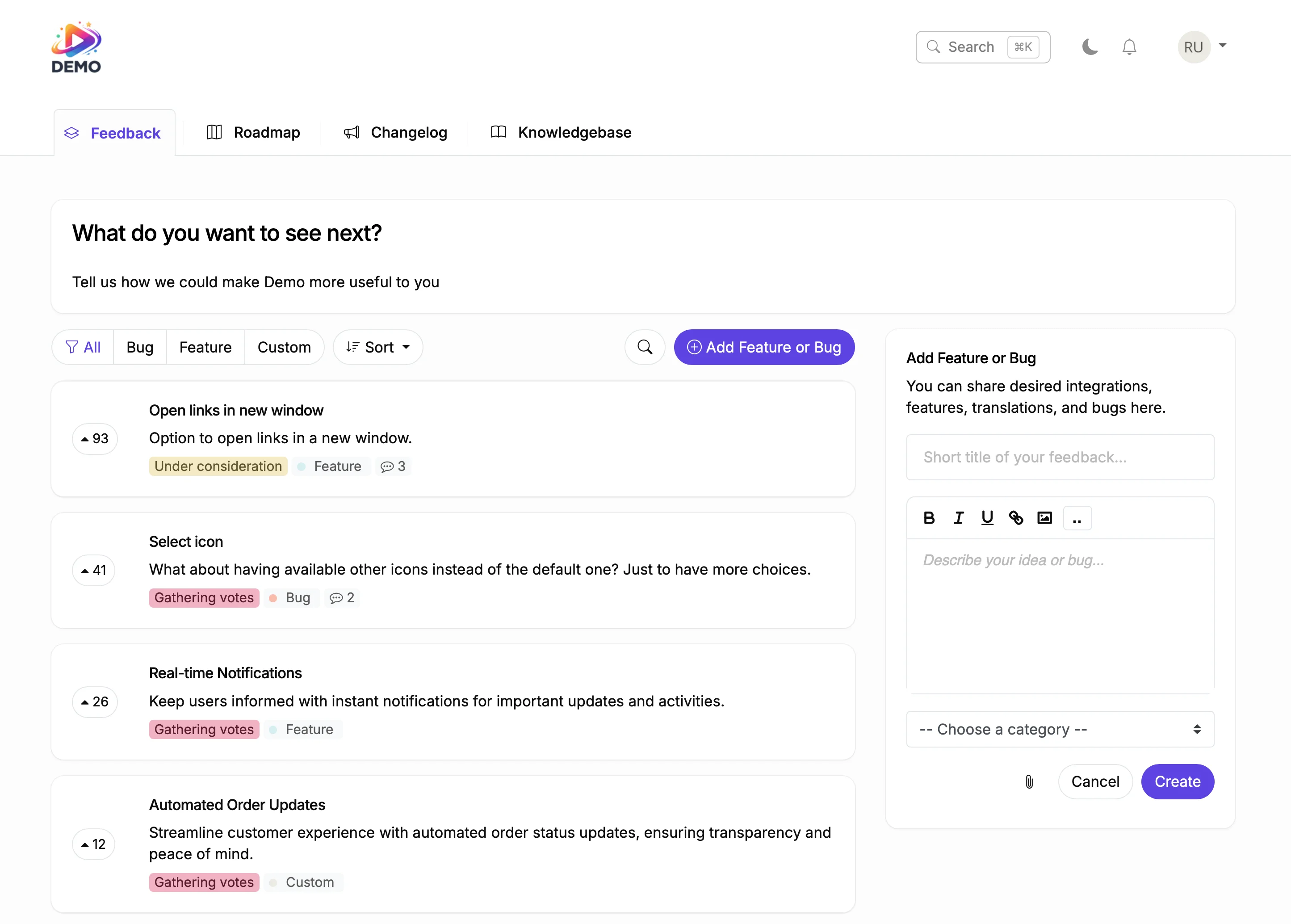
Support tickets about the same bug pile up while your team triages blindly. ProductLift gives customers a public board to report issues, vote on severity, and track when you fix them. You see which bugs affect the most users and close the loop automatically.
Before
With ProductLift
Customer-facing bug tracking is the practice of giving your users a structured way to report issues, see what others have already reported, and follow the resolution process. It differs from internal bug tracking (which happens inside tools like Jira) because the audience is external. The goal is to reduce duplicate support tickets, surface the highest impact issues, and maintain transparency with users about the status of known problems.
Without a public or customer-visible bug tracking system, every user who encounters a problem submits an independent support ticket. Your support team handles each one individually, often without realizing that twenty other users have reported the exact same thing. The engineering team receives a steady drip of escalations but has no aggregated view of how many users are affected by each issue. Prioritization becomes reactive: the bug that generates the most support volume gets attention, regardless of whether it is actually the most severe.
This pattern is expensive. Support agents spend time on repetitive conversations instead of complex cases. Engineering fixes low impact bugs because they happened to generate a few loud tickets, while high impact issues affecting silent users remain unresolved. Customers who report problems feel ignored when they never hear back about a resolution, which erodes trust and increases churn risk.
A customer-facing bug board flips this dynamic. When a user encounters a problem, they first see a list of known issues and can add their vote to an existing report instead of creating a new ticket. This alone can reduce duplicate support volume significantly. Vote counts give the engineering team an objective measure of user impact, making triage faster and more accurate. Status columns let affected users track progress without contacting support, and automatic notifications close the loop when a fix ships.
In ProductLift, bug reports follow the same Journey Model as feature requests. A report starts on the feedback board, moves to the roadmap when engineering commits to a fix, and appears in the changelog when the fix is released. The two-way Jira integration means confirmed bugs can be pushed to your engineering backlog while status updates flow back to the customer-facing board automatically. Users see their report move from Reported to In Progress to Fixed without anyone on your team sending a manual update.
Customers submit bug reports with descriptions, steps to reproduce, and file attachments. Categories separate bugs from feature requests.
Other users who experience the same bug upvote it. Vote counts give your team an objective measure of how many users are affected.
AI identifies duplicate bug reports and suggests merges. Users see existing reports before submitting, reducing noise and consolidating votes.
Move bugs through Reported, Confirmed, In Progress, and Fixed columns. Customers see the status of their report without contacting support.
When you fix a bug and mark it as resolved, every user who reported or voted on it gets an email. No more manual follow-up.
Fixed bugs appear in your changelog. Users see a history of resolved issues, which builds confidence in your product's reliability.
6,035
Teams using ProductLift
157,624
Reports and requests collected
39,406
Issues resolved and shipped
Sebastian F.
Entrepreneur
Aaron Dye
Timothy M.
Product Manager
Ben
Product Owner
Marco
Chris R.
Founder
Join 6,000+ teams using ProductLift to collect bug reports, prioritize by impact, and notify reporters automatically