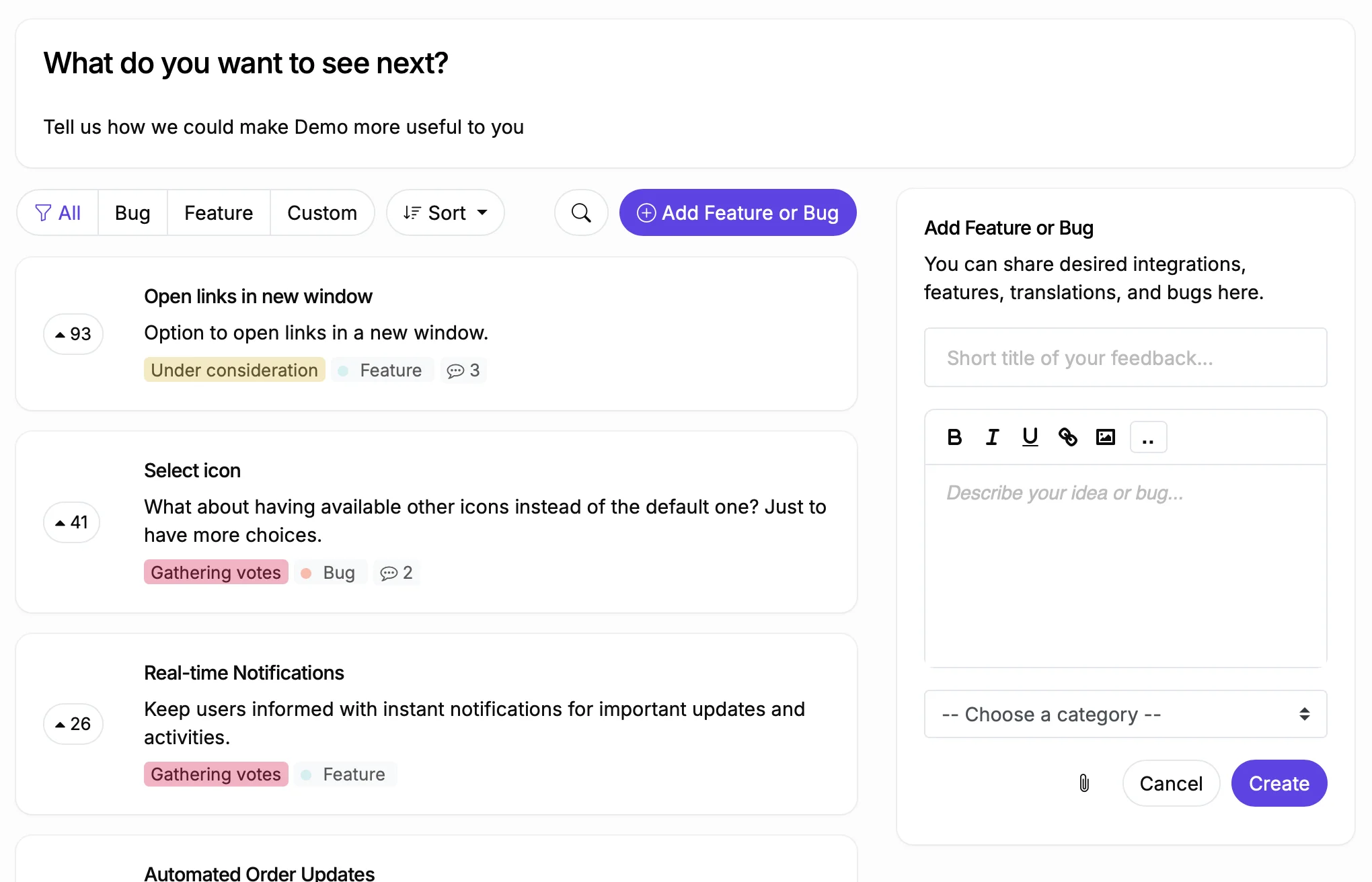
Beta testers send unstructured feedback through email, Slack, and forms. ProductLift gives them a dedicated board to report bugs, suggest improvements, and vote on what matters most. You see exactly what to fix before launch.
Before
With ProductLift
Beta testing is the phase in product development where a pre-release version is shared with a limited group of users to uncover bugs, usability problems, and missing features before a public launch. The feedback collected during this phase is uniquely valuable because it comes from real users interacting with the actual product under real conditions. But the quality of a beta program depends entirely on how well that feedback is captured, organized, and acted upon.
Most beta programs start with good intentions but quickly devolve into chaos. Testers send feedback through whatever channel is most convenient: email, Slack, Discord, social media, or direct messages. The result is a scattered collection of reports with no central index, no way to measure how many testers experience the same issue, and no mechanism for testers to see what has already been reported. Product teams end up spending more time organizing feedback than analyzing it.
The consequences of unstructured beta feedback are significant. Critical bugs get buried under noise. The team fixes a minor cosmetic issue reported by one vocal tester while a data loss bug affecting dozens of users goes unnoticed. Duplicate reports inflate the apparent number of unique issues, making triage harder. And testers lose motivation because they never see their reports acknowledged or resolved, leading to declining participation rates as the beta progresses.
A structured beta feedback system addresses these problems by giving testers a single destination to submit reports, browse existing submissions, and vote on the issues they consider most important. Categories separate bug reports from feature suggestions and usability observations. Duplicate detection prevents the same issue from being reported multiple times without consolidating the evidence. Status tracking lets testers see when their report moves from Submitted to Confirmed to Fixed, keeping them engaged throughout the testing period.
ProductLift provides this structure through private boards that can be restricted to invited testers only. Testers submit categorized reports with file attachments, vote on issues others have raised, and receive automatic notifications when the team resolves their reported problem. The roadmap view shows testers what the team is actively working on, which reduces repeated follow-up questions and builds confidence that their input is being taken seriously. When the beta concludes, the entire feedback history serves as documentation of what was found and how it was addressed.
Testers submit bug reports and feature suggestions through a clean interface. Categories, tags, and file attachments keep everything organized from the start.
Testers upvote the bugs and features that matter most to them. You focus on the issues with the highest impact instead of fixing them randomly.
AI identifies duplicate reports and suggests merges. Testers see existing reports before submitting, reducing noise and giving you accurate counts.
Share a roadmap showing what you are fixing and improving. Testers see progress in real time, which keeps them engaged through the entire beta.
When you resolve a bug or ship an improvement, every tester who reported or voted on it gets notified. They re-test and confirm the fix.
Restrict access to invited testers only. Keep beta feedback private until you are ready to launch publicly.
6,035
Teams using ProductLift
157,624
Reports and requests collected
39,406
Issues resolved and shipped
Sebastian F.
Entrepreneur
Aaron Dye
Timothy M.
Product Manager
Ben
Product Owner
Marco
Chris R.
Founder
Join 6,000+ teams using ProductLift to collect, organize, and act on tester feedback