Boei is a friendly lead widget that helps convert website visitors into leads through contact forms, WhatsApp, Facebook chat, and more. With a lead widget you always show the most important buttons on your website (like a WhatsApp button). Boei serves thousands of websites worldwide and, as a result, receives a steady stream of feedback from users across Twitter, email, Facebook, and WhatsApp.
Boei wanted to centralize user feedback and allow users to provide input without overburdening customer support. They aimed to prioritize work, gather structured feedback, and involve users in decision-making.
Before adopting ProductLift, Boei's feedback lived in scattered channels. Feature requests arrived through support emails, Twitter DMs, WhatsApp messages, and Facebook comments. The team had no single source of truth for what users actually wanted. This created several problems:
Boei needed a system that would collect feedback in one place, let users vote on what matters most, and keep everyone in the loop as features progressed. That is exactly where ProductLift's feedback boards came in.
We love to be able to prioritize new developments based on user feedback. We know exactly what users believe is important and we use that for our decision making.
| Metric | Result |
|---|---|
| Total votes collected | 1,600+ |
| Feature requests tracked | 350+ |
| Feedback channels consolidated | 5 (email, Twitter, Facebook, WhatsApp, in-app) |
| User notification method | Automatic update emails on status changes |
| Integration | SSO + in-app sidebar widget |
ProductLift has become an integral part of Boei's product development process, offering a range of features that enhance collaboration, prioritize work, and keep everyone informed.
With features like the sidebar widget, the impact/effort prioritization matrix, and transparent update emails, Boei achieved strong engagement and alignment with user needs. The seamless Single Sign-On integration made participation effortless.
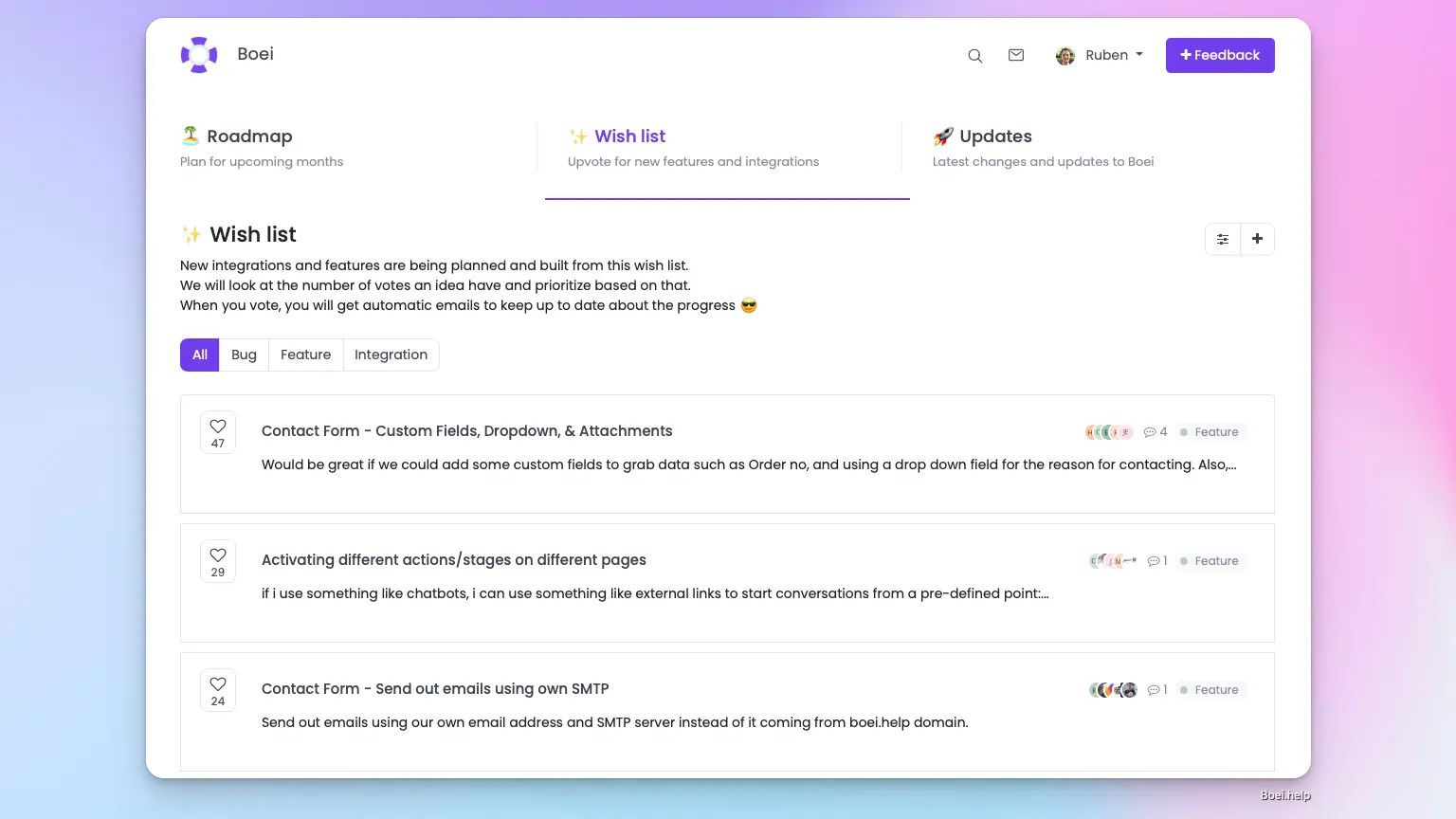
Boei empowers its users by giving them the opportunity to suggest, vote, and comment on the wish list. This democratic approach ensures that the most popular and highly requested features are given priority, aligning the product development roadmap with the needs and desires of the user community.
By involving users in the decision-making process, Boei can enhance their product in a way that resonates with their target audience, leading to higher satisfaction and adoption rates. Instead of sifting through inboxes and chat logs, the team now opens a single feedback board to see exactly what users care about, complete with vote counts and threaded discussions.
For tips on running an effective voting process, see our guide on feature voting best practices.
The impact/effort prioritization matrix in ProductLift was a game-changer for Boei. With all feature requests consolidated into a single list, along with customer data like plan type and company size, the Boei team can easily assess the popularity and importance of each feature.
The matrix helps them identify the features that have the highest impact and align with their strategic goals, enabling them to focus their efforts on the most valuable enhancements for their users.
Here is how the process works in practice:
The Boei team reviews the matrix on a regular cadence. This keeps the roadmap fresh and ensures that newly popular requests don't sit unnoticed for months.
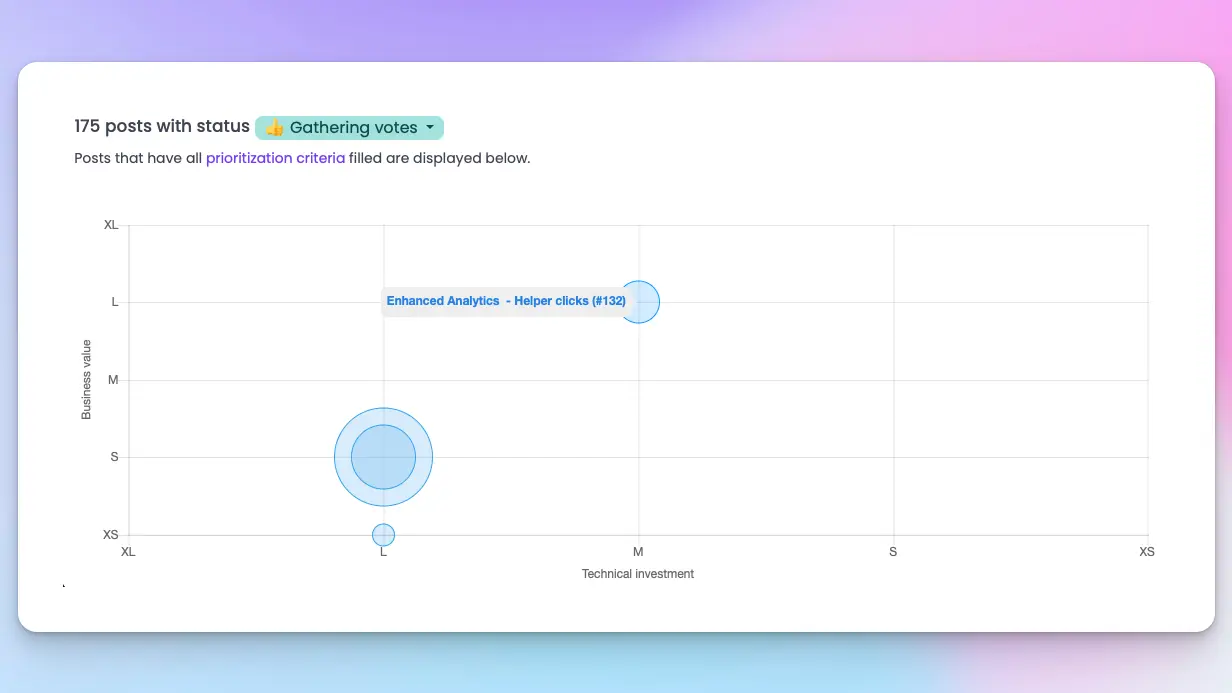
This structured workflow helped the product manager build a roadmap that truly reflects user demand.
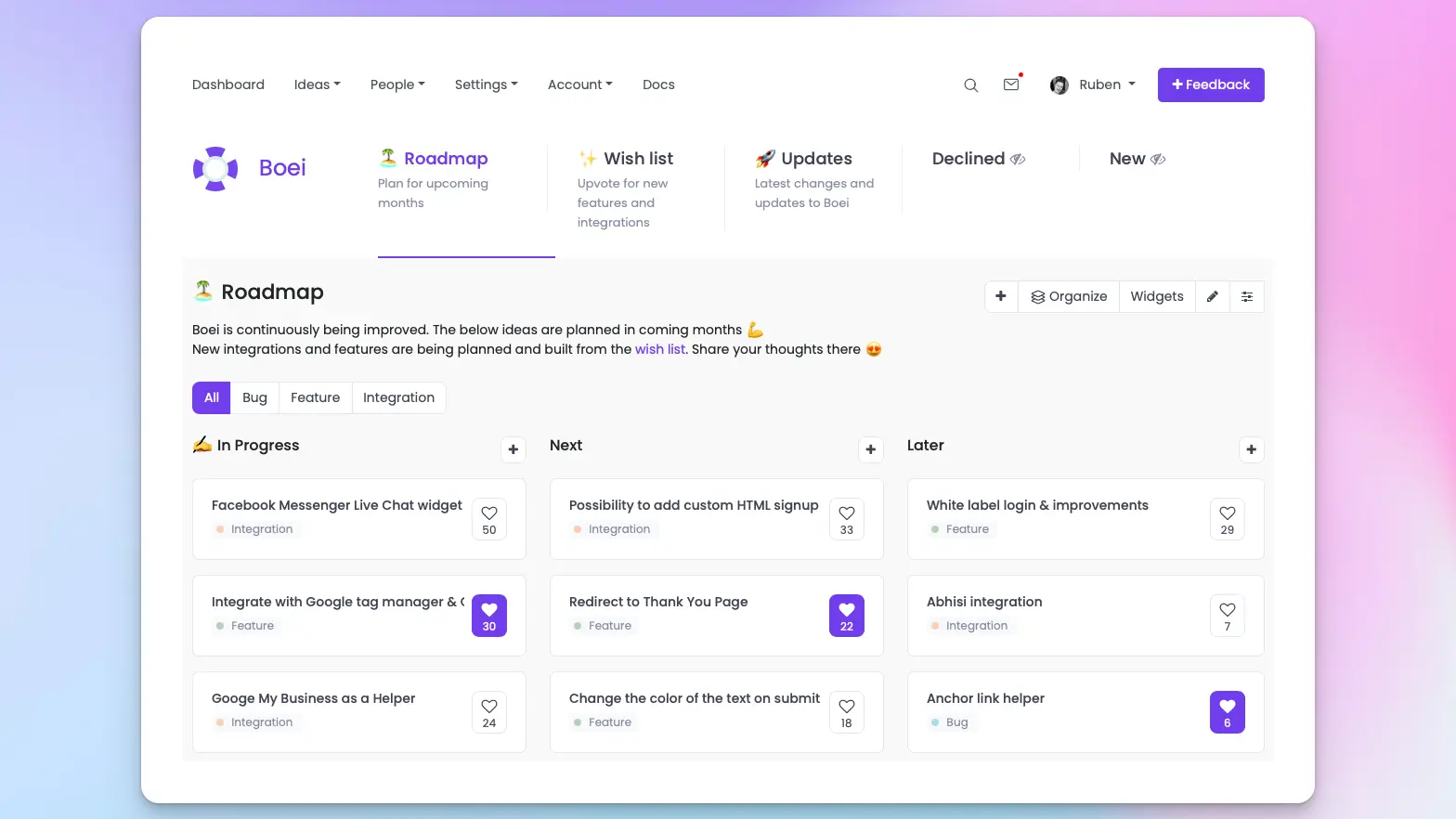
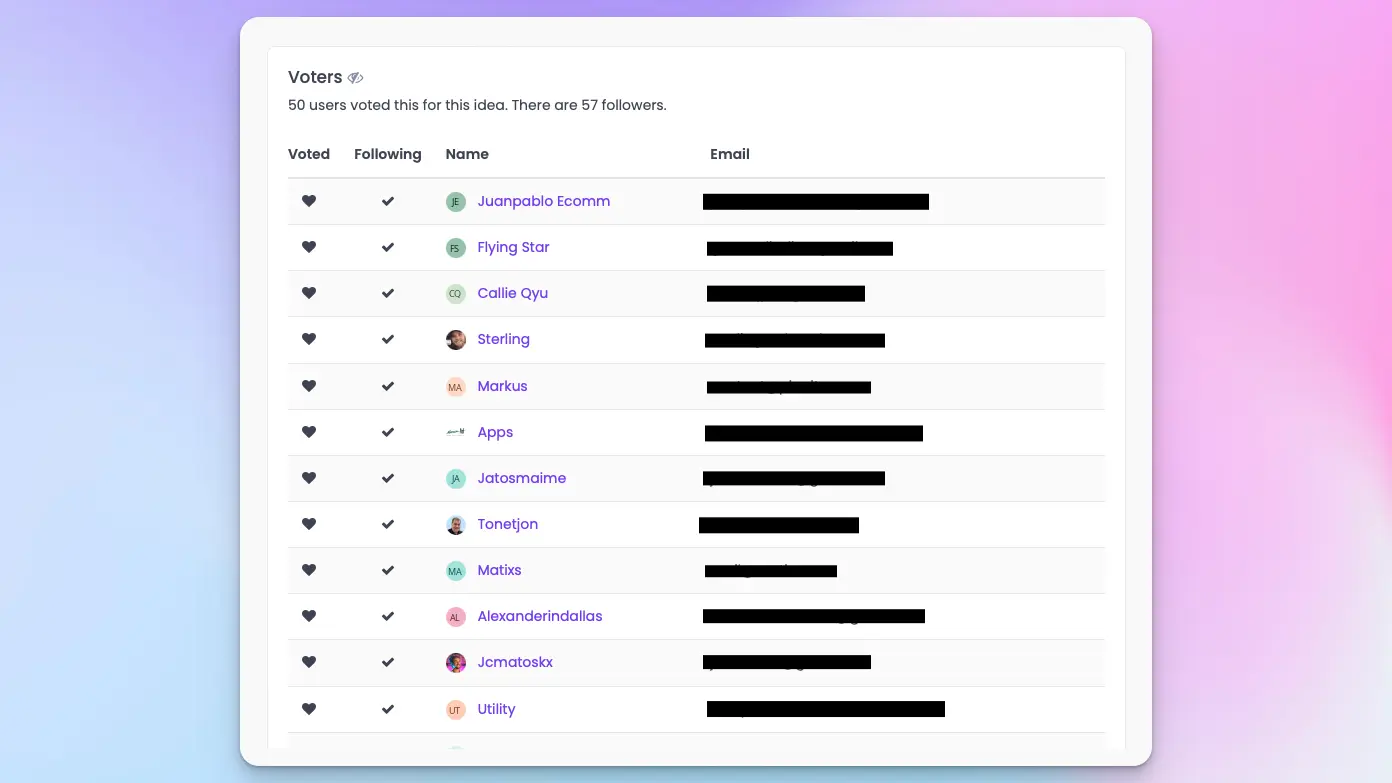
Closing the feedback loop is one of the most impactful things a product team can do, and Boei takes it seriously. Every feature in the wish list comes with a list of all the users who upvoted it. When the status of a feature changes (from "Under Review" to "Planned" to "Shipped"), ProductLift sends automatic update emails to every voter.
This means users who upvoted a particular feature are directly informed about the progress and can start using the feature as soon as it becomes available. The result is a virtuous cycle: users see that their feedback leads to real changes, so they continue to engage with the board, submit new ideas, and vote on existing ones.
Beyond automated emails, Boei also uses the changelog to announce shipped features publicly. This gives the broader user base visibility into what was built and why. Users who did not vote still benefit because they can discover new capabilities they might have missed otherwise.
The combination of automated notifications and a public changelog transforms a one-way feedback form into an ongoing conversation between the Boei team and their users.
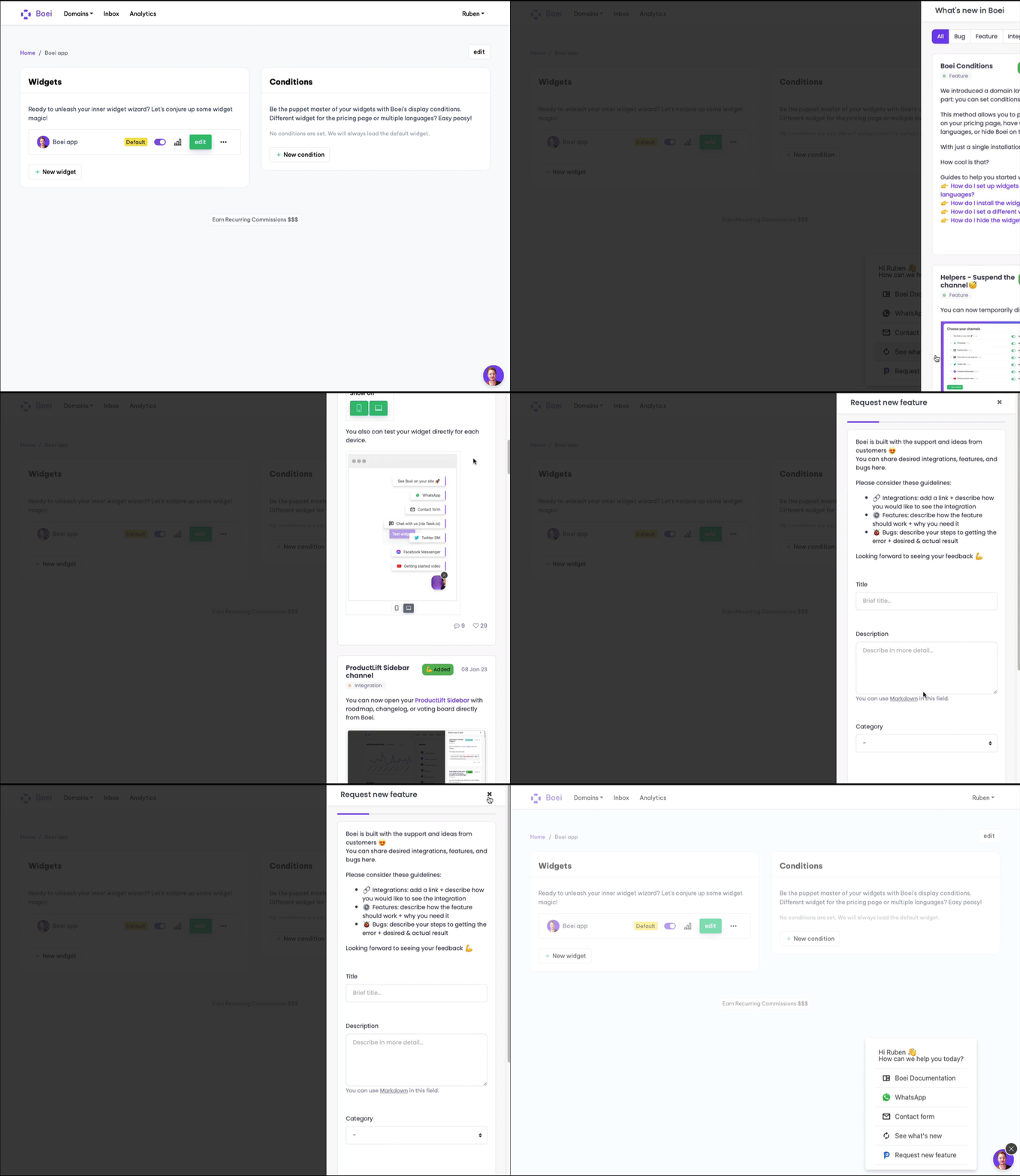
Boei uses the sidebar feature from ProductLift. The sidebar widget showcases what's new, keeping users informed and engaged with the latest updates and enhancements.
It also enables users to request new features effortlessly, without leaving the Boei app. This is critical for capturing feedback at the moment of inspiration. When a user thinks "I wish this tool could do X," they can submit that idea in seconds rather than switching to a separate website or sending an email.
Another major advantage for Boei is the seamless integration of Single Sign-On (SSO) with ProductLift.
Boei users are automatically logged into ProductLift without the need to create a separate account. This removes a significant friction point. Every extra step in the submission process costs you potential feedback, so eliminating the signup barrier means more users participate and the data becomes more representative of the actual user base.
ProductLift brought structure and clarity to Boei's product development, ensuring they built features that mattered most to users.
With 1,600+ votes on 350+ features, Boei is constantly receiving valuable feedback from their users and translating that feedback into shipped improvements.
If you want to replicate Boei's success, here are the actionable lessons from their experience:
Ready to bring the same structure to your own product development? Follow in Boei's footsteps and give ProductLift a try.
Join over 5,204 product managers and see how easy it is to build products people love.





Did you know 80% of software features are rarely or never used? That's a lot of wasted effort.
SaaS software companies spend billions on unused features. In 2025, it was $29.5 billion.
We saw this problem and decided to do something about it. Product teams needed a better way to decide what to build.
That's why we created ProductLift - to put all feedback in one place, helping teams easily see what features matter most.
In the last five years, we've helped over 5,204 product teams (like yours) double feature adoption and halve the costs. I'd love for you to give it a try.

Founder & Digital Consultant
Learn when and how to make your product roadmap public. Covers formats (Now/Next/Later, timeline, kanban), what to show vs hide, and managing expectations.
Learn how to write release notes people actually read. Covers structure, formatting, audience targeting, distribution, and templates.
Most feedback loops break after collection. Learn the 5 stages of a closed feedback loop and how to notify customers automatically.
Learn every feedback collection channel, how to organize responses, and how to build a program that drives product decisions. Practical SaaS guide.
Understand the difference between a changelog and release notes. Compare format, audience, frequency, and learn when to use each for your SaaS product.
With bike energy  from Utrecht
Ruby Foundry B.V. - KVK: 99995662 - BTW: NL869219789B01