Your customers keep asking "what's next?" every week. Your support team keeps answering the same question. Making your product roadmap public solves both problems at once, but it also raises real concerns about competitors, commitments, and flexibility. This guide helps you decide whether a public roadmap is right for your product, which format to choose, and how to manage it without creating headaches.
A public roadmap is any product roadmap that's visible to people outside your organization. That could mean customers, prospects, partners, or even the general public.
The trend toward public roadmaps has accelerated significantly. Gartner's 2024 Product Strategy report noted that 42% of B2B SaaS companies now publish some form of external roadmap, up from just 18% in 2020. Here's why.
When customers can see what you're working on, they stop guessing. They don't need to email your support team asking "are you planning to add X?" They can see for themselves.
This is especially powerful for B2B products where purchasing decisions depend on future capabilities. A prospect evaluating your tool against a competitor will feel more confident choosing you. They can see the features they need are on your radar.
Across the 6,035 product teams using ProductLift, the pattern is clear: teams that make their roadmaps public see higher engagement across every metric. Users who can see a public roadmap are more likely to submit feedback, vote on features, and stick around as paying customers.
Teams that publish a public roadmap consistently report fewer repetitive tickets. Instead of answering the same "when is feature X coming?" question dozens of times, you point people to the roadmap. Better yet, they find it themselves. Ready to try it? Start your free trial and set up a public roadmap in minutes.
One pattern that works well: link your roadmap from your knowledge base and from automated responses to feature request emails. This deflects a meaningful percentage of repetitive questions.
Key takeaway: A public roadmap isn't just a communication tool. It's a support deflection strategy that saves your team hours every week.
A public roadmap signals your product direction. Customers who align with that direction self-select in. Customers who need something fundamentally different self-select out. Both outcomes save everyone time.
This is a quiet benefit that doesn't get enough attention. Misaligned customers who churn after six months are expensive. A public roadmap helps set expectations before the sale.
If you're competing against a larger player with more features, a public roadmap shows momentum. It's one of the 19 proven tactics to differentiate your SaaS. It says: "We may not have everything today, but look at what's coming." For early stage products, this signal of velocity and responsiveness can be a real differentiator.
Try it yourself: Create a public roadmap in under 5 minutes with ProductLift. No credit card required.
Every team considering a public roadmap has the same set of concerns. Let's address them directly.
This is the most common objection, and it's almost always overblown. Here's why:
The exception: if you're in a small market with one or two direct competitors who are known to be fast followers, consider keeping specific items vague. But even then, the benefits of a public roadmap usually outweigh the risks.
This is a legitimate concern, but it's manageable with the right framing. The solution is expectation setting, not secrecy.
Every public roadmap should include a disclaimer. Something like: "This roadmap reflects our current plans and priorities. Items may change, be reordered, or be removed based on new information. Nothing here is a commitment."
ProductLift supports this directly with disclaimer text you can add to any roadmap page. This expectation-setting message appears prominently before users interact with roadmap items.
Beyond the disclaimer, your format choice matters. Now/Next/Later roadmaps (more on this below) are inherently non-committal because they avoid dates entirely. This is one reason they're the most popular format for public roadmaps.
A public roadmap actually helps you manage feature requests, not amplify them. When users can see your priorities, they're less likely to submit duplicate requests. And when they do request something, you have a framework for responding: "Thanks for the suggestion. Here's where it sits on our roadmap."
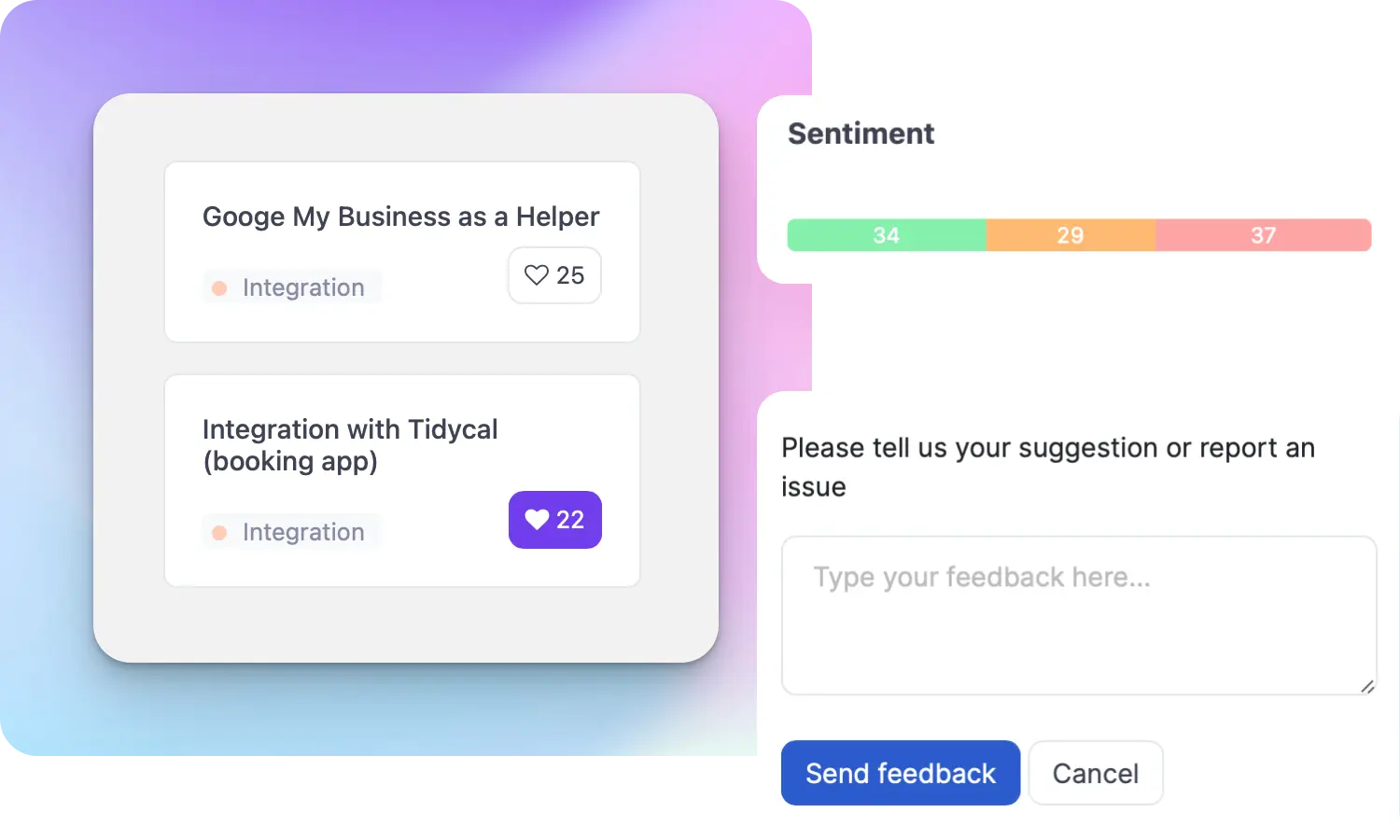
Connecting your roadmap to a feedback board makes this even easier. Users can vote on existing items instead of submitting new tickets for things you're already planning. In ProductLift, posts promoted from a feedback board to the roadmap keep all their original votes and comments, so you never lose context.
You'll always have the ability to change your roadmap. The key is framing. Present your roadmap as "this is what we're exploring" rather than "this is what we're shipping in Q3," and you have full freedom to adjust.
Teams that use fully customizable status labels like "Under Consideration," "Planned," "In Progress," "Testing," and "Released" give themselves natural flexibility. Moving something from "Planned" back to "Under Consideration" is a normal part of product development, not a broken promise. Each status can have its own color, making the progression visually intuitive.
The most important decision isn't whether to go public. It's what to include.
| Category | Examples | Why |
|---|---|---|
| High-level themes | "Better reporting," "Mobile experience," "API improvements" | Communicates direction without revealing specifics |
| User-facing features | "Dark mode," "CSV export," "Slack integration" | These are what customers care about |
| Status indicators | Under Consideration, Planned, In Progress, Shipped | Helps users understand where things stand |
| Voting and engagement | Vote counts, comment counts | Shows social proof and helps you gauge demand |
| Category | Examples | Why |
|---|---|---|
| Internal infrastructure work | "Migrate to new database," "Refactor auth system" | Customers don't care and it clutters the view |
| Revenue-driven priorities | "Enterprise SSO (because BigCorp needs it)" | Reveals your business strategy |
| Exact timelines (usually) | "Shipping March 15" | Creates commitments you may not be able to keep |
| Experimental items | Things you're 20% sure about | Removes them cleanly if they don't work out |
| Competitive response items | "Match competitor X's feature" | Reveals your competitive strategy |
Most roadmap tools let you control visibility at the item level. In ProductLift, each board has granular visibility options: Public (visible to everyone), Private (login required), Members Only (restricted to your user base), Admin Only (internal planning), or Specific User Groups (targeted audiences). This means you can maintain a complete internal roadmap while showing a curated subset to the public.
Board permissions go even further. You can control per board who can view, create posts, vote, and comment. Want a beta testing board that's visible only to select testers? Set it up alongside your main public roadmap.
Key takeaway: The best public roadmaps are curated subsets of a larger internal roadmap. You don't publish everything; you publish what serves your audience.
This is where most guides get vague. Here's a concrete decision framework, followed by a side-by-side comparison.
Best for: Most teams, especially early to mid stage products.
Instead of dates or quarters, items are grouped into three buckets:
In ProductLift, you create this by adding sections named "Now," "Next," and "Later" to a Kanban board. Each section displays as its own column, giving you the classic Now/Next/Later layout without any custom development.
Why it works: It communicates priority and sequence without locking you into dates. When something shifts from "Next" to "Later," nobody feels deceived because no date was promised.
When to avoid it: Enterprise customers with procurement cycles often need more specificity than "Later." If your primary audience is enterprise buyers, consider adding target quarters to your roadmap items.
Best for: Enterprise products, platforms with integration partners, or products with predictable release cycles.
Items are organized by time period (quarters, months, or halves). Some teams prefer a timeline format that maps items to specific periods. This works well for enterprise customers who need planning visibility.
Why it works: Gives partners and enterprise customers concrete planning information. A partner building an integration needs to know roughly when your API changes will ship, not just that they're "next."
When to avoid it: If your team frequently changes priorities or if you're still finding product-market fit. Timeline roadmaps create stronger expectations around timing.
Pro tip: Use quarters for the near term (Q1, Q2) and halves or years for the longer term (H2, 2027). This naturally communicates decreasing certainty over time.
Best for: Teams that want to show workflow progress, especially developer-facing products.
Items move across columns like "Under Consideration," "Planned," "In Progress," "In Beta," and "Shipped." The focus is on status, not timing. In ProductLift, Kanban columns can be organized by status or by custom sections, giving you full control over the workflow your users see.
Why it works: Users can see where each item sits in the development process. Moving a card from "Planned" to "In Progress" is a visible signal that generates excitement.
When to avoid it: When you have hundreds of items. Kanban boards get unwieldy at scale. Also, if your audience is non-technical, the workflow metaphor may not resonate.
Best for: Large backlogs, filterable by category.
A simple list of items with status labels, categories, and sort options. Users can filter by what they care about.
Why it works: Scales to hundreds of items without visual overload. Filters let different audiences find what's relevant to them.
When to avoid it: When you want to communicate a narrative or strategic direction. Lists are functional but don't tell a story.
| Now/Next/Later | Timeline-Based | Kanban (Status) | List View | |
|---|---|---|---|---|
| Commitment level | Low: no dates, just priority buckets | High: dates create expectations | Medium: status implies progress | Low: just a catalog |
| Best for | Most teams, public-facing roadmaps | Enterprise, partner-facing roadmaps | Developer tools, process-oriented teams | Large backlogs, diverse audiences |
| Flexibility | Very high: reordering columns is painless | Low: missed dates erode trust | High: status changes feel natural | Very high: items are just rows |
| Setup effort | Minimal: three sections and you're done | Moderate: requires estimated dates per item | Minimal: define status columns | Minimal: add items, assign categories |
| Audience clarity | Excellent: anyone understands "Now" | Good for planners, confusing for casual users | Good for technical audiences | Neutral: functional but not narrative |
Answer these three questions:
1. Who is your primary audience?
2. How predictable is your release cycle?
3. How many items will you show?
Try it yourself: Set up a Kanban or List roadmap in ProductLift and switch between views anytime. No credit card required.
Going public with your roadmap is only the beginning. Here's how to maintain it without creating problems.
Place it at the top of your public roadmap. Keep it short:
"This roadmap shows our current thinking and priorities. It's not a commitment. Items may be added, removed, or reordered at any time."
One or two sentences is enough. Don't write a paragraph of legal language. ProductLift includes built-in disclaimer support so you can add expectation-setting text directly to any roadmap page without custom code.
Your status labels do a lot of heavy lifting. Here's a set that works well:
| Status | What it means | Expectation level |
|---|---|---|
| Under Consideration | We're aware of this and evaluating it | Very low |
| Planned | We intend to build this | Moderate |
| In Progress | Actively being developed | High |
| Testing | Available to early testers | High |
| Released | Done and available | Complete |
In ProductLift, status labels are fully customizable with custom names and colors. You can create as many or as few as your workflow needs. Some teams add statuses like "Needs More Votes" or "Reviewing" to give users even more visibility into the decision process.
Notice there's no "Committed" or "Guaranteed" status. Every label leaves room for changes.
Dates create commitments. If you miss a date on a public roadmap, you erode trust instead of building it. The only time to include a specific date is when you're extremely confident in the delivery window and when the audience specifically needs that information.
For most teams, time horizons (this month, this quarter, this half) are better than specific dates.
One of the biggest mistakes teams make is treating the roadmap as a one-way communication channel. When you ship something from your roadmap, announce it. Update the status. Notify users who voted for it.
This creates a transparency loop that reinforces the value of your public roadmap. Users see that items actually move through the pipeline, which encourages them to engage more.
In ProductLift, this loop is built in. When you change a roadmap item's status, every user who voted on or follows that item receives an automatic notification. Your team can also add progress updates as comments (public or internal) during development, and each public comment notifies all followers. When the feature ships, connecting your roadmap to a changelog makes the announcement automatic.
For more on this pattern, see our guide on closing the feedback loop.
Key takeaway: A public roadmap works best when connected to a feedback system. Customers vote on roadmap items, see their suggestions move through stages, and get notified when features ship. This is the complete transparency loop.
Set a recurring calendar event (monthly or quarterly) to review your public roadmap. Remove items that are no longer relevant. Update statuses. Reorder priorities. ProductLift's bulk operations let you move multiple items between statuses at once, making these reviews efficient even with large backlogs.
A stale roadmap is worse than no roadmap. If users see items that have been "Planned" for a year with no progress, they'll lose trust in the entire system.
Let's go deeper on this because it's the most emotionally charged concern.
What competitors can learn from your public roadmap:
What they can't learn:
The reality is that most of your competitors aren't monitoring your roadmap daily. And even if they are, the information is too high-level to be actionable. "Company X is building reporting features" isn't useful competitive intelligence. Every product eventually builds reporting features.
If you're still worried, here are two middle-ground approaches:
Limit access to logged-in users. In ProductLift, you can set any board to Private (login required) or Members Only. This adds a friction barrier that keeps casual browsing competitors from easily tracking your plans. It also lets you see who's looking at your roadmap.
Keep items intentionally vague. Instead of "Salesforce CRM integration with bidirectional sync," write "CRM integrations." You communicate the direction without the specifics.
After studying hundreds of public roadmaps and the 157,624 feedback items submitted across ProductLift's customer base, a few patterns stand out.
How it works: users submit ideas through a feedback board, vote on them, and the most popular or most strategic items graduate to the roadmap.
In ProductLift, this is the core workflow. Posts promoted from a feature voting board to the roadmap maintain all their original votes and comments. You can also create linked posts with relationships like "Related To," "Depends On," "Blocks," and "Part Of" to show how roadmap items connect to each other.
Why it works: Users feel ownership. They see their input directly influencing the product direction. This creates a community of engaged users who actively participate in shaping the product.
Best for: B2B SaaS, developer tools, community-driven products.
Real example: FastPages uses ProductLift to run a feedback-driven roadmap. Read the full FastPages case study for details on their process. Users submit feature requests, vote on priorities, and watch as items move through the pipeline. They have captured over 800 votes from their users, and their "Completed" tab serves as a living changelog of everything they have shipped.
How it works: the product team maintains a small, carefully curated public roadmap (15 to 25 items) that represents strategic themes. The full internal roadmap has 10x more items.
Why it works: It communicates direction without overwhelming users. It gives the team maximum flexibility because most items don't appear publicly.
Best for: Products with large backlogs, enterprise products, products in competitive markets.
How it works: nearly everything is public. Internal discussions, prioritization reasoning, and even rejected ideas are visible. Think of it as building in public.
Why it works: Creates radical trust and a strong community. Users become advocates because they feel like insiders.
Best for: Early stage startups, open source projects, products where community is a core value.
Real example: Merch Dominator takes this approach with their 80,000+ user base. See the Merch Dominator case study for how they manage 1,200+ votes per month. By making their development process visible through ProductLift, they process over 1,200 votes per month and have turned their users into active participants in product development. Their 57,000+ SSO-connected users can see exactly what's being worked on, what's coming next, and what has already shipped.
How it works: instead of sending users to a separate roadmap URL, you embed the roadmap directly on your website using a JavaScript widget.
Why it works: Users never leave your site. The roadmap feels like a native part of your product rather than a third-party tool. This increases engagement because there's zero friction.
Best for: Teams that want the roadmap to feel integrated with their marketing site or product documentation. ProductLift's embedding widget makes this a single line of JavaScript. You can also link it from your knowledge base to create a smooth self-service experience.
If you're new to public roadmaps, start with Pattern 2 (Curated Showcase). It gives you the benefits of transparency with minimum risk. You can always expand to Pattern 1 (Feedback-Driven) or 3 (Transparent Pipeline) as you get more comfortable.
For guidance on how to drive traffic to your new public roadmap, see our guide on promoting your board.
Ready to make your roadmap public? Here's the practical sequence:
Try it yourself: Start your public roadmap today with ProductLift. Set up boards, configure statuses, and go live in minutes. No credit card required.
Not necessarily. Public roadmaps work best for products with an engaged user base that cares about future development. If you're pre-product-market-fit and pivoting frequently, a public roadmap can create more confusion than clarity. Once your direction is stable enough that your roadmap items persist for at least a few weeks, you're ready. The most successful teams tend to start with a small curated roadmap and expand from there.
At minimum, update statuses weekly and do a strategic review monthly. The worst thing you can do is publish a roadmap and forget about it. Stale roadmaps actively harm trust. Many teams tie roadmap updates to their sprint cycles so status changes happen naturally as work progresses. Adding progress updates as comments keeps users informed between status changes.
Yes, and you should. If priorities change and something is no longer planned, remove it or move it to an archive. Be transparent about it: a brief note like "We've deprioritized this to focus on X" goes a long way. Users respect honesty about changing priorities more than they respect a roadmap full of items that never move.
Acknowledge the request, explain your prioritization process, and point them to your feedback board where they can submit and vote on ideas. Phrases like "We track all requests and use voting data to help prioritize" set the right expectation without making promises. When multiple users request the same thing, their votes accumulate, giving you real data on demand. For more on prioritization, see our guides on prioritization frameworks.
For most teams, no. Time estimates create expectations that are hard to meet. Missing a public deadline does more damage than never providing one. If your audience specifically requires timelines (enterprise procurement, for example), use broad time horizons like quarters and only for near-term items. Leave longer-term items without dates.
A roadmap shows what's planned. A changelog shows what's shipped. For inspiration on how to communicate what you ship, see our roundup of 15 best changelog examples. They complement each other: the roadmap sets expectations, and the changelog delivers on them. Together, they create a complete picture of your product's evolution. The most effective setup connects the two so that shipped roadmap items automatically appear as announcements. In ProductLift, this connection closes the loop: customers who voted on a feature get notified when it ships and can see the release notes immediately. See our guide on closing the feedback loop for a deeper look at this pattern.
Join over 5,204 product managers and see how easy it is to build products people love.





Did you know 80% of software features are rarely or never used? That's a lot of wasted effort.
SaaS software companies spend billions on unused features. In 2025, it was $29.5 billion.
We saw this problem and decided to do something about it. Product teams needed a better way to decide what to build.
That's why we created ProductLift - to put all feedback in one place, helping teams easily see what features matter most.
In the last five years, we've helped over 5,204 product teams (like yours) double feature adoption and halve the costs. I'd love for you to give it a try.

Founder & Digital Consultant
Learn how to write release notes people actually read. Covers structure, formatting, audience targeting, distribution, and templates.
Most feedback loops break after collection. Learn the 5 stages of a closed feedback loop and how to notify customers automatically.
Learn every feedback collection channel, how to organize responses, and how to build a program that drives product decisions. Practical SaaS guide.
Understand the difference between a changelog and release notes. Compare format, audience, frequency, and learn when to use each for your SaaS product.
Analyze 15 outstanding SaaS changelogs from companies like Stripe, Linear, and Notion. See what makes each effective and steal patterns for your own.
With bike energy  from Utrecht
Ruby Foundry B.V. - KVK: 99995662 - BTW: NL869219789B01