Knowing how to say no to feature requests is one of the hardest skills in product management. A customer asks for something you're not going to build, and you need to tell them.
Saying no poorly damages trust. The customer feels ignored, questions whether you care about their needs, and starts evaluating competitors. But saying no well can actually strengthen the relationship. When you explain your reasoning transparently, customers respect the honesty and gain confidence that your product decisions are deliberate.
The challenge is that most product teams never practice saying no. They either avoid the conversation entirely (letting requests sit in limbo), or they say "we'll consider it" to everything. That is just a slow-motion no with extra disappointment.
This guide gives you seven approaches for declining feature requests, with response templates you can adapt for your own conversations.
There are only three reasons a product team needs to say no, but they're important ones:
Focus. Every feature you add increases the surface area of your product. More features means more code to maintain, more bugs to fix, more documentation to write, and more edge cases to test. Saying no to 10 mediocre features means you can invest deeply in 2 great ones.
Quality. Features built under pressure to "just get it done" create technical debt, confusing UX, and support tickets. The long-term cost of a poorly-built feature often exceeds the cost of not building it at all.
Strategy. Your product has a direction. Not every feature request aligns with it. Building features that pull you off-strategy makes your product worse for the customers who chose it because of that strategy.
The teams that ship the best products are the ones that say no to the most things. That sounds harsh, but it's true.
This is the most common situation. The feature request is reasonable, maybe even good, but it's not a priority right now. Be transparent about what you're focused on instead.
When to use it: The request is valid but doesn't fit the current roadmap cycle.
Template:
Hi [Name],
Thanks for submitting this idea. [Feature] is something we've discussed internally, and I can see how it would help with [their use case].
Right now, our team is focused on [current priority area], which we expect to wrap up in [timeframe]. We're not able to commit to [feature] in the near term, but it's captured in our backlog and we'll re-evaluate it during our next planning cycle.
In the meantime, you can track what we're working on and what's planned on our roadmap. I'll make sure to update the status of your request if anything changes.
Why it works: You acknowledge the request, explain your current priorities, and point them to a place where they can see what you are building. No vague promises, no false hope.
Sometimes the customer wants an outcome, not a specific feature. If your product already solves their problem through a different path, show them.
When to use it: The request can be addressed with existing functionality they may not know about.
Template:
Hi [Name],
Great question. While we don't have [exact feature] built the way you described, you can achieve a similar result using [existing feature/workaround].
Here's how: [brief steps or link to help article].
If this doesn't fully solve your problem, I'd love to hear more about the specific situation you're working with. That helps us understand whether we need a dedicated solution or if improving [existing feature] would cover it.
Why it works: You solve the customer's actual problem instead of just responding to their proposed solution. Often, customers don't know about features that already exist.
Some requests don't align with where you're taking the product. It's better to be upfront about this than to leave the request in limbo forever.
When to use it: The request goes against your product's core philosophy or target audience.
Template:
Hi [Name],
Thanks for the detailed suggestion. I appreciate you taking the time to think through how this would work.
After discussing this with our team, we've decided not to pursue [feature]. Our product is built around [core philosophy, e.g., "simplicity for small teams" or "integrated workflows rather than standalone tools"], and adding [feature] would pull us in a direction that doesn't serve that vision well.
I know that's not the answer you were hoping for, and I'm sorry about that. If [specific aspect of their use case] is a growing need for you, I'm happy to suggest some tools that handle that well and integrate with our platform.
Why it works: Transparency builds trust, even when the answer is no. Customers respect a team that knows what it's building and why.
Many feature requests are solutions masquerading as problems. The customer tells you what to build, but the real question is why they need it. Digging deeper often reveals a better path.
When to use it: The request feels oddly specific, or you suspect the underlying need could be solved differently.
Template:
Hi [Name],
This is an interesting idea. Before we evaluate it, I'd love to understand more about the situation driving this request.
- What are you trying to accomplish when you hit this limitation?
- How often does this come up?
- What do you do today as a workaround?
Sometimes the best solution looks different from the initial request once we understand the full picture. Your answers will help us figure out the right approach.
Why it works: You show the customer you're taking their problem seriously (not just their solution). And you often uncover a better path forward that serves more users.
Sometimes you genuinely don't know whether you'll build something. It's not a no, and it's not a yes. The honest answer is: we've captured it and will evaluate it when the time comes.
When to use it: The request is reasonable, you could see building it someday, but you have no concrete plans.
Template:
Hi [Name],
Thanks for the suggestion. We've added this to our feature backlog where it's being tracked alongside similar requests.
I can't commit to a timeline right now, but I want you to know it's not lost. As more customers request this (or as our priorities shift), it will move up in our planning process. You'll be notified if the status changes.
If you want to see what's currently in progress or planned, check out our roadmap.
Why it works: It's honest. You're not saying yes or no, you're saying "we'll see, and you'll know when we decide." Combined with a public roadmap, the customer can check on progress anytime without emailing your support team.
Some features are better handled by specialized tools. Building a mediocre version of something that already exists as a top-tier integration is a waste of your engineering team's time.
When to use it: The request is for functionality that falls outside your core product but could be addressed by a third-party tool or integration.
Template:
Hi [Name],
We've thought about building [feature] natively, and our conclusion is that it's better served by a dedicated tool that specializes in this area.
We integrate with [tool name], which handles [feature area] really well. Here's how to connect it: [link to integration docs or help article].
This way you get a purpose-built solution for [feature area] without us building a watered-down version that we can't maintain as well as [tool name] does.
Why it works: You're solving the customer's problem while being honest about what your product should and shouldn't do. Customers generally prefer a good integration over a half-built native feature.
When you're saying no to a feature, redirecting attention to what you are building helps the customer see that the product is still moving in a direction that benefits them.
When to use it: When you have something on the roadmap that addresses a related need or when you want to demonstrate momentum.
Template:
Hi [Name],
We're not planning to build [specific feature], but I think you'll be interested in what's coming. This quarter we're shipping [related feature/improvement], which addresses [related problem].
You can see the details and timeline on our roadmap. I think [upcoming feature] will solve a lot of the same pain you're describing, just from a different angle.
Once it's live, I'd love to get your feedback on whether it covers your use case.
Why it works: You shift the conversation from what you're not building to what you are building. The customer leaves the interaction feeling informed rather than dismissed.
Saying no is painful in a vacuum. When customers can't see what you're working on, every "no" feels like you're not doing anything.
A public roadmap changes the dynamic. When customers can see your priorities, current projects, and planned features, they have context for why their request isn't at the top of the list. They can see that you're actively building things. Just different things.
Public roadmaps help in three specific ways:
The key is keeping the roadmap honest and current. A stale roadmap with items stuck "In Progress" for six months destroys credibility.
Not every "no" is permanent. Some requests deserve a revisit:
Tag your declined requests with a reason ("out of scope," "too expensive," "low demand") so you can re-evaluate them periodically. A quarterly review of declined requests takes 30 minutes and occasionally surfaces something whose time has come.
Acknowledge the request, explain your reasoning, and point the customer to your roadmap or an alternative solution. Be specific about why you're declining. Vague responses like "we'll consider it" erode trust more than a clear, honest no.
Say no when the request conflicts with your product vision, when it serves a segment you don't target, or when the effort far outweighs the impact. Also say no when you already have too many priorities. A focused team that ships fewer features well outperforms one that ships many features poorly.
You can suggest existing workarounds, recommend integrations that solve the problem, ask deeper questions to uncover the real need, or say "not now" with a timeline for re-evaluation. Each approach keeps the customer engaged while being honest about your plans.
Use a template that thanks the customer, explains your current focus, and gives them a way to stay informed (like a public roadmap link). Be direct but empathetic. Avoid promising to "look into it" if you have no plans to build it.
Listen to the customer's reasoning and ask clarifying questions. If they present new information (like revenue at risk), re-evaluate. If the answer is still no, restate your reasoning calmly and offer alternatives. Consistency builds credibility over time.
Yes, always. Customers respect transparency. Explain whether the request conflicts with your strategy, falls outside your current priorities, or is better served by another tool. A clear reason turns a negative into a trust-building moment.
Saying no to feature requests is an unavoidable part of building a product. Do it poorly and you lose trust. Do it well and you build a reputation for thoughtfulness and transparency.
The key principles:
If you want to make this process easier, ProductLift gives you feedback boards with status tracking, a public roadmap that customers can browse, and automatic notifications when a request's status changes. Your customers always know where things stand, and your team spends less time writing "no" emails. Compare the top feedback tools for SaaS to find the right fit for your workflow.
Join over 3,051 product managers and see how easy it is to build products people love.





Did you know 80% of software features are rarely or never used? That's a lot of wasted effort.
SaaS software companies spend billions on unused features. In 2025, it was $29.5 billion.
We saw this problem and decided to do something about it. Product teams needed a better way to decide what to build.
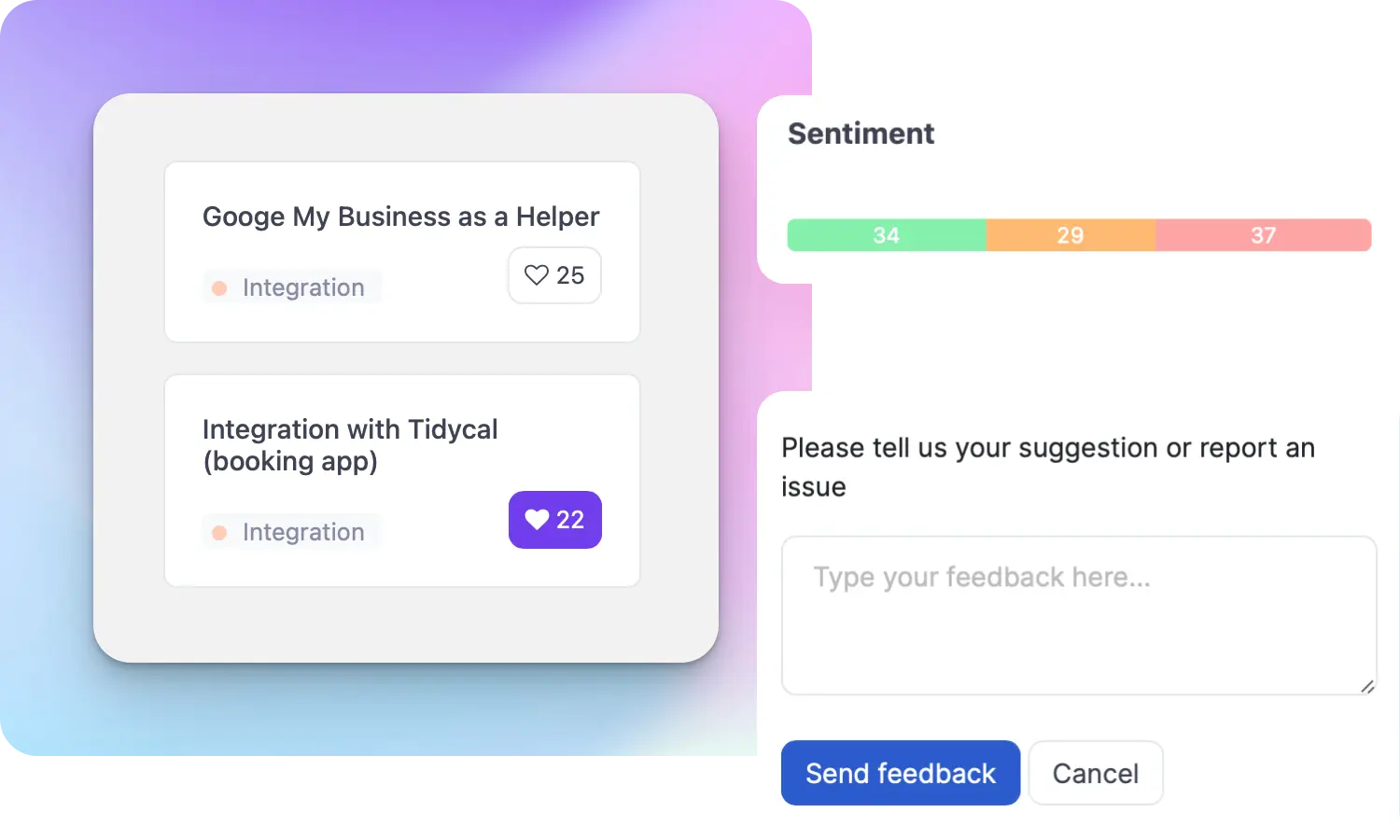
That's why we created ProductLift - to put all feedback in one place, helping teams easily see what features matter most.
In the last five years, we've helped over 3,051 product teams (like yours) double feature adoption and halve the costs. I'd love for you to give it a try.

Founder & Digital Consultant
Learn when to promote feature requests to your roadmap, how to merge duplicates, notify voters, and keep credibility through the full lifecycle.
Learn how to prioritize feature requests using RICE, ICE, MoSCoW, and Impact-Effort. Combine scoring models with revenue data to build what matters.
Learn how to distinguish bugs from feature requests, handle grey areas, and classify edge cases. Includes a decision framework and communication tips.
Copy these 5 proven feature request templates for any team size. From basic forms to enterprise formats, find the right structure for product feedback.
Learn 10 proven feature voting best practices to collect better feedback, prioritize by revenue impact, and build what customers want.
With bike energy  from Utrecht
KVK: 20145923 - BTW: NL001143413B86