Feature voting lets your customers tell you exactly what to build next. Instead of guessing which features matter most, you give users a simple way to submit ideas, upvote what they want, and follow progress as you ship.
But most teams get feature voting wrong. These feature voting best practices will help you avoid the common pitfalls. They set up a board, collect hundreds of votes, and then ignore the results. The data is noisy, biased toward power users, or disconnected from revenue. The board becomes a graveyard of stale requests.
This guide covers 10 best practices that separate teams who use feature voting as a growth engine from those who treat it as a checkbox.
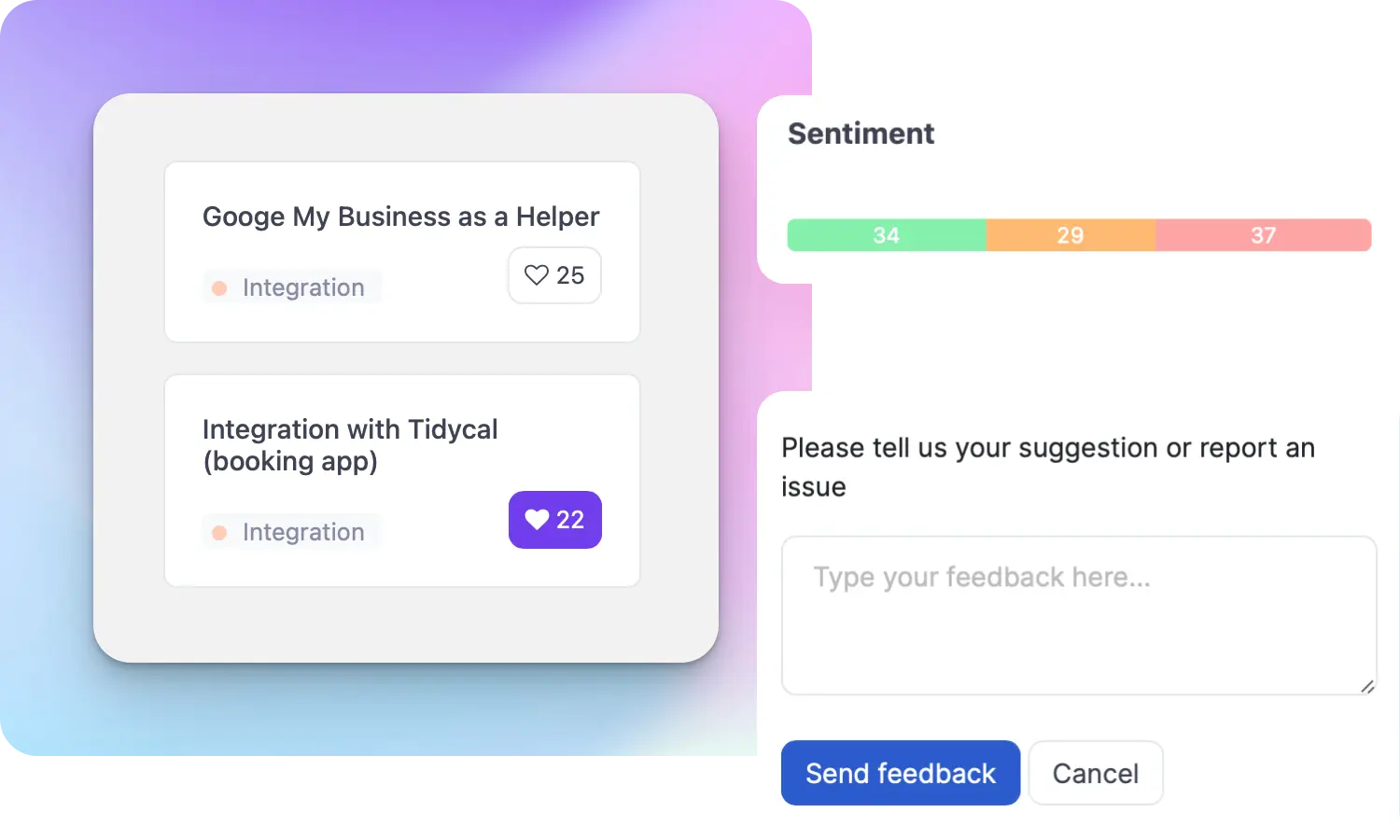
Feature voting is a system where customers submit feature requests and vote on ideas from other users. The most popular requests rise to the top, giving product teams a signal of demand.
A typical feature voting setup includes:
Tools like ProductLift, Canny, and Nolt provide dedicated voting boards. Some teams build their own using spreadsheets or GitHub issues. Purpose-built tools save significant time and provide better analytics.
Without structured feedback, product decisions rely on:
Feature voting replaces gut feelings with data. When 200 customers vote for the same feature, that's a signal you can't get from a single support conversation.
Public boards are visible to anyone. Private boards require authentication.
Use public boards when:
Use private boards when:
Many teams use both. A public board for general feature requests and a private board for enterprise clients who need discretion. ProductLift supports both public and private boards with SSO integration. Authenticated users see a different experience than anonymous visitors.
Raw vote counts are misleading. A feature requested by 50 free-tier users shouldn't automatically outrank one requested by 3 enterprise customers paying $10K/month each.
MRR-weighted voting assigns more influence to higher-value customers. If a $500/month customer votes, that carries more weight than a $10/month customer.
To implement this:
This doesn't mean you ignore smaller customers. It means you have full context when making decisions.
The most-voted feature isn't always the most important one. Popularity bias happens when:
To counter this:
A cluttered board with 500+ open requests is overwhelming for voters and useless for your team. Maintain your board regularly:
The fastest way to kill engagement on your feedback board is silence. When users vote and hear nothing back, they stop participating.
Set clear statuses for every request:
The real magic happens when you notify voters at each stage. When someone votes on "Dark mode" and 3 months later gets an email saying "Dark mode is now live," that builds deep loyalty. They feel heard.
ProductLift's journey model handles this automatically. When a post moves from feedback to roadmap to changelog, every voter gets notified. No manual work required.
Collecting feedback is only half the job. The other half is telling customers what you did with their input.
When you ship a feature that was requested:
This "close the loop" approach turns passive voters into active advocates. They share your changelog with their teams, tweet about features they requested, and keep coming back to vote on more ideas.
Feature voting is an input to your product strategy, not the strategy itself. You still need a product vision, and sometimes that means building things nobody asked for.
No customer voted for the iPhone. No user requested stories on Instagram. Sometimes the best product decisions are ones your users couldn't have imagined.
Use voting data as one signal alongside:
A good rule of thumb: let customer votes influence 40-60% of your roadmap. Reserve the rest for strategic bets and technical improvements.
Every barrier you add between a user and a vote reduces participation:
Not all feedback is equal, and not just because of revenue. Different customer segments have fundamentally different needs:
Segment your feedback data to spot patterns. If every enterprise prospect asks for SSO but your free users never mention it, that tells you SSO is a growth unlock, not just a nice-to-have.
Set a recurring meeting (weekly or biweekly) to review feedback data as a team. During this review:
This prevents the common failure mode where feedback boards become write-only databases that nobody checks.
If you don't have a feedback board yet, here's a simple path:
Within a month, you'll have a data-driven view of what your customers actually want.
Building everything that gets votes. You'll burn out your team and lose strategic focus. Votes inform priorities. They don't set them.
Ignoring low-vote requests from high-value customers. A feature requested by your top 3 accounts can have only 3 votes but represent 40% of your MRR.
Never saying no. If you leave every request as "Under Review" forever, users lose trust. It's better to decline with a clear explanation than to leave people hanging. Here's our guide on how to say no to feature requests gracefully.
Treating all voters equally. A churned user's vote tells you something different from an active user's vote. Context matters.
Running voting without a roadmap. If you collect feedback but never show what's planned, users feel like they're shouting into a void. Pair your feedback board with a public roadmap.
Feature voting lets customers submit ideas and upvote requests from other users. The most popular requests rise to the top, giving your product team a clear signal of demand. Your team then reviews, prioritizes, and communicates status updates back to voters.
Allowing anonymous voting lowers the barrier to participation and increases the volume of feedback you receive. However, anonymous votes can't be weighted by revenue or segmented by customer type. A good middle ground is to allow anonymous submissions but encourage sign-in for vote tracking.
Connect your feedback tool to your billing system. ProductLift integrates with Stripe to automatically weight each vote by the customer's MRR. This way, a vote from a $500/month account carries more influence than one from a $10/month account.
Limit voting to authenticated users to prevent duplicate votes. Use email verification and SSO to tie votes to real accounts. Also focus on vote velocity (votes per week) rather than total count, which reduces the impact of vote manipulation campaigns.
Dedicated tools like ProductLift, Canny, and Nolt offer voting boards with prioritization, status tracking, and notifications. ProductLift also includes MRR-weighted voting via Stripe integration, built-in prioritization frameworks, and automatic voter notifications.
Review your voting data weekly or biweekly as a team. Look at vote velocity on new requests, check alignment with quarterly goals, and identify quick wins. A regular cadence prevents your feedback board from becoming a backlog that nobody checks.
Feature voting works best when you treat it as a conversation, not a suggestion box. Collect votes, weight them by revenue impact, communicate status changes, and close the loop when you ship.
The teams that get the most value from feature voting share three traits: they review feedback regularly, they connect it to revenue data, and they're transparent about what they're building and why.
Ready to set up feature voting for your product? Start your free trial with ProductLift and have your feedback board running in under 10 minutes.
Join over 3,051 product managers and see how easy it is to build products people love.





Did you know 80% of software features are rarely or never used? That's a lot of wasted effort.
SaaS software companies spend billions on unused features. In 2025, it was $29.5 billion.
We saw this problem and decided to do something about it. Product teams needed a better way to decide what to build.
That's why we created ProductLift - to put all feedback in one place, helping teams easily see what features matter most.
In the last five years, we've helped over 3,051 product teams (like yours) double feature adoption and halve the costs. I'd love for you to give it a try.

Founder & Digital Consultant
Learn when to promote feature requests to your roadmap, how to merge duplicates, notify voters, and keep credibility through the full lifecycle.
Learn 7 tactful ways to decline feature requests while keeping customers engaged. Includes response templates and expectation management tips.
Learn how to prioritize feature requests using RICE, ICE, MoSCoW, and Impact-Effort. Combine scoring models with revenue data to build what matters.
Learn how to distinguish bugs from feature requests, handle grey areas, and classify edge cases. Includes a decision framework and communication tips.
Copy these 5 proven feature request templates for any team size. From basic forms to enterprise formats, find the right structure for product feedback.
With bike energy  from Utrecht
KVK: 20145923 - BTW: NL001143413B86