Looking for a MoSCoW prioritization template? We've created a simple MoSCoW spreadsheet in Excel that you can download and use right away:
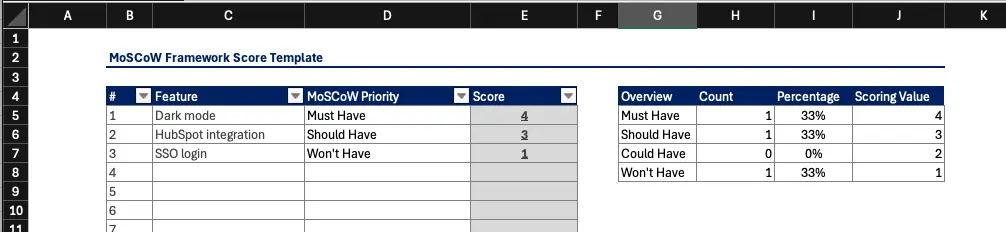
👉 Download MoSCoW Prioritization Template
🚀 Use MoSCoW in ProductLift. Visual categorization, team alignment, and roadmap generation
MoSCoW is a prioritization framework (also called MoSCoW analysis) that helps product managers and teams classify features or initiatives into four categories:
By organizing features into these categories, MoSCoW helps teams prioritize effectively and focus on what's essential for success.
For a more detailed explanation of MoSCoW prioritization, check out: Understanding MoSCoW Prioritization
Our Excel-based MoSCoW prioritization template is designed to be:
Here's a simple MoSCoW method example for a project management tool:
| Category | Feature |
|---|---|
| Must Have | User login, Task creation, Due dates |
| Should Have | Email notifications, Team assignments |
| Could Have | Calendar view, Dark mode |
| Won't Have | AI suggestions (future release) |
This MoSCoW prioritization example shows how to categorize features based on business requirements.
MoSCoW prioritization can help you:
The MoSCoW model provides a simple rating scale for feature prioritization without complex scoring.
Whether you're working on a new product or refining an existing one, the MoSCoW prioritization template will help you manage feature prioritization more efficiently.
Looking for other formats? Try a Miro MoSCoW template for collaborative workshops, or explore our other prioritization frameworks.
Join over 3,051 product managers and see how easy it is to build products people love.





Did you know 80% of software features are rarely or never used? That's a lot of wasted effort.
SaaS software companies spend billions on unused features. In 2025, it was $29.5 billion.
We saw this problem and decided to do something about it. Product teams needed a better way to decide what to build.
That's why we created ProductLift - to put all feedback in one place, helping teams easily see what features matter most.
In the last five years, we've helped over 3,051 product teams (like yours) double feature adoption and halve the costs. I'd love for you to give it a try.

Founder & Digital Consultant
See how real product teams use RICE, ICE, MoSCoW, and other prioritization frameworks. 6 practical examples with actual scores, decisions, and outcomes.
A practical decision guide for choosing the right product prioritization framework. Answer 4 questions to find the best framework for your team size, data, and decision type.
Side-by-side comparison of 10 product prioritization frameworks. Compare RICE, ICE, MoSCoW, Kano, and others on scoring type, complexity, data needs, and best use cases.
The best prioritization frameworks for startups at every stage. From pre-PMF to growth, learn which framework fits your team size, data, and speed requirements.
Learn when to promote feature requests to your roadmap, how to merge duplicates, notify voters, and keep credibility through the full lifecycle.
With bike energy  from Utrecht
KVK: 20145923 - BTW: NL001143413B86