Looking for an ICE prioritization template? We've created a simple ICE framework spreadsheet in Excel that you can download and use right away:
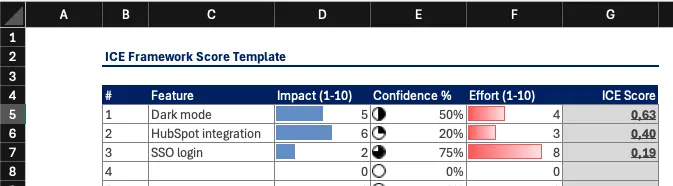
👉 Download ICE Prioritization Template
🚀 Use ICE in ProductLift. Automatic scoring, team collaboration, and roadmap generation
ICE is a prioritization framework (also called the ICE scoring model or ICE matrix) that stands for Impact, Confidence, and Ease. It helps product managers and teams evaluate initiatives based on these three straightforward factors:
These three ICE criteria help teams make objective decisions quickly. By multiplying these factors, the ICE score provides an easy-to-understand way to prioritize tasks, ensuring that teams focus on initiatives with the highest potential.
For a deeper dive into the ICE prioritization method, check out: Understanding ICE Prioritization
Our Excel-based ICE prioritization template is designed to be:
For quick calculations without downloading the Excel file, try this free online ICE prioritization tool: ICE Calculator. This ICE scoring system lets you calculate scores instantly.
The ICE framework for prioritization allows you to:
Whether you're managing a product team or working solo, the ICE prioritization template helps you focus on what matters most.
Looking for more prioritization framework templates? Check out these alternatives:
All our prioritization templates are free to download and use.
Join over 3,051 product managers and see how easy it is to build products people love.





Did you know 80% of software features are rarely or never used? That's a lot of wasted effort.
SaaS software companies spend billions on unused features. In 2025, it was $29.5 billion.
We saw this problem and decided to do something about it. Product teams needed a better way to decide what to build.
That's why we created ProductLift - to put all feedback in one place, helping teams easily see what features matter most.
In the last five years, we've helped over 3,051 product teams (like yours) double feature adoption and halve the costs. I'd love for you to give it a try.

Founder & Digital Consultant
See how real product teams use RICE, ICE, MoSCoW, and other prioritization frameworks. 6 practical examples with actual scores, decisions, and outcomes.
A practical decision guide for choosing the right product prioritization framework. Answer 4 questions to find the best framework for your team size, data, and decision type.
Side-by-side comparison of 10 product prioritization frameworks. Compare RICE, ICE, MoSCoW, Kano, and others on scoring type, complexity, data needs, and best use cases.
The best prioritization frameworks for startups at every stage. From pre-PMF to growth, learn which framework fits your team size, data, and speed requirements.
Learn when to promote feature requests to your roadmap, how to merge duplicates, notify voters, and keep credibility through the full lifecycle.
With bike energy  from Utrecht
KVK: 20145923 - BTW: NL001143413B86