Email, Slack, sales calls, support tickets, GitHub issues. Requests scatter across your team and the priority list dies in a spreadsheet. ProductLift is the single source of truth: capture every request, deduplicate the noise, and hand a clean backlog to engineering.
Before
With ProductLift
Feature request tracking is the practice of capturing every request for a product change in one system, deduplicating the noise, prioritizing based on evidence, and closing the loop with the requester when the work ships. Done well, it turns a scattered mess of Slack messages and support tickets into an ordered backlog engineering can actually work from.
The failure mode most teams live with is fragmentation. Sales hears feature-gap objections on discovery calls. Support tags recurring pain in tickets. Engineering flags technical debt in retros. Executives forward customer emails to product managers. Each of these sources feels legitimate in isolation. Together they form five parallel priority lists that never reconcile, and the product manager sits at the center trying to remember what came from where.
A working feature request tracking system solves this at the intake layer. Every request lands in the same board regardless of source. The public-facing board captures requests from customers directly. Integrations forward requests from support tools and Slack. Sales and support reps submit on behalf of customers when the request came in on a call. The board becomes the one place a product manager looks when a stakeholder asks "do we track that?".
Deduplication is what separates a request tracker from a dumping ground. Without it, the same request gets logged six times by six people and each copy has one voter. With merging, those six copies become one request with six votes and six pieces of context. Priority reflects actual demand instead of accidental duplication, and the requester on each of the six original submissions still gets notified when the work ships.
The last piece is dev handoff. A backlog that never leaves the request tool is a shadow backlog. ProductLift pushes prioritized requests into engineering issue trackers like Jira so engineering plans against one source of truth, and the feedback loop closes with an automatic changelog notification when the ticket ships.
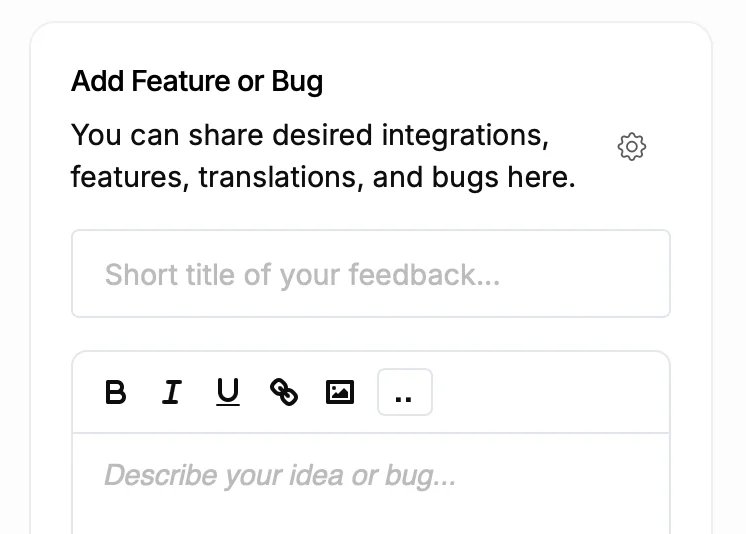
Customers submit requests directly on your board and vote on existing ones. New requests show source, requester, and timestamp so you know where every idea came from.
Sales and support reps submit requests on behalf of customers when a request came in on a call or ticket. Every internal submission carries context on deal size or account value.
Merge duplicate requests into one canonical entry. Votes combine, comments consolidate, and every original submitter stays in the notification loop when the work ships.
Score each request with Reach, Impact, Confidence, Effort or your framework of choice. Scores persist between planning sessions so the priority order is auditable, not remembered.
Prioritized requests flow into your public and internal roadmap, and the Jira integration syncs approved items into engineering tickets. One source of truth from request to ship.
Publish a changelog entry when the ticket closes and every voter on the original request gets notified. The customer who asked eighteen months ago finds out first.
6,035
Teams using ProductLift
157,624
Ideas collected
39,406
Features shipped
Sebastian F.
Entrepreneur
Aaron Dye
Timothy M.
Product Manager
Ben
Product Owner
Marco
Chris R.
Founder
Explore more ways to capture, prioritize, and ship the right features
Let customers vote on requests directly. Combine votes with RICE scoring for a defensible priority list.
See Feature VotingCompare ProductLift with Canny, Nolt, Frill, and others on price and features across the feature-request category.
Compare ToolsScore requests with Reach, Impact, Confidence, and Effort. Turn a raw request queue into a ranked backlog.
Learn RICESee how ProductLift stacks up against Upvoty on request-tracking depth, integrations, and price.
Compare Upvoty AlternativesJoin 6,035 teams using ProductLift to capture, prioritize, and ship the features that matter