14 Best Feature Request Tools for SaaS in 2026
 Ruben Buijs
April 2026 15 min read
Ruben Buijs
April 2026 15 min read TL;DR
The best feature request tool for most SaaS teams in 2026 is ProductLift (from $19/mo), the only tool where requests automatically become roadmap items and notify voters when shipped. Prices range from free (Fider, self-hosted) to $1,333/mo (UserVoice, enterprise). The key trend this year is the shift from simple voting boards to full-journey tools that connect feature requests to roadmap and changelog in one workflow.
Comparison Table
| Tool | Best For | Starting Price | G2 Rating |
|---|---|---|---|
| ProductLift | Request → Roadmap → Ship workflow | From $19/mo | 5.0/5 |
| Canny | Public voting board | Free (25 users) | 4.6/5 |
| Productboard | Advanced customer research | Free (Starter) | 4.3/5 |
| FeatureBase | Modern all-in-one | Free tier | 4.9/5 |
| Aha! | Enterprise feature requests | $39/user/mo | 4.3/5 |
| UserVoice | Enterprise legacy | $1,333/mo | 2.8/5 (Trustpilot) |
| Frill | Budget-friendly option | $25/mo | 4.7/5 |
| Nolt | Simple and beautiful | $25/mo | 5.0/5 |
| Upvoty | Affordable with anonymous voting | $25/mo | 4.6/5 |
| Fider | Open source, self-hosted | Free | 3K+ GitHub stars |
| FeedBear | Solid core features | $49/mo | 4.8/5 |
| Sleekplan | Satisfaction surveys built-in | $13/mo | 4.7/5 |
| Feature Upvote | Minimalist approach | $29/mo | 4.8/5 |
| Trello/Notion | DIY feature requests | Free | 4.4-4.7/5 |
Tools Covered
Why This Comparison is Different
Most feature request tool comparisons focus on features. This guide focuses on workflow, because the real question for SaaS teams is: "What happens after customers vote?"
What makes this guide useful for SaaS teams:
- Voting → Roadmap → Shipped workflow – Which tools connect the entire journey (not just collect votes)
- Auto-notify voters – Do customers get notified when you ship their request?
- Anonymous voting – Can customers vote without creating an account? (Critical for participation)
- Real pricing at scale – What happens when you go from 100 to 1,000 voters?
- Prioritization frameworks – RICE, ICE, MoSCoW scoring or just vote counts?
Why SaaS Teams Need Different Feature Request Tools
SaaS feature request management is fundamentally different from traditional product feedback:
1. Requests Should Automatically Become Roadmap Items
In traditional tools, feature requests live in a separate "ideas" bucket:
- Customer submits request → Gets 200 votes → Sits in backlog forever
- You decide to build it → Manually create roadmap item
- You ship it → Manually email everyone who voted (or forget)
Modern SaaS workflow (ProductLift's journey model):
- Customer submits request → Gets 200 votes → Automatically appears on roadmap
- You mark it "In Progress" → All 200 voters get notified
- You ship it → Changelog created → All 200 voters notified automatically
Same item, same votes, complete history. No manual syncing between tools.
2. Anonymous Voting Drives 3-10x More Participation
Most feature request tools require account creation to vote. This kills participation:
- With login required: 5-10% of visitors vote (high friction)
- With anonymous voting: 30-50% vote (one-click, no barriers)
Tools with anonymous voting: ProductLift, Upvoty. Most others require login: Canny, Productboard, Aha!, UserVoice.
3. Prioritization Should Use Data, Not Just Votes
Vote count alone is misleading. 200 votes from free users ≠ 20 votes from enterprise customers:
- Vote-only prioritization: Build what's most popular (often the wrong thing)
- RICE/ICE scoring: Reach × Impact × Confidence / Effort
- Revenue-weighted: Enterprise customer vote = 10x free user vote
- Segment-based: Filter by plan type, industry, user cohort
Tools with advanced prioritization: ProductLift (RICE/ICE/MoSCoW + Stripe MRR weighting), Productboard (custom scoring), Aha! (strategic alignment). Tools with vote-only: Canny, Nolt, Frill.
4. Feature Requests Shouldn't Live in Email/Slack Chaos
SaaS teams get feature requests from 5+ channels:
- Support tickets (Zendesk, Intercom)
- Sales calls (Salesforce notes)
- Slack messages ("Can we add X?")
- Email ([email protected])
- Social media (Twitter replies)
Without a feature request tool, you're tracking this in spreadsheets (or worse, not tracking it). You need:
- Central repository: One place for all requests, regardless of source
- Duplicate detection: AI merges "Add SSO" with "We need SAML login"
- Vote on behalf: Add customer votes from sales calls/support tickets
Bottom line: Generic feedback tools treat requests as static. SaaS teams need requests that travel through a journey (Requested → Planned → In Progress → Shipped) with automatic notifications at each stage. For practical tips, see our guide to prioritizing feature requests and our feature request template.
Quick Picks by Use Case
🏆 Best All-in-One (Requests + Roadmap + Changelog): ProductLift – Journey model where requests become roadmap items automatically. From $19/mo.
📊 Best for Advanced Prioritization: Productboard – Custom scoring, customer research, strategic alignment. $59+/maker/mo.
🎯 Best Public Voting Board: Canny – Clean interface, GitHub integration. Free (25 users) or $19+/mo.
💰 Best Budget Option: Frill or Upvoty – Both $25/mo flat with core features.
⚡ Best Anonymous Voting: ProductLift or Upvoty – No login required to vote.
🔓 Best Open Source: Fider – Free, self-hosted, full control.
💼 Best for Enterprise: UserVoice or Aha! – Enterprise features, expensive ($1,333+/mo).
🚀 Best Workflow (Request → Roadmap → Ship): ProductLift – Only tool with automatic journey model.
What SaaS Teams Should Look For
✅ Must-Have Features
- Public voting board – Customers can see, vote, comment on requests
- Easy submission – Customers can submit requests without friction
- Duplicate detection – AI or manual merging of similar requests
- Status tracking – Planned/In Progress/Shipped workflow
- Admin management – Mark requests as duplicate, spam, or merge
🚀 SaaS-Specific Features
- Anonymous voting – Vote without account (drives 3-10x more participation)
- Roadmap integration – Requests automatically become roadmap items
- Auto-notify voters – Email voters when status changes or shipped
- Vote on behalf – Add customer votes from sales calls/support tickets
- Changelog connection – Ship feature → Link to original request → Notify voters
📊 Prioritization Capabilities
- Vote count: Simple popularity contest (everyone has this)
- RICE/ICE scoring: Frameworks that balance impact vs effort
- Revenue weighting: Weight votes by MRR/LTV (enterprise vote = 10x free user)
- Segment filtering: See what Enterprise vs Starter plan customers want
- Internal scoring: Team can add effort/impact scores invisible to customers
⚡ Integration & Workflow
- Dev tool sync: Push requests to Jira/Linear/GitHub as tickets
- Support tool integration: Intercom, Zendesk, Help Scout
- Stripe integration: Auto-fetch customer MRR/plan for prioritization
- Slack notifications: Team gets notified of new high-priority requests
- API & webhooks: Automate workflows, custom integrations
1. ProductLift – Best Request → Roadmap → Ship Workflow
⭐ G2 Rating: 5.0/5 | 💰 Starting Price: From $19/mo (unlimited requests)
Best for: SaaS teams who want feature requests to automatically become roadmap items and notify voters when shipped
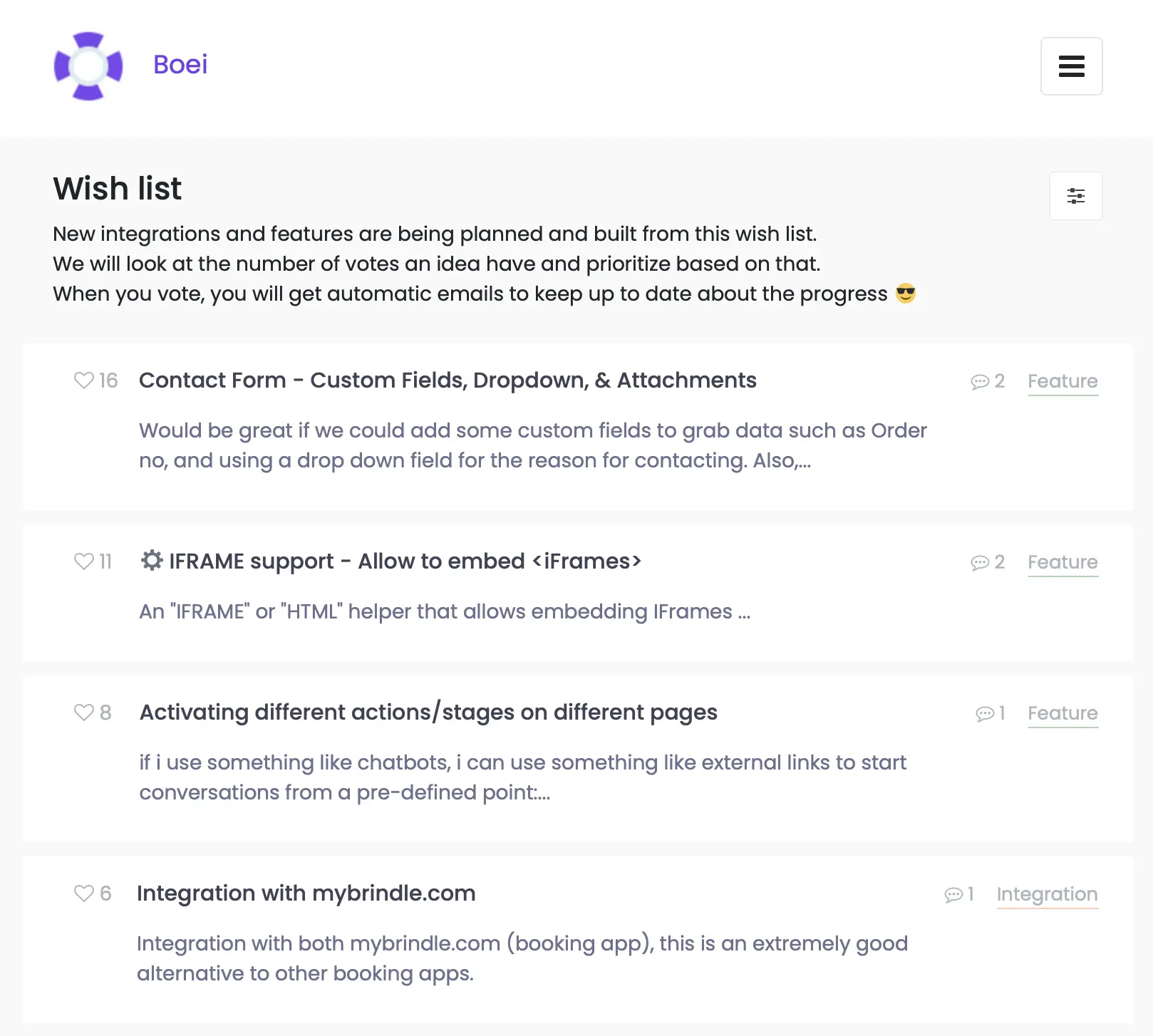
What ProductLift Does Well
- Journey model: Feature request → Roadmap item → Changelog entry. Same item, complete history.
- Anonymous voting: Customers vote with one click (no login required)
- Auto-notify voters: Ship feature → All voters get email automatically
- Prioritization frameworks: RICE, ICE, MoSCoW, Impact-Effort scoring built-in
- Stripe integration: Auto-weight votes by customer MRR (enterprise customer = higher priority)
- Vote on behalf: Add customer votes from support tickets or sales calls
- Duplicate detection: AI suggests similar requests to merge
- Internal comments: Team discusses requests privately
- 28 languages: International customers can submit/vote in their language
- Tiered pricing: from $19/mo, unlimited customer votes
The Workflow That Closes the Loop
Traditional feature request workflow (separate tools):
- Customer submits feature request → Canny/UserVoice ($80-200/mo)
- Gets 200 votes → You manually create roadmap item in Productboard ($200-500/mo)
- You ship it → Manually create changelog in Beamer ($50-100/mo)
- Manually email voters (or use Canny's clunky notification)
Cost: $330-800/mo. Time: 20-30 minutes per shipped feature.
ProductLift workflow:
- Customer submits request → Automatically votable on feedback board
- Gets 200 votes → Already on your roadmap (same item)
- Mark as Shipped → Changelog auto-created → 200 voters auto-notified
Cost: from $19/mo. Time: 30 seconds.
Where ProductLift Falls Short
- Simpler than Productboard: No customer research portal or objectives linking
- No Zapier yet: Roadmap feature, but not available today
- No GitHub integration: Has Jira/Azure DevOps, but not GitHub
- No Intercom integration: Can't pull requests from Intercom conversations
Pricing
- Starter $19/mo, Pro $49/mo, Business $129/mo – Unlimited feature requests, unlimited end-users
- Includes roadmap, changelog, KB. No add-ons
- 14-day free trial, no credit card required
Who should use ProductLift: SaaS teams who ship weekly and want requests → roadmap → shipped workflow automated.
Who should look elsewhere: Teams needing Intercom/GitHub integration, or enterprises needing advanced customer research portal.
Want to See It in Action?
2. Canny – Best Public Voting Board
⭐ G2 Rating: 4.6/5 | 💰 Starting Price: Free (25 tracked users), then $19/mo (Core)
Best for: Early-stage SaaS (<25 tracked users) with GitHub-centric workflow
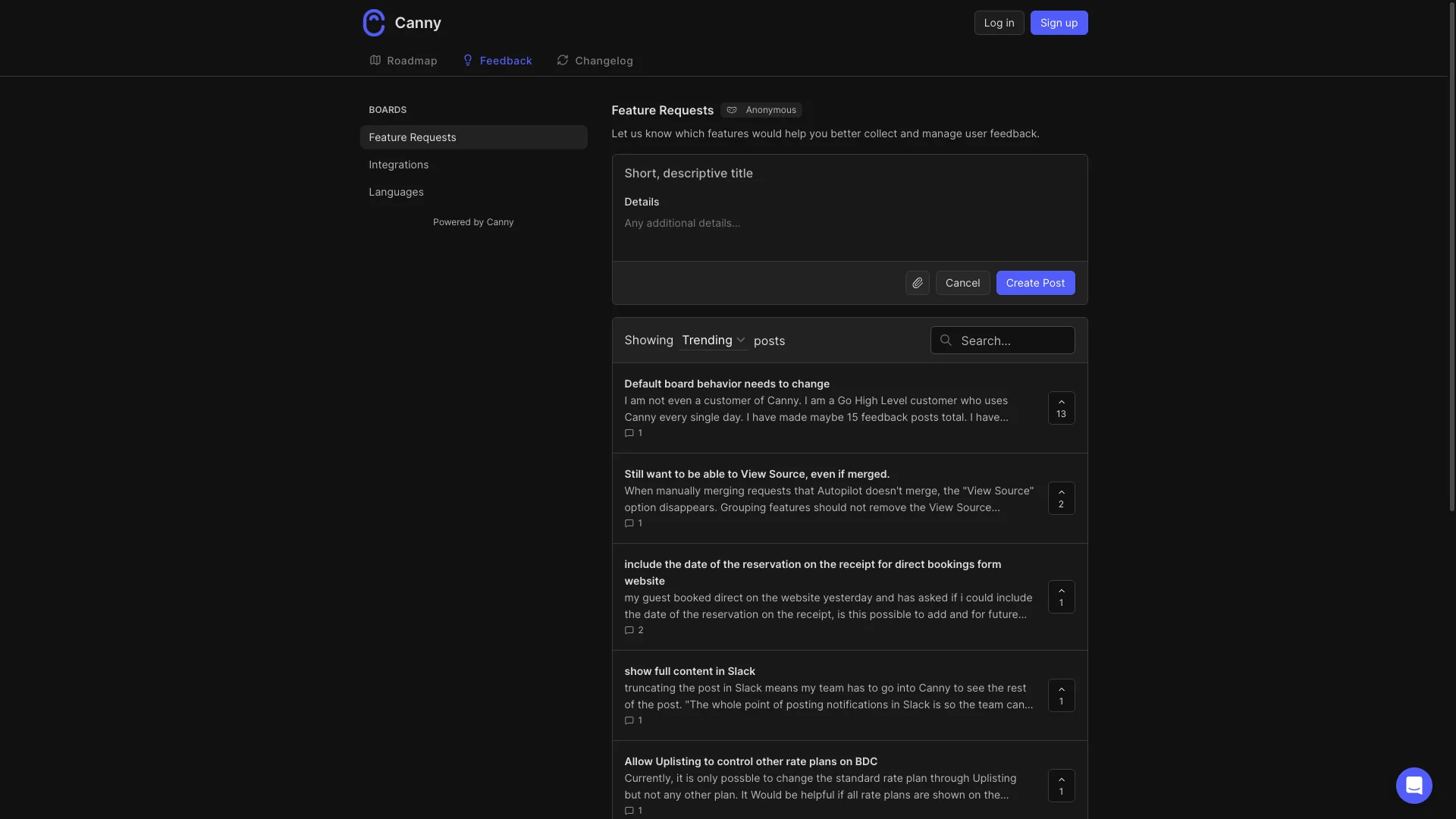
What Canny Does Well
- Clean public boards: Beautiful, customer-facing voting interface
- GitHub integration: Best-in-class sync with GitHub issues
- Intercom integration: Collect requests from support conversations
- Roadmap included: Move requests to roadmap, show customers what's coming
- Changelog included: Announce shipped features
- AI features: Auto-categorize requests, detect duplicates
- Vote on behalf: Add votes from sales calls/support
Why SaaS Teams Choose Canny
Early-stage SaaS teams choose Canny for:
- Free plan: 25 tracked users is enough for the earliest-stage startups
- GitHub-native workflow: If you live in GitHub, Canny's integration is unmatched
- Simple setup: Public voting board running in 30 minutes
- Modern UI: Customers love the clean design
The Tracked User Pricing Trap
Canny's pricing page shows $19/mo (Core) and $79/mo (Pro), but those are the starting prices for ~100 tracked users only. The cost scales with your user count:
- Free: 25 tracked users
- 200 users: $49/mo Core, $129/mo Pro
- 700 users: $175/mo Core, $379/mo Pro
- 1,250 users: $275/mo Core, $579/mo Pro
- 2,500 users: $399/mo Core, $829/mo Pro
That's a 21x price increase on Core from the advertised $19/mo as you grow. Many SaaS companies hit this wall and switch to flat-pricing tools.
Why SaaS Teams Leave Canny
- Pricing anxiety: Growth = higher bills. Teams fear adding customers to platform
- No anonymous voting: Customers must create account (reduces participation 3-10x)
- English-only: No localization (dealbreaker for international SaaS)
- No prioritization frameworks: Just vote count sorting, no RICE/ICE
- Manual workflow: Requests don't auto-become roadmap items
What Users Say
"Canny looked cheap at $79/mo but at 700 users we were paying $379/mo. Switched to ProductLift—a fraction of the cost with all features included." – SaaS Founder
Who should use Canny: Early-stage SaaS (<25 tracked users) with GitHub workflow serving English-only markets.
Who should look elsewhere: Growing SaaS, international products, teams needing predictable pricing or anonymous voting.
3. Productboard – Best for Advanced Customer Research
⭐ G2 Rating: 4.3/5 | 💰 Starting Price: Free (Starter), $19/maker/mo (Essentials), $59/maker/mo (Pro)
Best for: SaaS product teams ($1M+ ARR) who need customer research workflows beyond simple voting
What Productboard Does Well
- Insights portal: Aggregate requests from support, sales, research, social media
- Custom prioritization: Build your own scoring formulas with weighted criteria
- Objectives linking: Connect requests to strategic OKRs (requires Pro)
- Customer segmentation: Filter by plan, industry, revenue, custom segments
- Portal customization: Advanced white-label branding
- Integrations: Deep sync with Jira, Salesforce, Zendesk, Intercom
Why SaaS Teams Choose Productboard
Growth SaaS ($1M-$50M ARR) with dedicated product teams choose Productboard when they need:
- Research at scale: Track 1,000s of feedback pieces, surface insights
- Strategic alignment: Link requests to company OKRs
- Complex prioritization: Custom scoring beyond RICE (add your own criteria)
- Sales/support integration: Pull requests from Salesforce notes, Zendesk tickets
Why SaaS Teams Avoid Productboard
- Expensive: Pro tier ($59/maker) required for objectives. 10-person team = $590/mo
- Steep learning curve: Takes weeks to implement properly
- No changelog: Need separate tool (Beamer, ProductLift, etc.)
- Overkill for simple needs: If you just need voting + roadmap, this is too much
- No anonymous voting: Customers must create account to vote
Pricing Reality
- Starter: Free – Limited features, good for exploring
- Essentials: $19/maker/mo (annual) – Basic only, no objectives or advanced scoring
- Pro: $59/maker/mo (annual) – Most teams need this
- Enterprise: Contact Sales – SSO, advanced security
A 10-maker team pays $590/mo on Pro = $7,080/year.
Who should use Productboard: SaaS product teams at $1M+ ARR with complex customer research needs and budget.
Who should look elsewhere: Early-stage SaaS, teams needing simple voting, or anyone wanting integrated changelog.
4-8. Mid-Tier Feature Request Tools
FeatureBase – Modern All-in-One
💰 Price: Free tier; paid from $29/seat/mo | ⭐ G2: 4.9/5
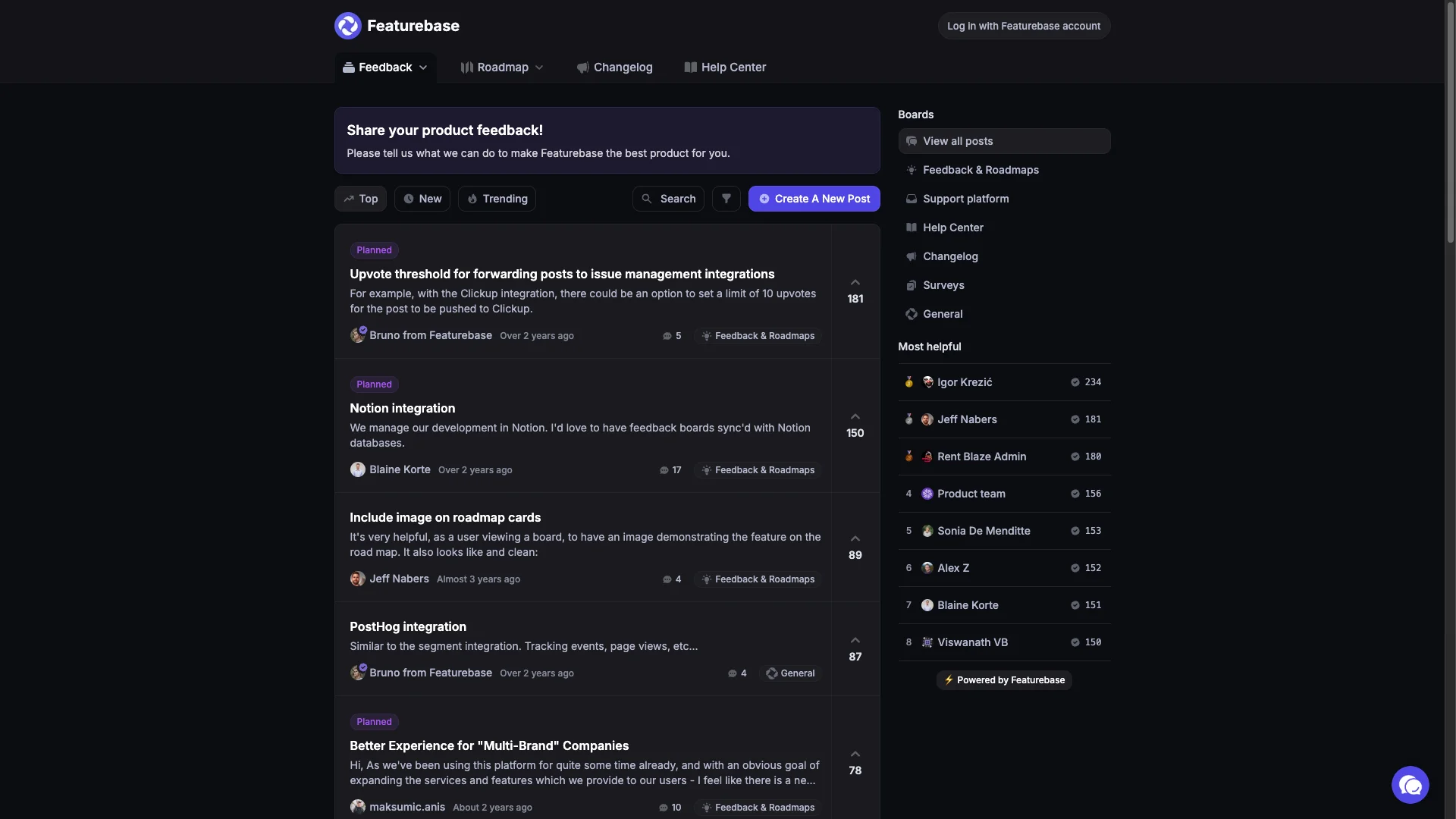
Why SaaS teams choose it: Modern UI with AI features (duplicate detection, content generation). Includes requests, roadmap, changelog, help desk. Growing fast, good free tier.
Why SaaS teams avoid it: Newer player (less proven at scale). Pricing increases at higher tiers. Some features locked behind premium. No anonymous voting.
Aha! Ideas – Enterprise Feature Request Platform
💰 Price: $39/user/mo (Ideas), $59/user/mo (Roadmaps) | ⭐ G2: 4.3/5
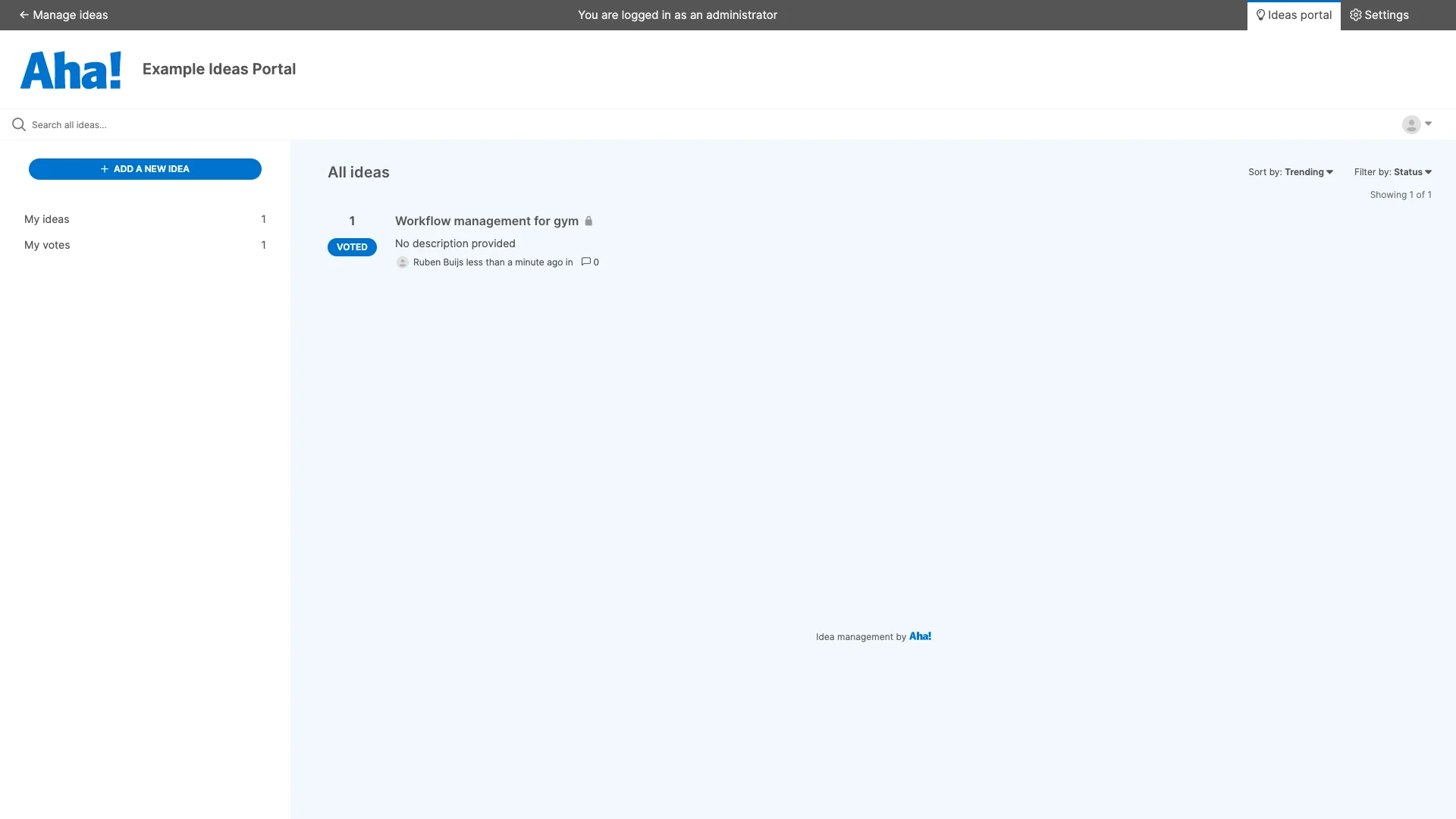
Why SaaS teams choose it: Enterprise SaaS ($10M+ ARR) need Aha!'s complete suite with strategy mapping and goal tracking. Powerful prioritization.
Why SaaS teams avoid it: Steep learning curve ("weeks of training"), dated UI, expensive ($195-295/mo for 5 users), too complex for simple request management.
UserVoice – Enterprise Legacy Player
💰 Price: $1,333/month ($16,000/year) minimum (enterprise only) | ⭐ Trustpilot: 2.8/5 (⚠️)
Why SaaS teams choose it: Enterprise SaaS with compliance needs. Trusted by Fortune 500. Advanced analytics. 30-day free trial available. No per-seat charges.
Why SaaS teams avoid it: Expensive ($1,333-2,000+/mo), sales-driven pricing, long sales cycle just to get quote. Trustpilot 2.8/5 is concerning. No self-serve signup.
Frill – Budget-Friendly Option
💰 Price: $25/mo flat | ⭐ G2: 4.7/5
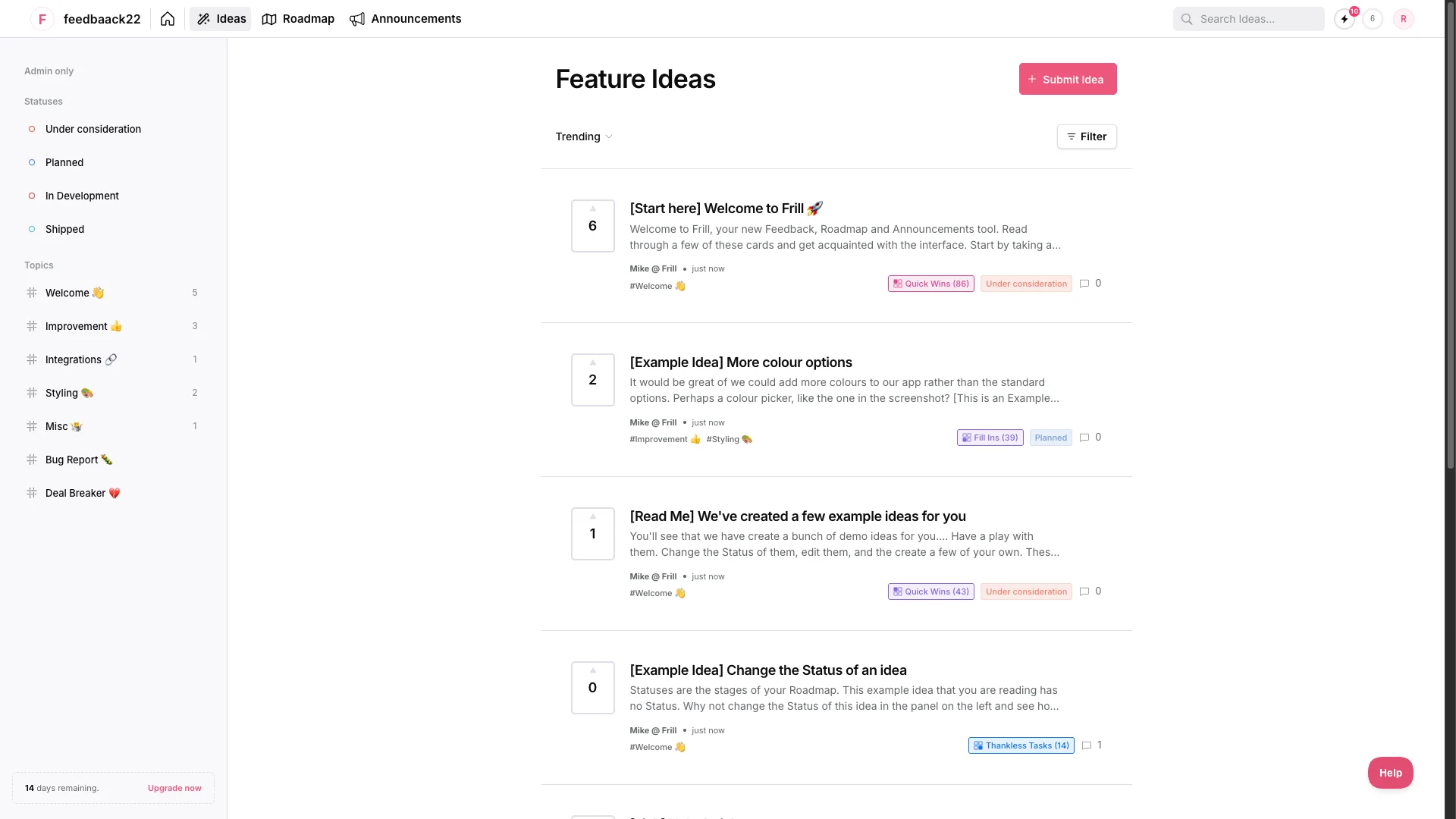
Why SaaS teams choose it: Affordable alternative to Canny. Flat $25/mo (no per-user pricing). Includes requests, roadmap, changelog. GitHub/Jira integration.
Why SaaS teams avoid it: English-only (dealbreaker for international SaaS). No internal comments. No knowledge base. Simpler feature set.
Nolt – Simple & Beautiful
💰 Price: $25/mo flat | ⭐ G2: 5.0/5
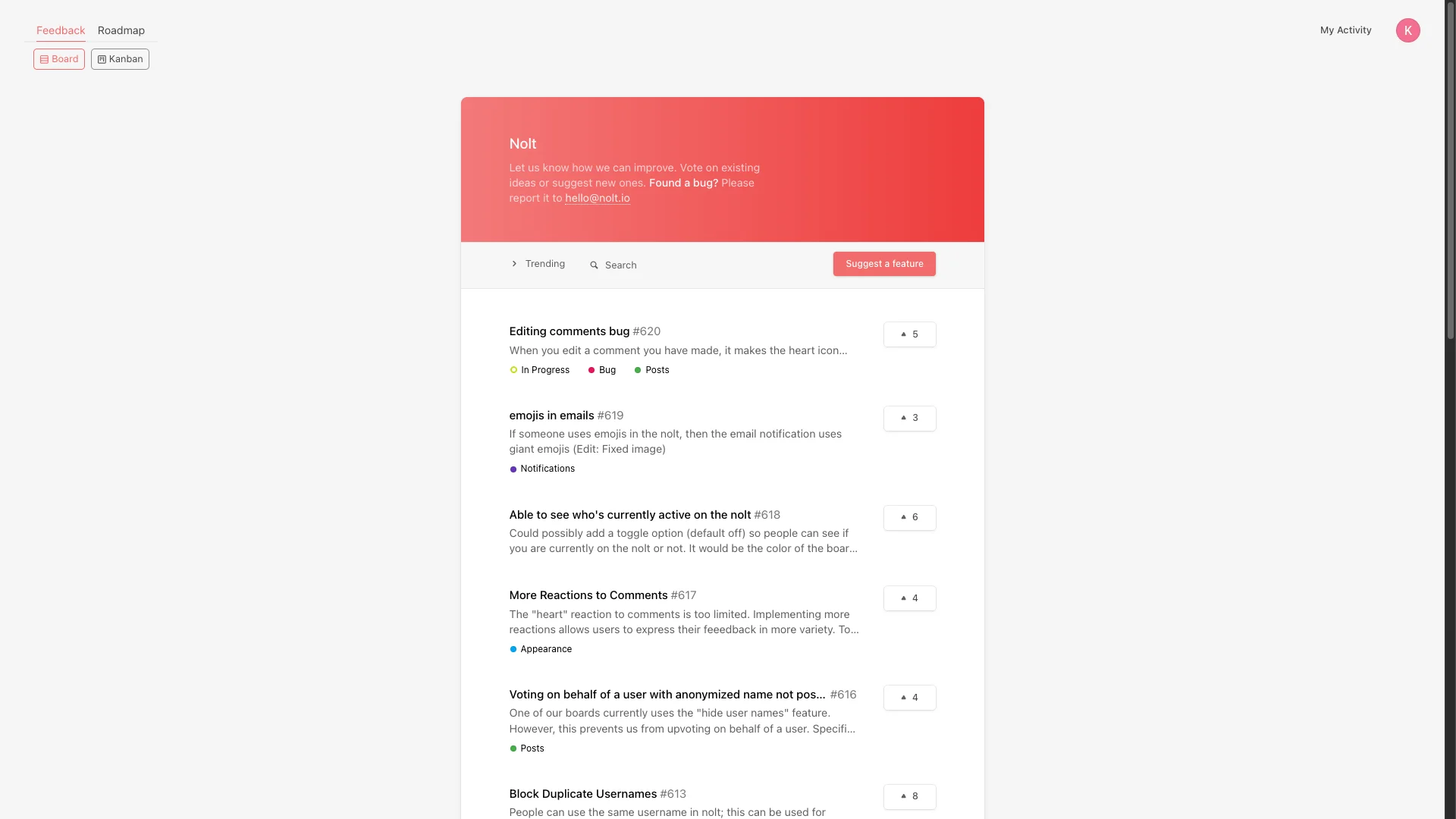
Why SaaS teams choose it: Beautiful UI, simple feature voting. Perfect for tiny SaaS teams who just need basics. $25/mo flat, no complexity.
Why SaaS teams avoid it: Too simple. No API, no Jira, no prioritization scoring, English-only. Teams outgrow it quickly.
9-14. Budget & Specialized Tools
Upvoty – Cheapest Option with Anonymous Voting
💰 Price: $25/mo flat | ⭐ G2: 4.6/5
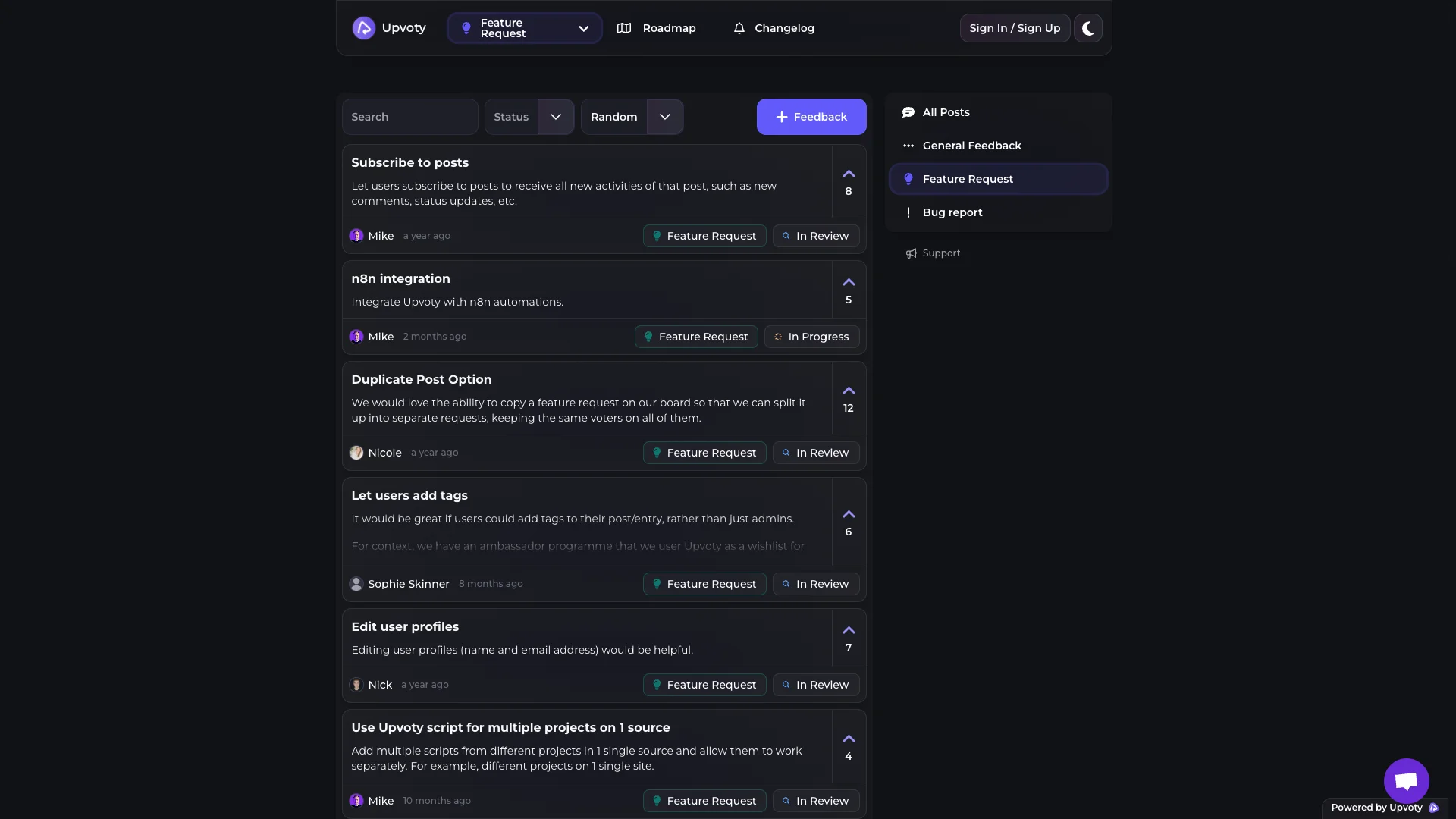
Why SaaS teams choose it: Affordable tool with anonymous voting. $25/mo flat (Power plan). Basic voting + roadmap. Good for bootstrapped startups.
Why SaaS teams avoid it: No AI, no prioritization frameworks, no Jira, no knowledge base, no changelog. Outgrow it fast.
Fider – Best Open Source
💰 Price: Free (self-hosted) | ⭐ GitHub: 3K+ stars
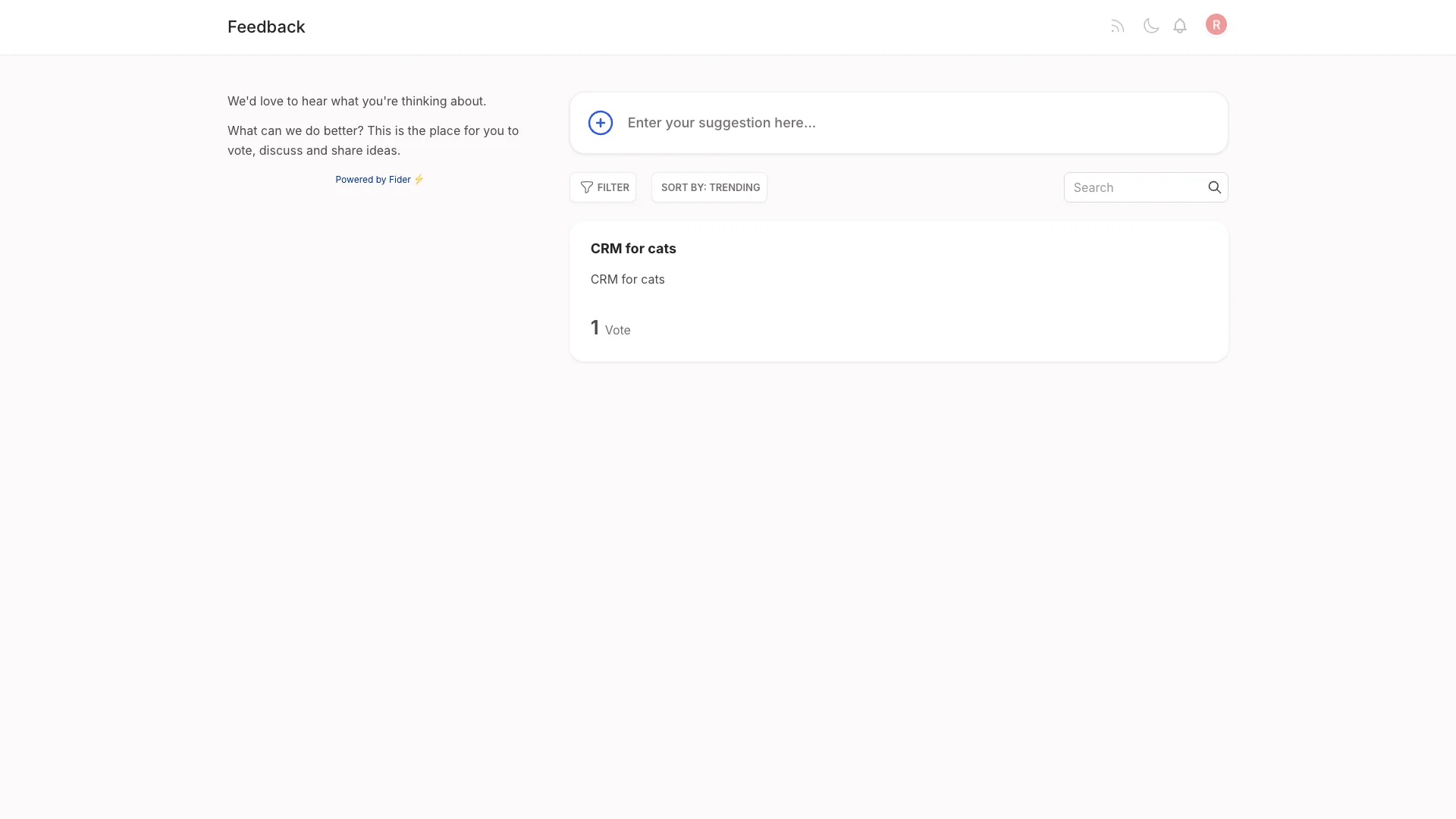
Why SaaS teams choose it: Open source, self-hosted, free. Full control over data. Good for privacy-focused or technical SaaS teams.
Why SaaS teams avoid it: Requires DevOps time (server, backups, security). Basic features (no RICE scoring, no roadmap integration). You're responsible for uptime.
FeedBear – Solid Core Features
💰 Price: $49/mo | ⭐ G2: 4.8/5
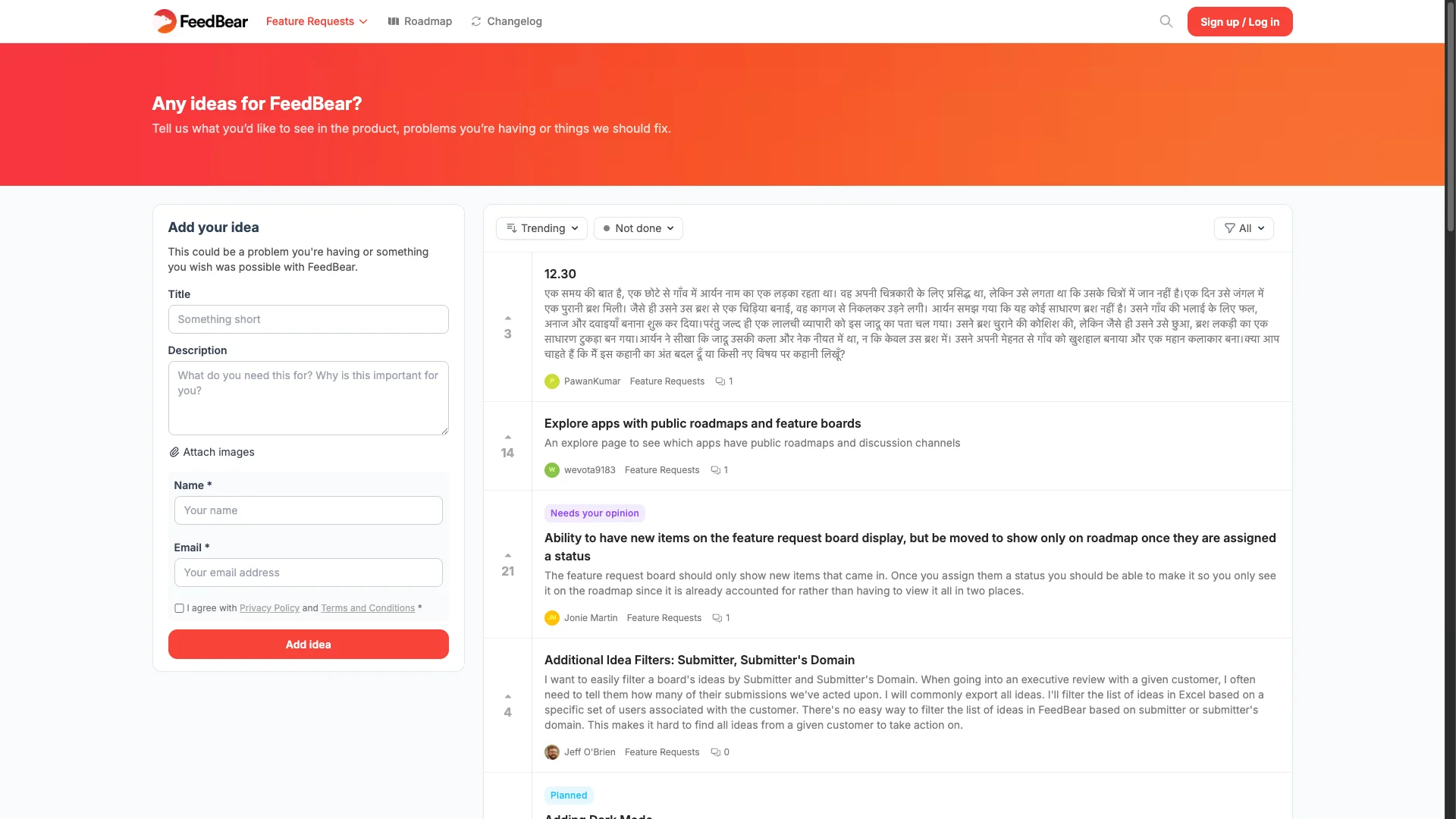
Why SaaS teams choose it: Solid voting + roadmap + changelog. Simple, works well. Good for small SaaS teams.
Why SaaS teams avoid it: Limited integrations. No AI features. No advanced prioritization. No anonymous voting.
Sleekplan – Satisfaction Surveys Built-In
💰 Price: $13/mo | ⭐ G2: 4.7/5
Why SaaS teams choose it: Feature requests + CSAT/NPS surveys in one tool. $13/mo (Starter). Good value.
Why SaaS teams avoid it: No private boards, no AI, no anonymous voting, English-only.
Feature Upvote – Minimalist Approach
💰 Price: $29/mo | ⭐ G2: 4.8/5
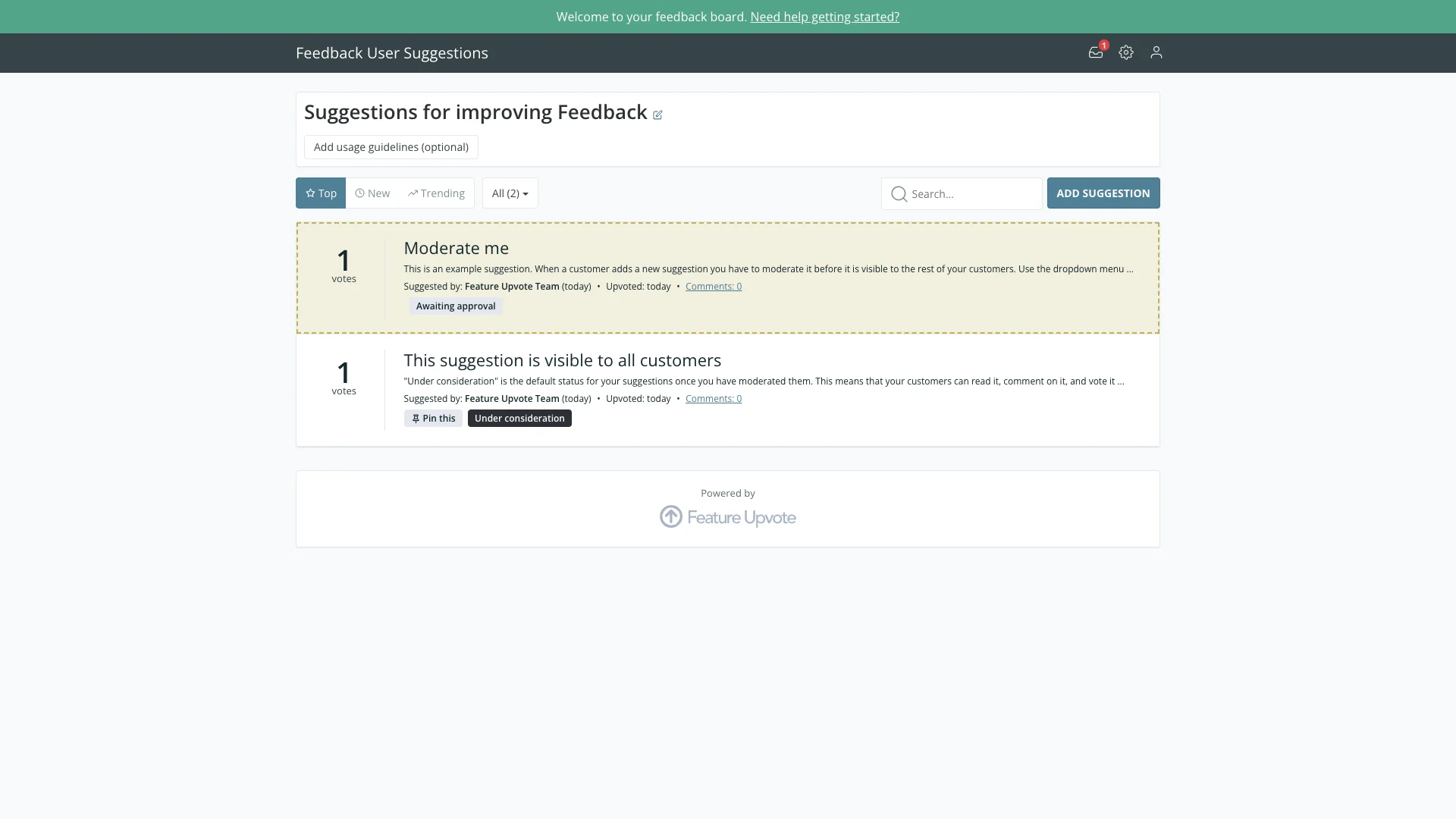
Why SaaS teams choose it: Simple, focused on core voting. No feature bloat. Easy setup.
Why SaaS teams avoid it: Too minimal. No roadmap, no changelog, no integrations. Just voting.
Trello/Notion – DIY Feature Requests
💰 Price: Free-$10/user/mo | ⭐ G2: 4.4-4.7/5
Why SaaS teams use it: Pre-revenue startups create public board using Trello or Notion. $0 cost, full control.
Why SaaS teams outgrow it: Manual everything. No voting, no auto-notifications, no analytics. Works for 2-3 person teams, breaks at scale.
Feature Comparison
| Feature | ProductLift | Canny | Productboard | Frill | Upvoty |
|---|---|---|---|---|---|
| Public Voting | ✅ | ✅ | ✅ | ✅ | ✅ |
| Anonymous Voting | ✅ | ❌ | ❌ | ❌ | ✅ |
| Auto-Notify Voters | ✅ | ⚠️ Manual | ⚠️ Manual | ⚠️ Manual | ❌ |
| Journey Model (Request→Roadmap) | ✅ Auto | ⚠️ Manual | ⚠️ Manual | ⚠️ Manual | ⚠️ Manual |
| Prioritization (RICE/ICE) | ✅ | ❌ | ✅ Advanced | ❌ | ❌ |
| Revenue Weighting (Stripe) | ✅ | ❌ | ⚠️ Manual | ❌ | ❌ |
| Duplicate Detection | ✅ AI | ✅ AI | ⚠️ Manual | ⚠️ Manual | ⚠️ Manual |
| Vote on Behalf | ✅ | ✅ | ✅ | ✅ | ❌ |
| Internal Comments | ✅ | ✅ | ✅ | ❌ | ❌ |
| Changelog Included | ✅ | ✅ | ❌ | ✅ | ❌ |
| Multi-Language | ✅ (22) | ❌ | ❌ | ❌ | ❌ |
| GitHub Integration | ❌ | ✅ Best | ✅ | ✅ | ❌ |
| Jira Integration | ✅ | ✅ | ✅ | ✅ | ❌ |
Pricing Reality
| Tool | 100 Voters | 500 Voters | 1,000 Voters | Pricing Model |
|---|---|---|---|---|
| ProductLift | Starter $19/mo | Pro $49/mo | Business $129/mo | Per tier |
| Canny (Pro) | $79/mo | ~$279/mo | ~$529/mo | Tracked users |
| Productboard (5 makers) | $295/mo | $295/mo | $295/mo | Per maker (Pro) |
| Frill | $25/mo | $25/mo | $25/mo | Flat rate |
| Upvoty | $25/mo | $49/mo | $99/mo | Tiered flat |
| Nolt | $25/mo | $25/mo | $25/mo | Flat rate |
| Aha! (5 users) | $195/mo | $195/mo | $195/mo | Per user (Ideas) |
| UserVoice | $1,333+/mo | $1,333+/mo | $1,333+/mo | Enterprise (no per-seat) |
| Fider | Free* | Free* | Free* | Self-hosted |
*Fider is free software but requires server costs ($10-50/mo) and DevOps time.
Key Insight: Canny's advertised $19-79/mo prices are for ~100 users. At 1,000 users, you're paying $250-529/mo. Flat pricing (ProductLift, Frill, Nolt) and tiered flat pricing (Upvoty) stay predictable regardless of user count.
Still Comparing? Try It Yourself
Which Feature Request Tool Should You Choose?
🚀 Early-Stage SaaS (<$100K ARR)
Choose ProductLift (from $19/mo) if you want requests → roadmap → changelog automated workflow.
Choose Canny (free) if you have <25 tracked users and live in GitHub.
Choose Upvoty ($25/mo) if you need anonymous voting on a tight budget.
Choose Frill ($25/mo) if you need GitHub/Jira integration + flat pricing.
📈 Growth SaaS ($100K-$1M ARR)
Choose ProductLift (Pro $49/mo or Business $129/mo) if you want integrated workflow and predictable pricing.
Choose Productboard ($295-590/mo) if you have budget and need advanced customer research.
Choose FeatureBase (Free or $29/seat/mo+) if you want modern all-in-one with AI features.
🏢 Scale SaaS ($1M+ ARR)
Choose Productboard ($590-1,180/mo) for enterprise customer insights and strategic alignment.
Choose Aha! ($195-590/mo) if you need complete product suite with strategy mapping.
Choose UserVoice ($1,333-2,000/mo) for enterprise compliance and Fortune 500 features.
🎯 Specific Scenarios
Need anonymous voting: ProductLift > Upvoty (only two options)
Need automatic workflow (request → roadmap → ship → notify): ProductLift (only option)
GitHub-centric team: Canny > Frill > Productboard
Jira-native team: ProductLift > Canny > Frill > Productboard
International SaaS (multilingual): ProductLift (28 languages) only option
Need MRR-based prioritization: ProductLift (Stripe integration) only option
Need RICE/ICE scoring: ProductLift > Productboard > Aha!
Bootstrapped, minimal budget: Fider (free, self-host) > Upvoty ($25) > Frill ($25)
Feature Request FAQs
Should I allow anonymous feature requests and voting?
How do I prioritize feature requests beyond vote count?
What happens after customers vote on requests?
How do I collect requests from sales calls and support tickets?
Should I make my feature request board public or private?
How do I prevent duplicate feature requests?
Can I connect feature requests to my development workflow (Jira/GitHub)?
What's the difference between feature request tool and feedback tool?
How much should I pay for feature request software?
Can I migrate feature requests from one tool to another?
Related Comparison Guides
Explore more tool comparisons to find the right software for your team:
- Best Feedback Tools for SaaS — Complete feedback platforms compared
- Best Feature Voting Tools — Let customers vote on features
- Best Idea Management Software — Turn ideas into product decisions
- Best Customer Feedback Platforms for Teams — Centralize all customer feedback
- Best Product Roadmap Software — Connect feature requests to your roadmap
- Best Website Feedback Widgets & Surveys — Collect feedback directly on your website
- Compare Feedback Tools Head-to-Head — Feature tables for Canny, UserVoice, Productboard & more
- Productboard Pricing 2026 — Pricing of a top feature request platform
- Feature Request Template — Template for collecting structured feature requests
- How to Say No to Feature Requests — Decline requests without losing customers
- Feature Request Tracking Use Case — Track requests from email, Slack, sales calls, and support in one board