Best Idea Management Software in 2026: 7 Tools Compared
 Ruben Buijs
August 2026 14 min read
Ruben Buijs
August 2026 14 min read TL;DR
Our top pick is ProductLift starting at $19/mo with unlimited end-users, AI prioritization, and a unique journey model that takes ideas from submission to shipped feature. Prices across all 7 tools range from free tiers to $59+/user/mo for enterprise options. The biggest trend in idea management for 2026 is AI-powered duplicate detection and prioritization scoring, with tools increasingly connecting to revenue data (like Stripe) to weight ideas by customer value rather than raw vote count.
Comparison Table
| Tool | Best For | Starting Price | G2 Rating |
|---|---|---|---|
| ProductLift | SaaS teams who want structured idea management with a journey model | From $19/mo | 5.0/5 |
| Canny | Dev-first teams who need GitHub/Intercom integration | Free (25 tracked users) | 4.6/5 |
| Productboard | Mid-to-large product orgs needing advanced prioritization | Spark $15/maker/mo (annual) | 4.3/5 |
| Aha! | Large product organizations needing a complete PM suite | Ideas from $39/user/mo; Roadmaps $59/user/mo | 4.3/5 |
| Featurebase | Teams wanting modern, AI-powered idea boards | Free tier; paid from $29/seat/mo | 4.9/5 |
| ProdPad | Lean product teams focused on idea validation | Ideas Essentials $30/editor/mo | 4.2/5 |
| Frill | Small teams on a budget with GitHub/Jira integration | $25/mo flat | 4.7/5 |
Tools Covered
- ProductLift — Best overall idea management for growing SaaS
- Canny — Best for dev teams with GitHub/Intercom integration
- Productboard — Best for enterprise idea management
- Aha! — Complete PM suite with idea management
- Featurebase — Modern UI with AI duplicate detection
- ProdPad — Lean idea validation
- Frill — Budget-friendly idea management
Why This Guide is Different
Most "best idea management software" lists are written by affiliate marketers who've never managed a product backlog. This guide is different. We've spent weeks testing each tool, analyzing real pricing at scale, and reading hundreds of reviews on G2, Capterra, and Reddit.
What you'll find here:
- Real pricing at scale – Not just "starting at $X" but what you'll actually pay with 5, 10, or 20 admins
- Honest trade-offs – Every tool has strengths and weaknesses. We cover both
- User quotes from real reviews – Not cherry-picked testimonials, but actual complaints and praise from G2 and Reddit
- Scenario-based recommendations – Different teams need different tools. We help you match your needs
Quick Picks by Use Case
Short on time? Here's the TL;DR:
🏆 Best Overall: ProductLift – Journey model turns ideas into shipped features. Feedback, roadmap, changelog, and knowledge base from $19/mo.
🏢 Best for Enterprise: Productboard – Advanced prioritization, customer research workflows, and strategic alignment. New Spark plan $15/maker/mo (annual), Enterprise custom.
💸 Best Budget Pick: Frill – $25/mo flat with GitHub/Jira integration and prioritization scoring.
⚡ Best for Dev Teams: Canny – Deep GitHub and Intercom integration. Free for under 25 tracked users.
Idea Management vs Feature Voting: What's the Difference?
Buyers often cross-shop these two categories, but they solve different problems and the tools optimize for different things:
- Idea management is the full lifecycle: capture ideas from customers and internal teams, deduplicate, score with prioritization frameworks (RICE/ICE/MoSCoW), route to a roadmap, ship, notify voters. The tools on this page (ProductLift, Productboard, Aha!, ProdPad) are built for this.
- Feature voting is the front door only: a public board where users submit and upvote requests. Vote counts are the primary signal, and scoring/prioritization is usually manual. Tools like Frill, Canny, and Featurebase started here before expanding.
If your workflow ends at "we saw the votes, we picked what to build next", a feature voting tool is enough. If you need to also merge duplicates, weight ideas by customer revenue, run them through a prioritization framework, and close the loop through a roadmap and changelog, you need a full idea management platform. See our best feature voting tools guide for the narrower category.
Must-Have Features in Idea Management Software
Before diving into individual tools, here's what actually matters when choosing idea management software for SaaS:
1. Idea Capture & Voting
The core purpose of idea management software is collecting and prioritizing ideas from customers and internal teams. Look for:
- Public voting boards – Let customers submit and vote on ideas without friction
- Anonymous voting – Lowers the barrier to participation
- Duplicate detection – AI-powered merging prevents fragmented feedback
- Custom statuses – Track ideas from submission to launch
2. Prioritization Frameworks
Vote counts alone don't tell the full story. Enterprise customers paying $10K/mo matter more than free users. Look for:
- RICE scoring (Reach, Impact, Confidence, Effort)
- ICE scoring (Impact, Confidence, Ease)
- MoSCoW method (Must have, Should have, Could have, Won't have)
- Revenue-weighted prioritization – Connect to Stripe to prioritize by MRR impact
3. The Idea Journey (Not Just a Bucket)
Most tools treat ideas as static items in a list. Better tools use a journey model where an idea travels: Idea → Roadmap → Changelog. Voters get notified automatically when you ship their request. This closes the loop without manual work.
4. Pricing Model (This is Critical)
Idea management tools use different pricing models:
- Flat tiered pricing (ProductLift, Frill) – Predictable costs. Customer votes are unlimited.
- Tracked user model (Canny) – Costs scale with how many customers submit ideas. Can get expensive fast.
- Per-maker/user model (Productboard, Aha!) – Feature-gated tiers where you need expensive plans for essentials like SSO or prioritization.
5. Integration Ecosystem
Does the tool connect with your existing stack? Key integrations for idea management:
- Development: Jira, GitHub, Azure DevOps, Linear
- Revenue data: Stripe (for MRR-based prioritization)
- Communication: Slack, Intercom, email
- Automation: Zapier, webhooks, API
6. Localization
If you serve international customers, multi-language support is non-negotiable. Many popular tools (Canny, Frill) are still English-only in 2026.
1. ProductLift – Best Overall Idea Management for Growing SaaS
⭐ G2 Rating: 5.0/5 | 💰 Starting Price: From $19/mo (unlimited end-users)
Best for: SaaS teams who want structured idea management with a journey model that takes ideas from submission to shipped feature
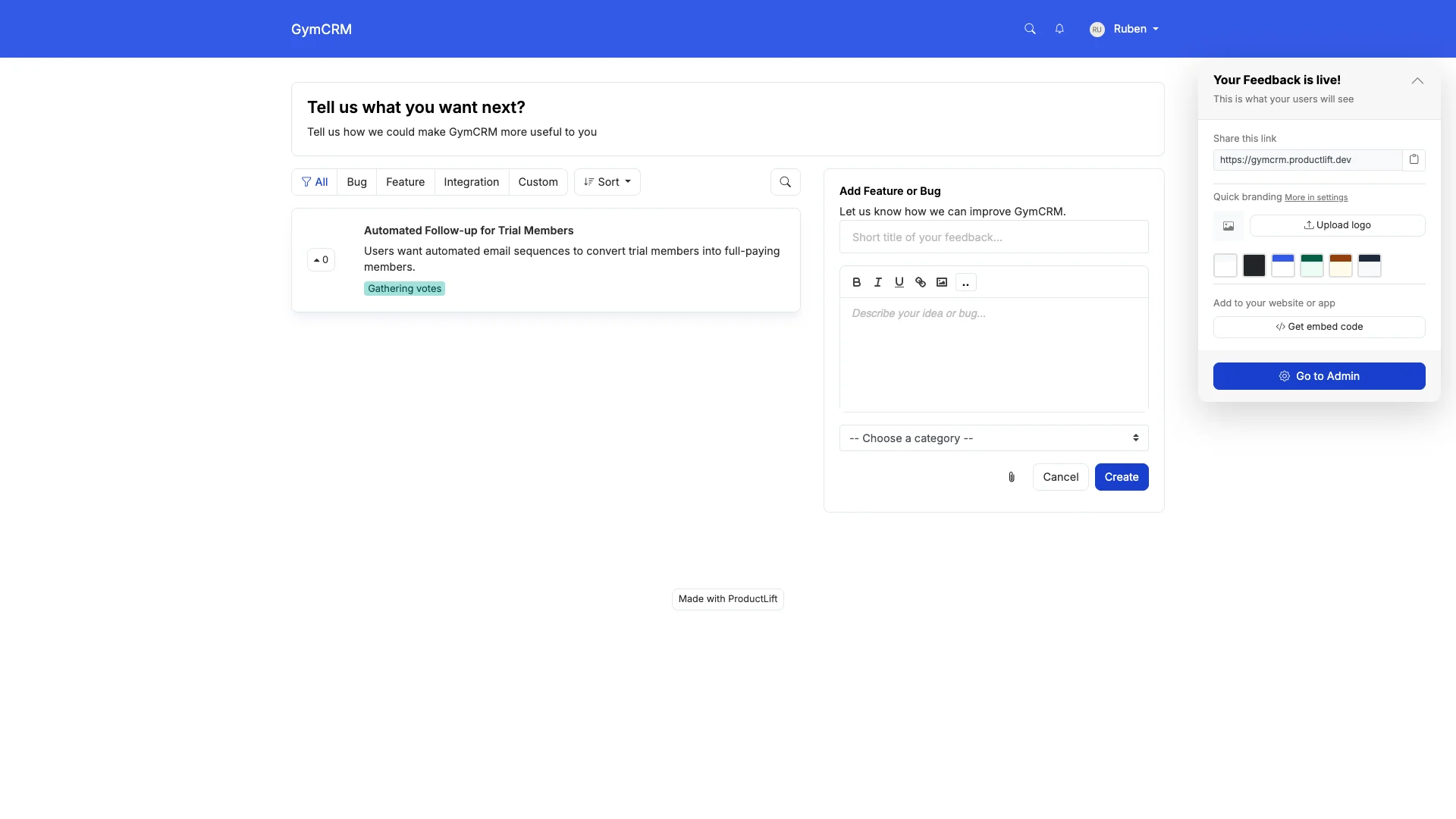
Pricing verified from productlift.dev/pricing on 2026-08-23.
What ProductLift Does Well
- Journey Model: Ideas travel from Feedback → Roadmap → Changelog. Voters get notified automatically when you ship their idea. No manual status updates needed.
- AI-Powered Prioritization: Auto-calculates RICE, ICE, MoSCoW, and Impact-Effort scores. Connects to Stripe for MRR-based prioritization. So you build what your highest-value customers want.
- Simple Tiered Pricing: Starter $19/mo, Pro $49/mo, Business $129/mo. All plans include unlimited end-users, white-label, and 28 languages. No pricing anxiety as your user base grows.
- 4-in-1 Platform: Replaces separate tools for idea boards, roadmap, changelog, and knowledge base.
- 28 Languages: Built-in localization for global teams (Spanish, French, German, Japanese, and 18 more).
- Full White-Label: Custom domain, CSS, branding. Even on the Starter plan.
- SSO included: No expensive tier upgrade required for single sign-on.
Where ProductLift Falls Short
- No GitHub integration (Jira and Azure DevOps available)
- No Intercom integration
- No Zapier integration (yet. It's on the roadmap)
- Smaller user base compared to Canny or Productboard
What Users Say
"We switched from Canny after their pricing jumped. ProductLift gives us everything we need starting at $19/mo. The journey model. Where ideas automatically move to the roadmap and changelog. Saves us hours every month." – Sarah M., Product Manager
"The Stripe integration is a game-changer. We can finally see which ideas come from our highest-paying customers instead of just sorting by vote count." – G2 Review
Pricing Breakdown
- Starter $19/mo – Pro $49/mo – Business $129/mo – All plans include unlimited end-users, white-label, and 28 languages
- No hidden costs: White-label, SSO, prioritization, knowledge base all included
- 14-day free trial (no credit card required)
Who should use ProductLift: Growing SaaS teams (5-50 people) who want predictable pricing, AI-powered prioritization, and a complete idea-to-launch workflow.
Who should look elsewhere: Teams deeply invested in the GitHub ecosystem or needing Intercom integration.
Want to See It in Action?
2. Canny – Best for Dev Teams (But Watch the Pricing Trap)
⭐ G2 Rating: 4.6/5 | 💰 Starting Price: Free (25 tracked users, Autopilot AI included), Pro $79/mo annual (100+ tracked users), Business custom (5,000+ users)
Best for: Dev-first teams who need GitHub/Intercom integration and can stay under 25 tracked users
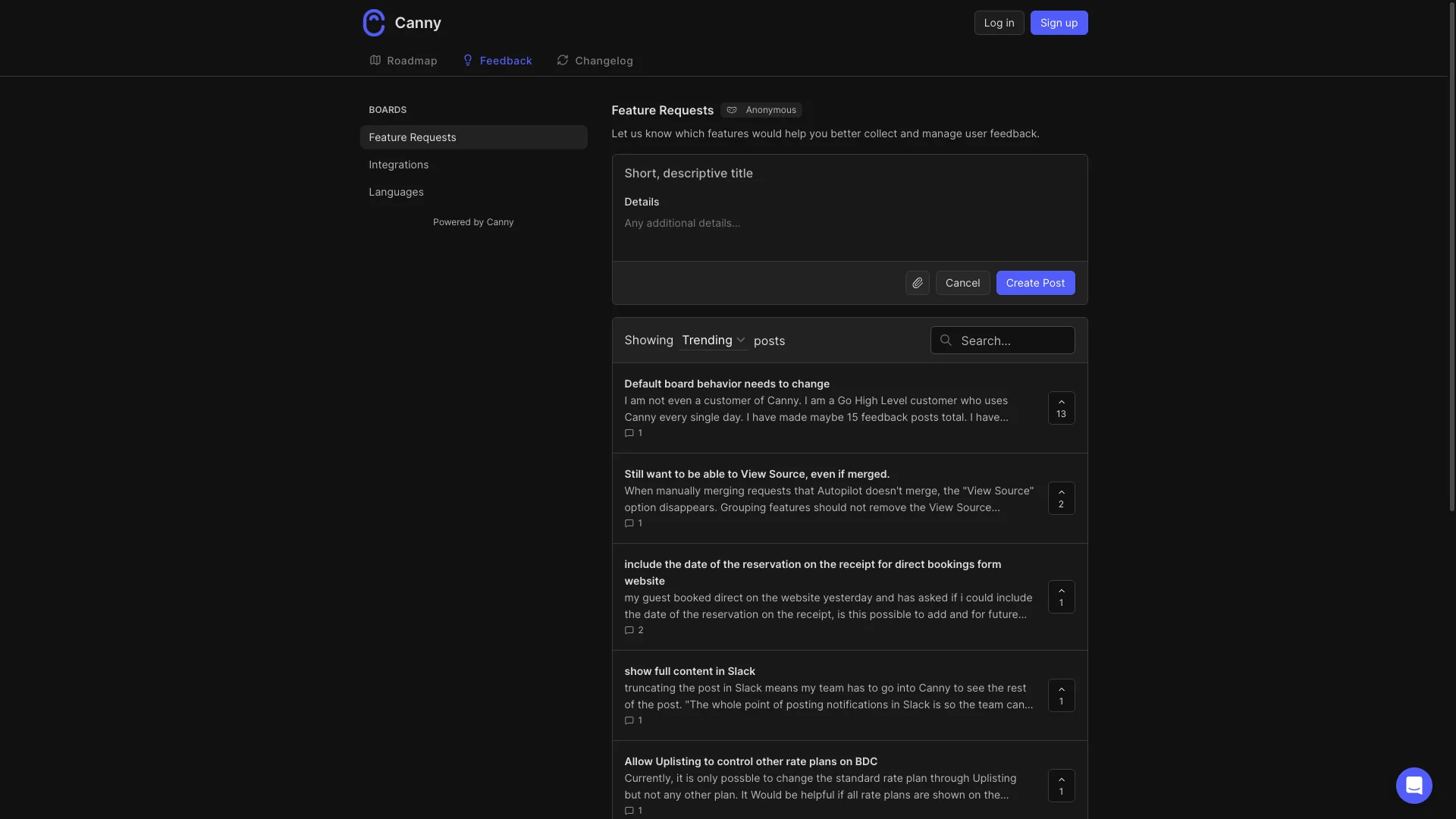
Pricing verified from canny.io/pricing on 2026-08-23. Autopilot AI (feedback discovery, deduplication, smart replies) now bundled across all tiers including Free.
What Canny Does Well
- Deep GitHub integration: Auto-sync issues, link commits to ideas, close the dev loop
- Intercom native integration: Collect ideas directly from support conversations
- Clean, modern UI: Easy to set up, customers love the design
- AI-powered insights: Auto-categorize ideas, detect trends
The Pricing Reality
Canny uses a tracked user model that can get expensive fast:
- Free: 25 tracked users (anyone who submits or votes on ideas), Autopilot AI included
- Pro: $79/mo billed yearly (higher monthly) for 100+ tracked users, PM integrations, MCP access, segmentation, automation
- Business: Custom pricing for 5,000+ tracked users, SSO, CRM integrations, unlimited tracked users on the largest deployments
Costs escalate quickly as your tracked user count grows. For idea management software where you want maximum participation, this punishes success.
What Users Say
"Outgrew Canny's 25-user free plan and the jump to $79/mo for Pro felt steep. We're now evaluating alternatives with flat pricing." – Reddit user, r/SaaS
Where Canny Falls Short
- English only: No localization despite years of user requests
- No knowledge base: Need a separate docs tool
- No built-in prioritization frameworks: Manual sorting only. No RICE, ICE, or MoSCoW
- Tracked-user pricing: The more people submit ideas, the more you pay
Who should use Canny: Dev-first startups (<25 tracked users on the free plan) who live in GitHub/Intercom and only serve English-speaking markets.
Who should look elsewhere: Growing companies, international teams, or anyone needing predictable idea management costs.
3. Productboard – Best for Enterprise Idea Management
⭐ G2 Rating: 4.3/5 | 💰 Starting Price: Spark $15/maker/mo (annual) or $19/maker/mo (monthly), Enterprise custom
Best for: Mid-to-large product orgs who need advanced prioritization, customer research, and strategic alignment
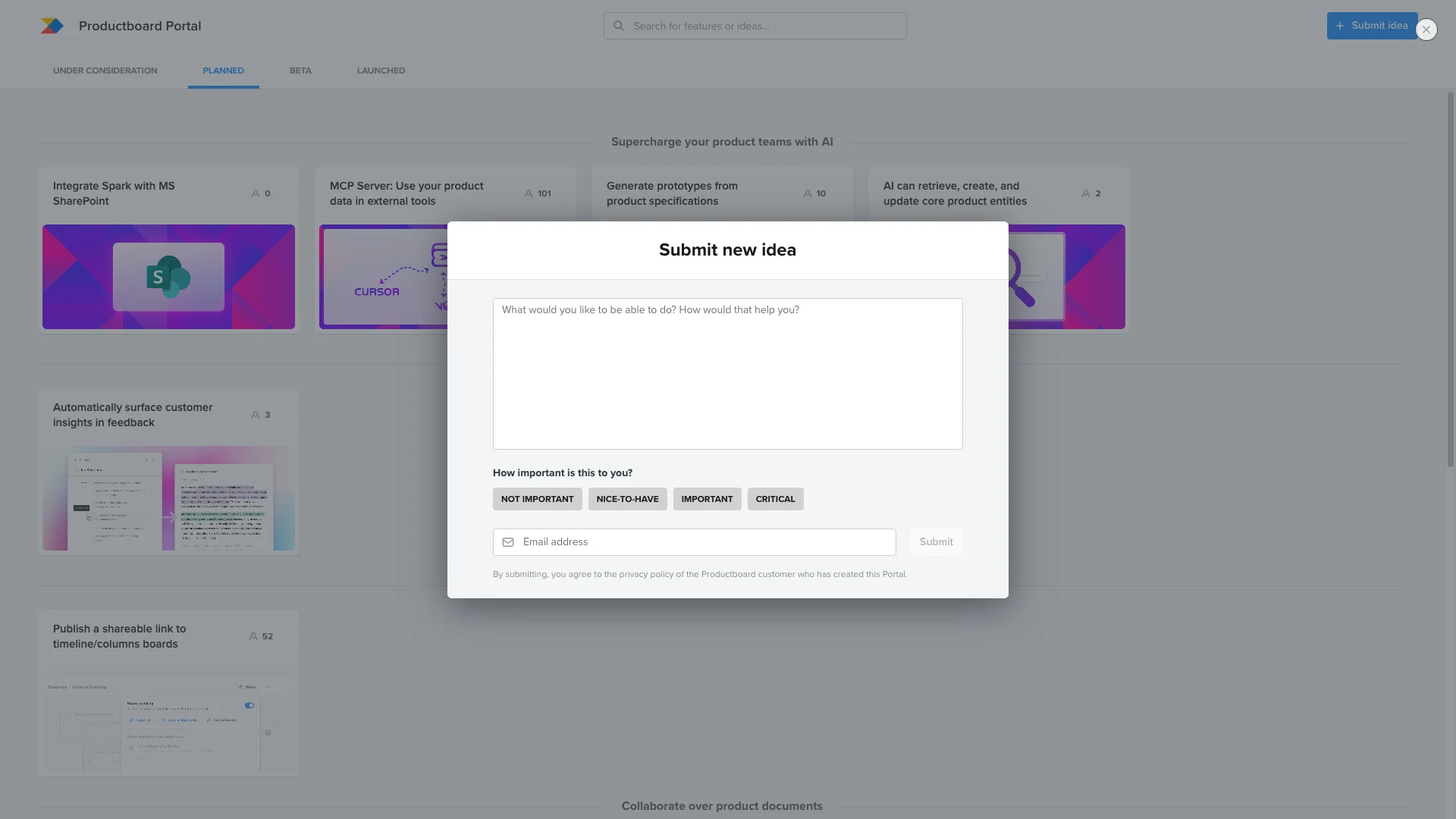
Pricing verified from productboard.com/pricing on 2026-08-23. Legacy Essentials/Pro tiers still available to existing customers; new signups routed to Spark.
What Productboard Does Well
- Powerful prioritization: Custom scoring frameworks with weighted criteria. Far beyond basic vote counts
- Customer insights portal: Aggregate ideas from support, sales, user research, and direct submissions
- Objectives & Key Results: Link ideas to strategic goals and track progress (requires Pro tier)
- Feature audit trail: See exactly why an idea was prioritized or deprioritized
The Pricing Reality
Productboard consolidated onto a single Spark plan in 2026 with AI credits bundled per maker seat:
- Spark: $15/maker/mo (annual) or $19/maker/mo (monthly) – 250 AI credits per maker per month
- Enterprise: Custom pricing, typically $300-400/maker/mo for large deployments
- Legacy plans (Essentials $19, Pro $59, Scale) remain available for existing customers, not visible to new signups
A 10-maker team on Spark pays $150/mo ($1,800/year annual), dramatically cheaper than the retired Pro plan. Enterprise contracts still land in the $30,000-100,000/year range for large teams.
What Users Say
"Most teams use less than 20% of Productboard's features but pay for 100%. Incredibly powerful if you need it, but overkill for simple idea management." – G2 Review
Where Productboard Falls Short
- Expensive: Pro tier ($59/maker) required for meaningful prioritization
- Steep learning curve: Takes weeks to fully implement and configure
- No knowledge base or changelog: You need separate tools
- Overkill for simple needs: If you just need idea voting and a roadmap, this is too much
Who should use Productboard: Product teams at companies with $10M+ ARR who need enterprise-grade idea management with strategic alignment.
Who should look elsewhere: Startups, small teams, or anyone with straightforward idea management needs.
4. Aha! – Complete PM Suite with Idea Management
⭐ G2 Rating: 4.3/5 | 💰 Starting Price: Aha! Ideas $39/user/mo, Aha! Roadmaps $59/user/mo (bundles Ideas Essentials)
Best for: Large product organizations needing a complete product management suite with strategy, roadmaps, and idea management
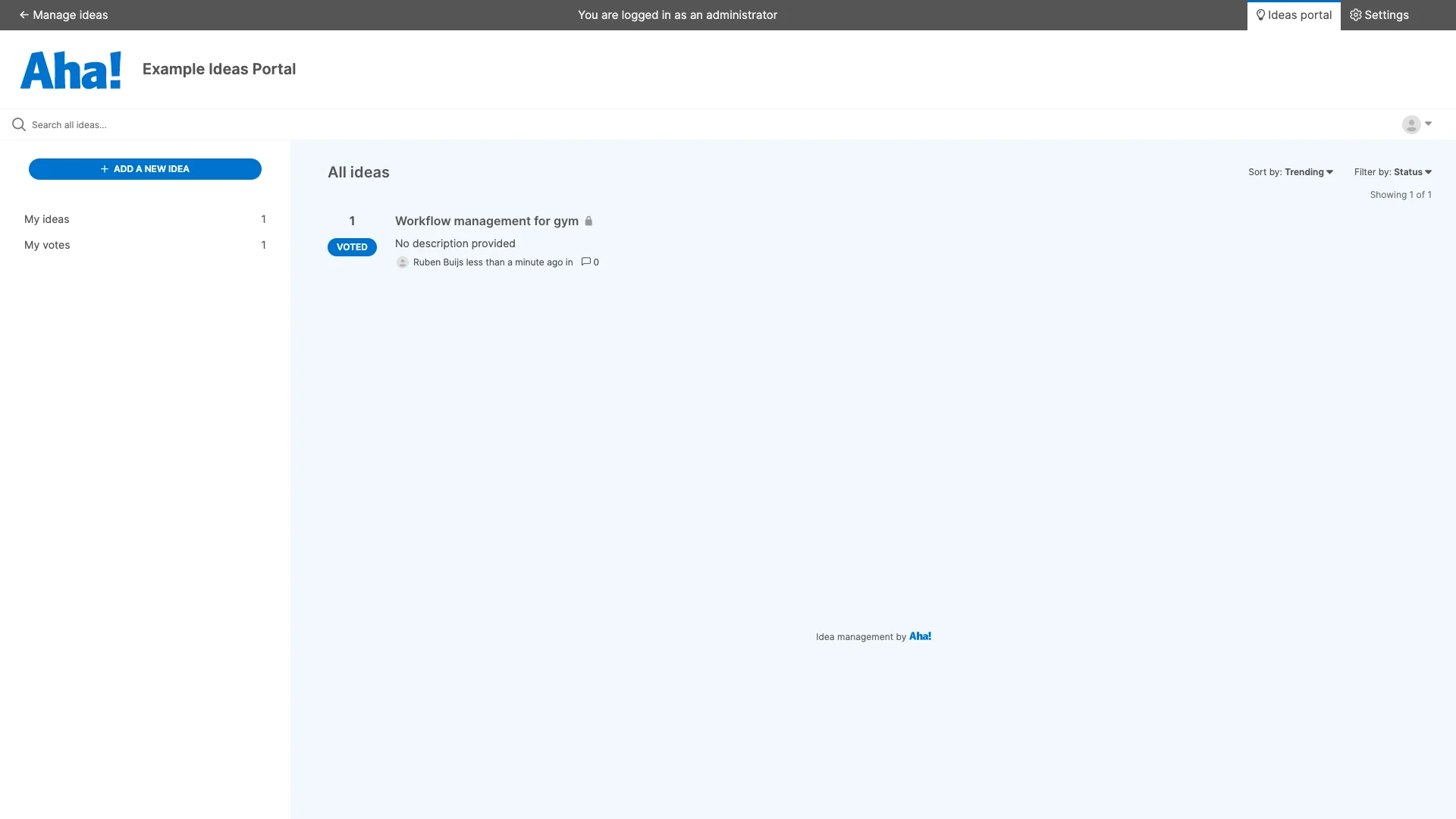
Pricing verified from aha.io/pricing on 2026-08-23.
What Aha! Does Well
- Full product management suite: Strategy, roadmaps, ideas, and development tracking in one platform
- Ideas portal: Dedicated public-facing portal for idea collection and voting
- Custom workflows: Deeply configurable idea stages and approval processes
- Scoring & prioritization: Weighted scorecards, strategic value alignment
The Catch
Aha! tries to be everything for everyone. Strategy, roadmaps, ideas, development, and more. That means:
- Overwhelming complexity: New users report weeks-long onboarding
- Dated UI: Interface feels less modern compared to newer tools
- High cost: Most teams need Roadmaps ($59/user) or higher to get real value. Roadmaps now includes Ideas Essentials, Whiteboards Essentials, and Knowledge Essentials.
What Users Say
"Aha! is incredibly powerful but we spent more time configuring it than actually managing ideas. For straight idea management, it's like using a sledgehammer to hang a picture frame." – G2 Review
Where Aha! Falls Short
- Complex setup: Steep learning curve, long implementation time
- Dated interface: UI feels heavy and less intuitive than modern alternatives
- Expensive at scale: 20 users on Roadmaps = $1,180/mo minimum. Enterprise pricing is Contact Sales only.
- No knowledge base or changelog: Focus is on PM workflows, not customer communication
Who should use Aha!: Large product organizations (50+ people) that need a complete PM suite and have the budget and time for implementation.
Who should look elsewhere: Teams who just want simple, fast idea management without the complexity of a full PM platform.
5. Featurebase – Modern UI with AI Duplicate Detection
⭐ G2 Rating: 4.9/5 | 💰 Starting Price: Free (1 seat, no AI); Growth $29/seat/mo, Professional $59/seat/mo, Enterprise $99/seat/mo (all annual)
Best for: Teams wanting a modern, AI-powered idea board with built-in feedback, roadmap, and changelog

Pricing verified from featurebase.app/pricing on 2026-08-23. AI features (Fibi Agent, Copilot) metered at $0.49 per resolution across all paid tiers, not available on Free.
What Featurebase Does Well
- AI duplicate detection: Automatically finds and merges duplicate ideas. Saves significant time
- Modern UI: Clean, fast interface that customers enjoy using
- All-in-one: Idea boards, roadmap, changelog, and help center included
- Free tier: Generous free plan to get started
What Users Say
"Featurebase's AI deduplication saves us from wading through hundreds of 'same idea, different words' submissions. Easily the best implementation I've seen." – G2 Review
Where Featurebase Falls Short
- Pricing tiers: Advanced features locked behind higher-cost plans
- Newer product: Smaller community and fewer integrations than established players
- No Stripe integration: Can't do revenue-weighted prioritization
- Limited prioritization frameworks: No RICE/ICE/MoSCoW scoring
Who should use Featurebase: Teams who value modern UI and AI-powered workflows, especially if duplicate idea management is a big pain point.
Who should look elsewhere: Teams needing advanced prioritization frameworks or Stripe-based revenue weighting.
6. ProdPad – Lean Idea Validation
⭐ G2 Rating: 4.2/5 | 💰 Starting Price: Ideas Essentials $30/editor/mo, Advanced $45/editor/mo (modular per-editor pricing)
Best for: Lean product teams focused on idea validation and experimentation before committing to building
Pricing verified via ProdPad public listings on 2026-08-23. Unlimited free reviewer seats on any plan.
What ProdPad Does Well
- Idea validation workflow: Test and validate ideas before they hit the roadmap
- Lean product management: Designed around lean/agile principles
- Experiments tracking: Track hypotheses and outcomes alongside ideas
- Dotted-line roadmaps: Time-horizon roadmaps (Now/Next/Later) instead of fixed deadlines
What Users Say
"ProdPad shines if you follow lean methodology. The Now/Next/Later roadmap forces you to think strategically instead of committing to dates. But if you just want a voting board, it's overkill." – G2 Review
Where ProdPad Falls Short
- No public voting portal: Idea collection is more internal-focused
- No changelog: Need a separate tool for product updates
- No knowledge base: Docs require another solution
- Per-user pricing: Costs scale with team size
- Limited customer-facing features: Better for internal idea management than external feedback
Who should use ProdPad: Lean/agile product teams who prioritize idea validation and want strategic roadmapping.
Who should look elsewhere: Teams needing customer-facing voting boards or an all-in-one feedback platform.
7. Frill – Budget-Friendly Idea Management
⭐ G2 Rating: 4.7/5 | 💰 Starting Price: Startup $25/mo, Business $49/mo, Growth $149/mo, Enterprise $349/mo (all flat, unlimited admins)
Best for: Small teams on a budget who need idea boards with GitHub/Jira integration
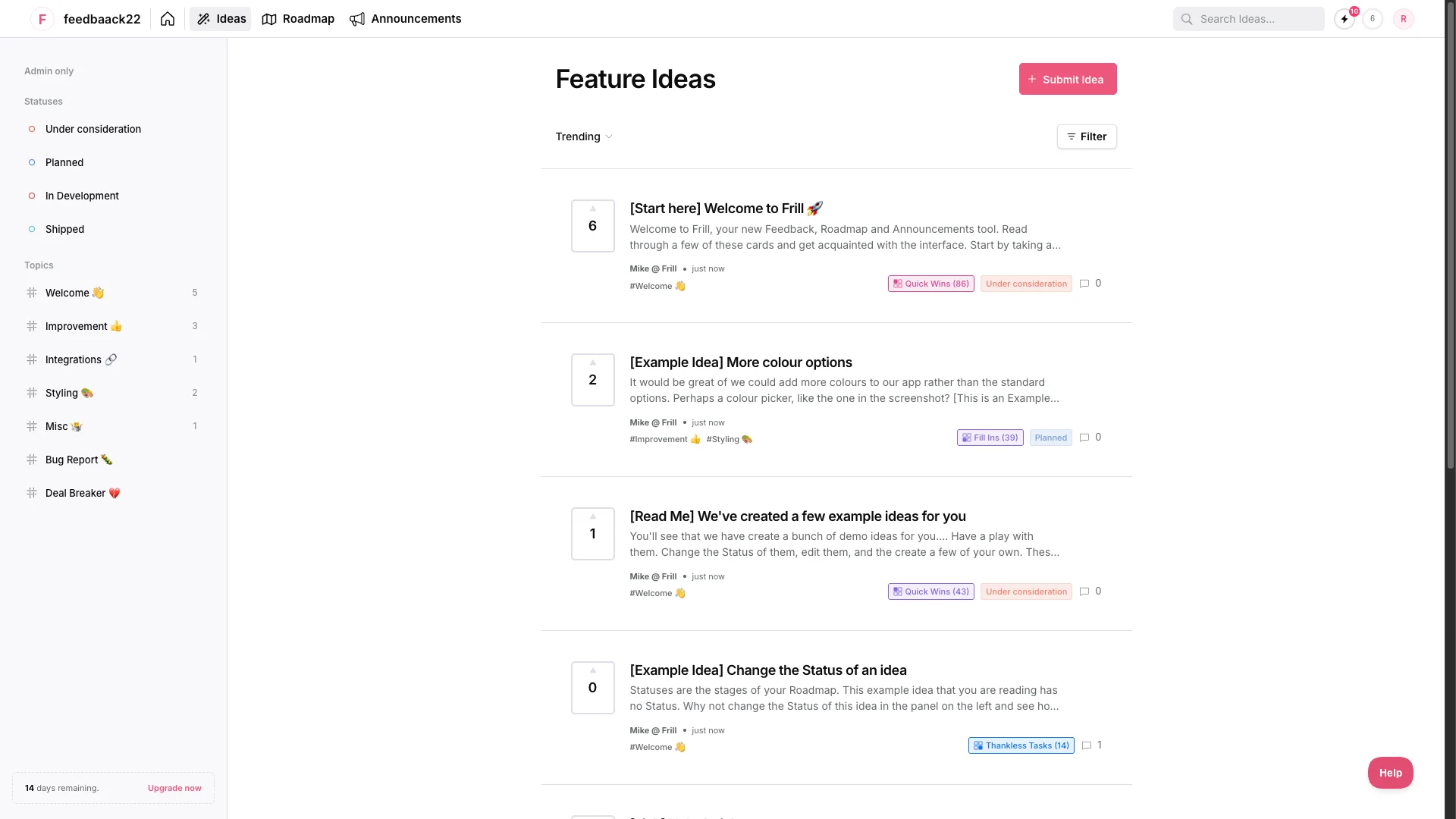
Pricing verified from frill.co/pricing on 2026-08-23. All paid tiers include unlimited admins and widgets, 14-day free trial no card.
What Frill Does Well
- Flat pricing: $25/mo regardless of team size or voter count
- GitHub & Jira integration: Link ideas directly to dev issues
- Prioritization scoring: Basic scoring to rank ideas beyond vote count
- Clean interface: Simple, easy to set up in minutes
- Changelog included: Built-in product updates feature
What Users Say
"Frill does exactly what we need at a price that makes sense. It's not fancy, but it works. The GitHub integration is solid." – G2 Review
Where Frill Falls Short
- English-only: No multi-language support. Dealbreaker for global SaaS
- No knowledge base: Need a separate docs tool
- No internal comments: Team can't discuss ideas privately before responding
- No AI features: Manual idea management only
- No Stripe integration: Can't weight ideas by revenue
Who should use Frill: Small teams (<10 people) on a tight budget who need basic idea management with dev tool integration.
Who should look elsewhere: International teams, or anyone needing AI-powered features or revenue-based prioritization.
Feature Comparison Table
Here's how all 7 idea management tools stack up on the features that matter most:
| Feature | ProductLift | Canny | Productboard | Aha! | Featurebase | ProdPad | Frill |
|---|---|---|---|---|---|---|---|
| Public Voting | ✅ | ✅ | ✅ | ✅ | ✅ | ❌ | ✅ |
| Roadmap | ✅ | ✅ | ✅ | ✅ | ✅ | ✅ | ✅ |
| Changelog | ✅ | ✅ | ❌ | ❌ | ✅ | ❌ | ✅ |
| Knowledge Base | ✅ | ❌ | ❌ | ❌ | ✅ | ❌ | ❌ |
| Prioritization (RICE/ICE) | ✅ | ❌ | ✅ | ✅ | ❌ | ⚠️ Basic | ⚠️ Basic |
| Stripe Integration | ✅ | ❌ | ❌ | ❌ | ❌ | ❌ | ❌ |
| GitHub Integration | ❌ | ✅ | ✅ | ✅ | ✅ | ✅ | ✅ |
| Jira Integration | ✅ | ✅ | ✅ | ✅ | ✅ | ✅ | ✅ |
| AI Features | ✅ | ✅ | ❌ | ❌ | ✅ | ❌ | ❌ |
| Multi-Language | ✅ (22) | ❌ | ❌ | ❌ | ⚠️ Limited | ❌ | ❌ |
| White-Label | ✅ | ✅ (Pro+) | ✅ | ✅ | ✅ | ✅ | ✅ |
| SSO | ✅ | ✅ (Pro+) | ✅ (Enterprise) | ✅ (Enterprise) | ✅ (Paid) | ✅ | ❌ |
Pricing Comparison: What You'll Actually Pay
Forget "starting at" prices. Here's what these idea management tools actually cost at different team sizes:
| Tool | Small Team | Growing Team | Large Team | Pricing Model |
|---|---|---|---|---|
| ProductLift | $19/mo | $49/mo | $129/mo | Starter / Pro / Business |
| Canny (Pro) | $79/mo* | $79-529/mo* | Custom | Tracked users* |
| Productboard (Spark) | $75/mo | $150/mo | $300/mo | Per maker (Spark, annual) |
| Aha! | $295/mo | $590/mo | $1,180/mo | Per user (Roadmaps) |
| Featurebase | Free | $29/seat/mo | $59+/seat/mo | Per seat |
| ProdPad (Ideas Essentials) | $150/mo | $300/mo | $600/mo | Per editor (modular) |
| Frill | $25/mo | $25/mo | $25/mo | Flat rate |
Key Takeaway: Per-user pricing (Aha!, ProdPad) still scales 5-10x with team growth compared to flat tiers like ProductLift and Frill. Productboard's new Spark plan closed most of that gap for small teams. Canny's tracked-user model continues to punish growth. The more customers submit ideas, the more you pay.
Pricing snapshot dates: ProductLift, Canny, Featurebase, Frill, Aha!, Productboard, ProdPad all verified between 2026-08-04 and 2026-08-23. See each vendor's pricing page (linked above) for the current source of truth.
Still Comparing? Try It Yourself
Decision Framework: Which Idea Management Tool Should You Choose?
Here's our honest recommendation based on different scenarios:
🎯 You're a growing SaaS startup (5-50 employees)
Choose ProductLift for predictable pricing and a journey model that closes the loop with customers. It covers ideas, roadmap, changelog, and knowledge base in one platform.
Choose Canny if you're under 25 tracked users (free plan), live in GitHub, and only serve English-speaking markets.
💼 You're an enterprise with complex needs
Choose Productboard if you have the budget ($30K+/year) and need advanced customer research workflows, OKR alignment, and deep prioritization.
Choose Aha! if you need a complete PM suite covering strategy, roadmaps, ideas, and development.
👨💻 You're a dev-first team
Choose Canny if you need a public idea portal with deep GitHub/Intercom integration.
Choose Frill if you need a budget-friendly option with GitHub/Jira integration.
🧪 You follow lean methodology
Choose ProdPad if you prioritize idea validation, experimentation, and Now/Next/Later roadmapping.
💸 You're bootstrapped / budget-conscious
Choose Frill ($25/mo) for basic idea management with dev integrations.
Choose ProductLift (from $19/mo) for a complete solution that won't get expensive as you grow.
🌍 You serve international customers
Choose ProductLift (28 languages). Most alternatives. Canny, Frill, ProdPad, Aha!.are English-only, which is a dealbreaker for global SaaS products.
Frequently Asked Questions About Idea Management Software
What is idea management software?
What's the difference between idea management and feedback management software?
How do RICE, ICE, and MoSCoW prioritization frameworks work?
What's the 'journey model' vs 'bucket model' for idea management?
Can I migrate my ideas from one tool to another?
Which idea management tools support multiple languages?
What's a realistic budget for idea management software?
Do I need a separate changelog tool with idea management software?
How does Stripe integration help with idea prioritization?
What if my team already uses Jira for development?
Related Comparison Guides
Explore more tool comparisons to find the right software for your team:
- Best Feature Request Tools. Collect and manage feature requests
- Best Feature Voting Tools. Let customers vote on what to build
- Best Product Roadmap Software. Plan and visualize your roadmap
- Best Customer Feedback Platforms for Teams. Centralize feedback from every channel
- Best Feedback Tools for SaaS. Complete feedback collection platforms
- Best Website Feedback Widgets. Collect ideas directly on your website
- Compare Feedback Tools Head-to-Head — Feature tables for Canny, UserVoice, Productboard & more
- Productboard Pricing 2026. Pricing breakdown of a popular idea management tool
- Idea Management Use Case. How ProductLift handles the idea management workflow